ChatGPT vs Grok: Which Is Better for Coding, Writing and Research?
ChatGPT vs Grok for coding, writing and research: independent test data, real costs per task and plan pricing, so you know which one to pay for.
4 Nov 2026·13 min read·General
Most ChatGPT vs Grok advice is a vibe check: one is smarter, the other edgier. That does not help when you have a bug to fix, a draft due and a question that needs real sources. It also goes stale quickly. Both labs shipped new flagships in September, and xAI rebuilt Grok's plans on 12 October.
This guide compares the two on exactly those three jobs, using independent test data dated between 17 and 30 October 2026. The short version: use ChatGPT first, and add Grok only where the table below says it earns its place.
Job | Start with | Why | Add Grok when |
|---|---|---|---|
Coding | ChatGPT with Codex | Finishes more of the task, faster and at a fraction of the cost per task in independent agent tests | You already work in Cursor |
Writing | ChatGPT | Human voters rank it above Grok on mixed text tasks | You want a livelier second draft |
Research | ChatGPT for the open web | Higher knowledge-accuracy score and a cited deep research mode | The question starts with what people are saying on X |
Skimming? The table is the answer. Deciding what to pay for? Go to pricing, then to how to test both on your own work.
A note on method: we ran no benchmark of our own. The figures come from Artificial Analysis (AA), which runs independent tests, and from arena.ai's human-vote leaderboards, with prices taken from the vendors. AA has moved to Intelligence Index v5.0, so scores quoted in older articles are not comparable with the ones here. Image and video generation, voice and Grok's agent product fall outside these three jobs and are not covered.
If Claude or Gemini is also on your shortlist, the four-way comparison after October's launches covers both.
What you are actually comparing
Neither name means one model. ChatGPT is a product that runs OpenAI's GPT-6 family, split into tiers: Astra at the top, then Sol, Terra and Luna. According to an October 7 OpenAI release note quoted by SSD Nodes, Free and Go run Luna while Plus and above run Sol, so a free-plan test and a Plus test are different experiments. Check the model picker before you judge anything.
Grok is a single flagship today. Its newest released model is Grok 4.7, which arrived on 21 September, and xAI has said only that Grok 5 is still in training, with no release date published. Every Grok result below is Grok 4.7.
Spec | ChatGPT (GPT-6.1 Sol) | Grok (Grok 4.7) |
|---|---|---|
Released | 29 September 2026 | 21 September 2026 |
Context window | 1M tokens | 500K tokens |
API price per 1M tokens, input / output | $2 / $10 | $2 / $6 |
API price per 1M cached input tokens | $0.10 | $0.50 |
Output speed at the top effort setting | 79 tokens/s | 104 tokens/s |
Source: Artificial Analysis release comparison. Speeds are as measured by AA on each lab's first-party API. Unless a section says otherwise, AA figures later in this post come from the same comparison.
Each section below asks the same three questions: how much of the job gets done, what it costs per task rather than per token, and how much checking the output needs.
ChatGPT vs Grok for coding: Codex finishes more, for less
For handing off a multi-step coding task, ChatGPT with Codex beat Grok Build on Artificial Analysis's coding-agent test, and it did so at a fraction of the cost per task. Grok's strengths are narrower: answering questions about a codebase, and fitting into an editor you already use.
AA scores the agent and the model together, which is how you would actually use them.
Agent and model | Coding Agent Index | Terminal-Bench 4.0 | Repo Q&A (SWE-Atlas-QnA) | Cost per task | Time per task |
|---|---|---|---|---|---|
Codex with GPT-6 Astra (max) | 55 | 56% | 59% | $7.04 | 24.8 min |
Codex with GPT-6.1 Sol (max) | 54 | 53% | 60% | $1.50 | 23.7 min |
Grok Build with Grok 4.7 (xhigh) | 47 | 33% | 63% | $9.48 | 35.8 min |
Source: Artificial Analysis, Codex vs Grok Build, Coding Agent Index v2.0. Costs are pay-per-token API costs, not plan prices. Inside ChatGPT, OpenAI says Codex is included across plans, including Free and Go, with usage limits that vary by plan. AA tested one Grok Build configuration against several Codex ones.
Terminal work is the widest gap, and repository question answering is the one column Grok Build wins. That split suits a developer who mostly wants to understand an unfamiliar codebase rather than change it. For delegating a bug fix, a refactor or a test-writing job, the Codex rows are the ones to read.
The model-level numbers point the same way, before any agent harness is involved. On AA's Intelligence Index v5.0, GPT-6.1 Sol at max effort scores 55 against 34 for Grok 4.7 at xhigh, and 56.1% against 25.8% on Terminal-Bench 4.0.
Chart: at top effort, GPT-6.1 Sol scores 21 points higher than Grok 4.7 on the Artificial Analysis Intelligence Index v5.0 for about a sixth of the cost per task. Sol reaches 55 at $1.27 per task; Grok 4.7 peaks at 35 and costs up to $7.51 per task.
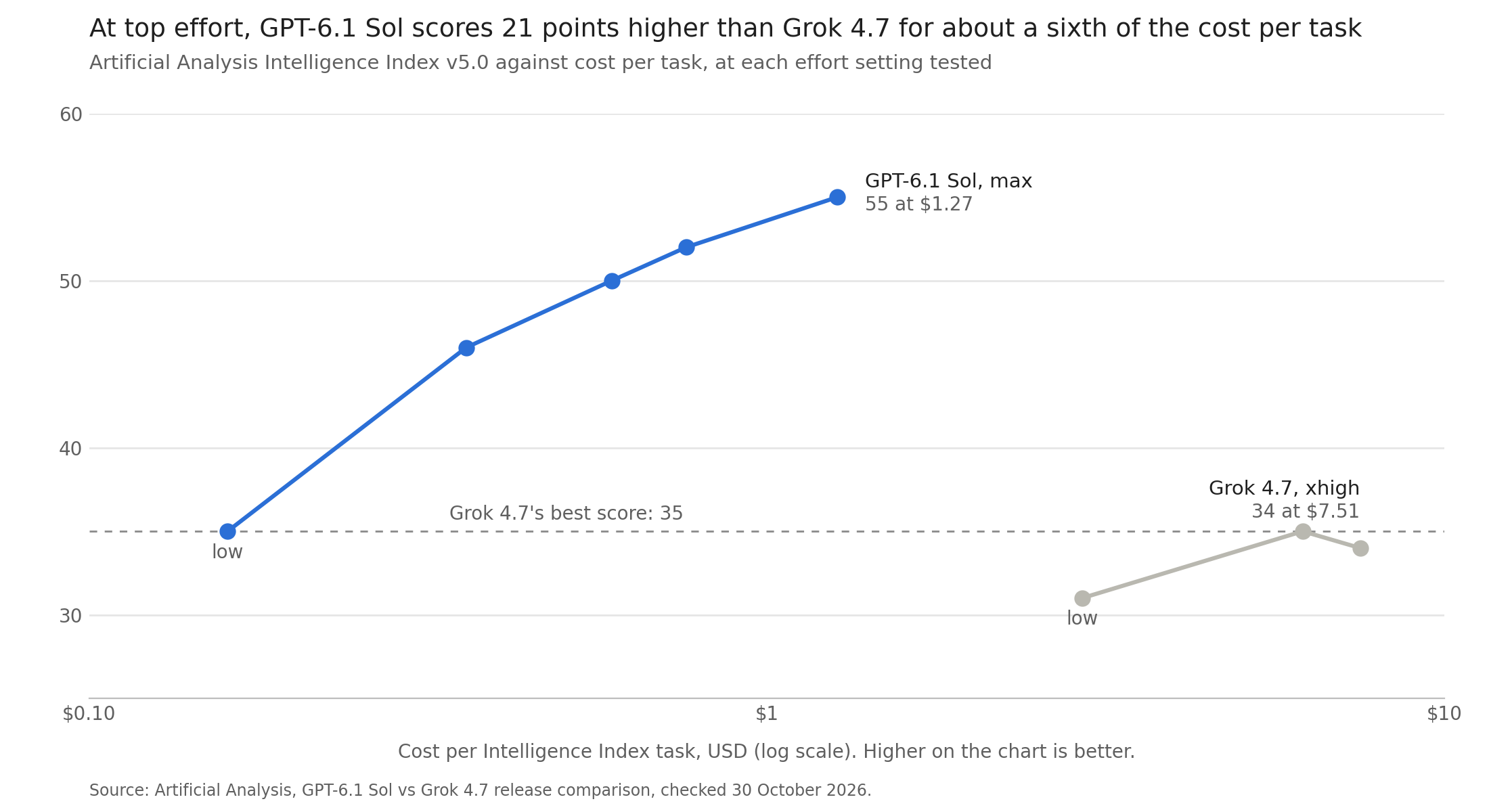
Artificial Analysis, GPT-6.1 Sol vs Grok 4.7 release comparison, Intelligence Index v5.0, 8 effort settings, checked 30 October 2026.
Two things the chart shows that a table would hide. Sol's score climbs steadily with effort, while Grok 4.7's barely moves and its cost keeps rising, so extra thinking buys Grok very little. And Sol at its lowest effort already ties Grok's best score at a fraction of the cost. Grok's per-token output price is lower ($6 against $10 per million), but AA prices every token a task uses, including input, cached and reasoning tokens, so a model that thinks longer can cost more despite a cheaper rate card. Compare cost per task, not price per token.
Scale that to a working month. At AA's per-task costs, 100 agent tasks run to roughly $150 on Codex with GPT-6.1 Sol and roughly $948 on Grok Build, at API prices. Plan prices work differently, so the question to ask of any subscription is how much of its allowance one task burns.
A second, independent source agrees. On the Code Arena WebDev board at arena.ai, where people vote between anonymous models' outputs, GPT-6.1 Sol (Max) ranks 4th and Grok 4.7 (xHigh) ranks 16th in a snapshot of the leaderboard verified on 17 October. WebDev measures front-end web builds, a narrower job than agentic coding, so treat it as corroboration rather than proof.
Where Grok fits
Grok 4.7 launched inside Cursor and Grok Build, and the Premium tier of xAI's X Subscription bundles Cursor Pro with Grok. If you already work in that editor, you can trial Grok on a real backlog without changing tools. The bundle is built to favor Grok: models from other labs used inside Cursor are billed at API list prices on top of the plan.
Choosing an editor you stay in the loop with, or an agent you hand a task to, is a separate decision. Cursor vs Claude Code works through that split, and the wider field is mapped in AI developer tools.
ChatGPT vs Grok for writing: ChatGPT is the safer default, Grok adds range
For writing, ChatGPT is the safer default and Grok is the better source of range. The two independent signals we have point in different directions, and the way they differ is the useful part.
The first is AA-PersonalityBench, where a panel of LLM judges compares models' default answers to 900 open-ended prompts and rates how strongly each one shows a trait. It measures how prominent a trait is, not whether it is good. Comparing GPT-6.1 Sol (max) with Grok 4.7 (xhigh) on its expressiveness traits, AA's ratings imply that Grok's answer would be judged more eloquent 86% of the time, more lexically varied 84% of the time, more metaphorical 74% of the time and more natural sounding 65% of the time. On the "literate" trait the two are level, with Grok at 51%. In plain terms, Grok writes with more flourish.
The second is human preference. On arena.ai's Text Arena Overall board, where people vote between anonymous answers across math, coding, creative writing and other open-ended tasks, GPT-6.1 Sol (Max) ranks 22nd. Grok 4.7 does not appear among the board's top 25 entries in the snapshot cited in the coding section, so it sits below the 25th-place score. That board is broad rather than writing-only, and it uses human voters where AA uses LLM judges, so neither result is a verdict on writing alone.
Put together, they say Grok's style is livelier, but people voting on mixed tasks still prefer ChatGPT's answers. Flair and preference are different things. Expressiveness is a reason to ask Grok for a second draft, not to make it your default writer. In our judgment, which no benchmark has tested, variety and metaphor help a headline list or a brainstorm and hurt when the brief says to cut 30%, keep every heading and add nothing. Test that on your own material in the bake-off below.
One caution on the ChatGPT side. OpenAI's own model guidance, as summarized by PrompTessor, points to GPT-6.1 Terra for natural writing and scoped code fixes, so "ChatGPT" in a writing test means whichever model your plan routes you to.
ChatGPT's nearest rival for drafting is Claude, and ChatGPT against Claude on editing and long-form writing shows how that matchup went on a small set of non-blind exercises. If you also need enforced terminology and approval steps around the model, the AI writing category lists dedicated tools.
ChatGPT vs Grok for research: Grok owns X, ChatGPT is the safer generalist
Grok is the only one of the two with first-party access to X, and for research that starts with what people are saying, that decides it. For broad, source-heavy research, ChatGPT is the safer default, partly on accuracy.
xAI documents an X Search tool that supports keyword, semantic, user and thread lookups, with filters for handles and dates. On the ChatGPT side, OpenAI documents web search plus a deep research mode that browses sources and returns a cited report. Both are summarized in PrompTessor's documentation-based comparison, which also notes that neither assistant has live information unless the right search tool is switched on for your session.
On accuracy, AA-Omniscience asks 6,000 factual questions, rewards correct answers, penalizes wrong ones and does not penalize abstaining, so a model that says it is unsure beats one that guesses. GPT-6.1 Sol (max) scores 42 against 31 for Grok 4.7 (xhigh). The test measures recall without search tools, so it says little about a search-assisted session. It is still the best available signal for how often each model states something wrong with confidence.
Treat X results as leads
X is one platform with its own skew, and early posts about a breaking event are often incomplete or wrong. Ask Grok to list the posts it used, open the originals, and confirm anything you will publish or send to a client against a primary source. The same rule applies to ChatGPT's deep research reports: a citation next to a claim shows where the claim came from, not that the source supports it.
Here is an illustrative workflow, not a measured result. A communications lead tracking reaction to a product launch asks Grok for the main threads and complaints from the last 48 hours, runs a ChatGPT deep research report on the technical claims being argued, and reconciles the two in one brief with links to every source.
ChatGPT vs Grok pricing: $20 against $30 is the real comparison
ChatGPT Plus costs $20 a month. Grok's closest match is Premium at $30, because the $8 Plus tier excludes Grok Bot, xAI's agent product. Since 12 October, new Grok subscribers buy through The X Subscription, which replaced the old SuperGrok tiers.
Tier | ChatGPT | Grok (The X Subscription) |
|---|---|---|
Free | $0 | $0 |
Entry | Go, $8 | Plus, $8 |
Standard | Plus, $20 | Premium, $30 (4x Plus usage) |
Heavy | Pro, $100 or $200 (5x or 20x Plus) | Super, $100 (15x Plus), or Ultra, $200 (50x Plus) |
US list prices before tax. Sources: OpenAI's Pro tiers page and xAI's announcement of The X Subscription. OpenAI also lists a $500 Pro tier. Regional and app-store prices differ, so confirm at checkout.
Three details change the math:
Neither vendor publishes message counts. xAI states Grok usage as multiples of Plus, and OpenAI frames Pro against Plus the same way. Watch how often you hit a limit during a trial month and upgrade only when you do.
Premium is a bundle. xAI says it carries the benefits of SuperGrok, Cursor Pro and X Premium+, which were previously $90 a month combined. It pays off mostly if you would have bought those parts anyway. Third-party models used inside Cursor are billed separately at API list prices, and Grok Bot is limited to Premium and above (reported here).
Free is not the same on both sides. ChatGPT's free plan runs the lightest GPT-6 tier and, per OpenAI, includes Codex with limits that vary by plan. Grok's free tier gives daily access with a limit xAI describes only as "limited". ChatGPT Go, the $8 plan, may show ads.
If you build on the models rather than chat with them, the API rates in the comparison table above apply, and cost per task matters more than any plan price.
How to decide for your own work
The default is ChatGPT, and the table at the top lists the three cases where Grok earns a place. Whether those cases describe your work is a question for your own tasks, so test them rather than trusting any leaderboard, including the ones cited here.
On a tight budget, start with the free tiers, since both vendors' entry plans cost $8. Paying for both standard tiers runs $50 a month, which only makes sense if each one has a job the other does worse.
A one-week bake-off
Pick five real tasks from last month: a bug with a failing test, an edit to a strict brief (cut a 600-word draft by 30% and keep every heading), a 150-word post in your brand voice, a research question that needs sources, and a question about conversation on X.
Write the pass condition for each before you run anything. Tests pass, every claim traces to a source, the edit needs fewer than ten minutes of cleanup.
Run both assistants on identical inputs, on plans you would actually pay for. Run the coding task twice, because a single run is an anecdote.
Log elapsed time, credits or tokens used and corrections needed, then decide task by task.
If the real workload is an API pipeline, an evaluation tool will do the logging for you. Braintrust starts from the eval and gates changes against it.
Questions
Frequently asked questions
Is Grok better than ChatGPT?
Not overall. Independent tests put GPT-6.1 Sol well ahead of Grok 4.7 on general capability, and Grok's clearest wins are X data and expressive style.
Which is better for coding, ChatGPT or Grok?
ChatGPT with Codex, on AA's coding-agent test: it scores higher, runs faster and costs far less per task. Grok Build did better at answering questions about a repository.
Is Grok better than ChatGPT for research?
For research that starts on X, yes, because only Grok has first-party X search. For general web research, ChatGPT's deep research mode and higher knowledge-accuracy score make it the safer default.
Which is better for writing?
ChatGPT is the safer default: people voting on mixed text tasks at arena.ai rank GPT-6.1 Sol above Grok 4.7. Grok rates as more expressive and varied, which makes it useful for a livelier second draft. No benchmark measures how closely either follows an editing brief, so test both on your own material.
How much does Grok cost compared with ChatGPT?
ChatGPT Plus is $20 a month, and Grok's closest match, Premium, is $30. The tier-by-tier comparison is in the pricing section above.
When is Grok 5 coming out?
xAI has published no date and has said only that the model is in training. Grok 4.7 is the newest released model we could confirm as of 30 October 2026.
Do ChatGPT and Grok train on my chats?
On personal plans, both are reported to use conversations for training unless you opt out, and business plans differ. Check the data controls in each app's settings before you paste anything sensitive.
Can I use both?
Yes. Keep both only if each has a job the other does worse, and let the bake-off decide.
Conclusion
ChatGPT first and Grok by exception is where the evidence lands today, but the useful takeaway is the process, not the winner. Run the five-task bake-off before you pay, write the pass conditions first, and keep whichever assistant clears them at the lowest cost per task.
Then set a reminder. Plans, models and index versions all moved within six weeks, and Grok 5 or the next GPT-6 release would change this picture. Recheck prices, rankings and cost per task whenever either vendor ships a flagship.
WebTechOS accepts no payment for coverage, placement or scores. Where a piece references pricing, it reflects published list rates at the date shown.
Keep reading
All insights →I tried 7 Discord alternatives to find the best platform (2026)
We tested 7 Discord alternatives, from Slack to Google Chat, as both an admin and a member. See which platform actually fits your community in 2026.
The Best Customer Service Automation Platforms for Mid-Market Teams
Compare the best customer service automation platforms for mid-market teams: features, trade-offs, and how to choose one that scales.
ChatGPT vs Gemini: Which AI Assistant Wins in 2026?
ChatGPT vs Gemini in 2026: compare GPT-6 Sol and Gemini 4 Argon on writing, research, coding, price and privacy, and pick the right assistant.
Zapier Pricing 2026: What Each Plan Actually Costs
Zapier pricing 2026: see exactly what Free, Professional, Team, and Enterprise cost, how task billing works, and which plan actually fits you.