ChatGPT vs Gemini: Which AI Assistant Wins in 2026?
ChatGPT vs Gemini in 2026: compare GPT-6 Sol and Gemini 4 Argon on writing, research, coding, price and privacy, and pick the right assistant.
4 Nov 2026·21 min read·General

The ChatGPT vs Gemini review you just read may have tested a model your $20 plan does not run. On October 7, OpenAI moved ChatGPT Plus to GPT-6 Sol. On October 13, Google opened Gemini 4 Argon to AI Pro. Most comparisons online still pit models that neither app serves by default.
Here is the short answer. On the $20 plans, the evidence leans toward Gemini for knowledge work: higher scores on independent leaderboards, a much larger context window, and a bundle that includes 5 TB of storage. It leans toward ChatGPT when you delegate work: Codex for coding agents, Work for tasks across apps, and the strongest public score for constrained creative writing. Neither lead is large, and several depend on which model your plan actually serves.
This guide compares the two the way a buyer would use them: writing, research, coding, images and video, ecosystem, price, and privacy. We did not run our own benchmark suite for this piece. It draws on vendor pages and independent leaderboards, and where those disagree we say so. Because no review can replace your own work, the last section before the FAQ gives you a 20-minute test and a scoring sheet. For how WebTechOS scores software in general, see how we review tools.
Quick verdict: which assistant wins which job
On the evidence we could verify, Gemini leans ahead for research, long documents and Google-based work, while ChatGPT leans ahead for coding agents, interactive answers, image generation and constrained creative writing. Two rows (video and Workspace) are decided by product design, not model quality, and several margins are small.
Job | Edge | Why |
|---|---|---|
Everyday research and knowledge work | Leans Gemini | Gemini 4 Argon leads a professional-work index and guesses less, though it also answers fewer questions correctly |
Long documents and big uploads | Gemini | 1M-token context on AI Pro, against 256K for reasoning models on ChatGPT Plus |
Agentic coding | Leans ChatGPT | GPT-6 Astra in Codex ranks above Argon on one public coding table; in the chat window the order flips |
Constrained creative writing | ChatGPT's top model | GPT-6 Astra ranks 4th of 59 writers on a public benchmark and Argon 19th, but Astra is not the Plus chat model |
Image generation | Leans ChatGPT | GPT Image 2 leads a blind-vote arena by roughly 75 Elo, while Gemini is praised for consistent editing |
Interactive answers (charts, forms, tools) | ChatGPT | Intelligent UI builds working interface elements inside replies |
Google Workspace and Search | Gemini (by design) | Built into Gmail, Docs, Chrome and AI Mode |
Video generation | Gemini (by design) | OpenAI closed its Sora app in April 2026 |
Entry-level price | Gemini | $4.99 for AI Plus against $8 for ChatGPT Go |
Business writing and editing | No public winner | No benchmark covers it; test both on your own brief |
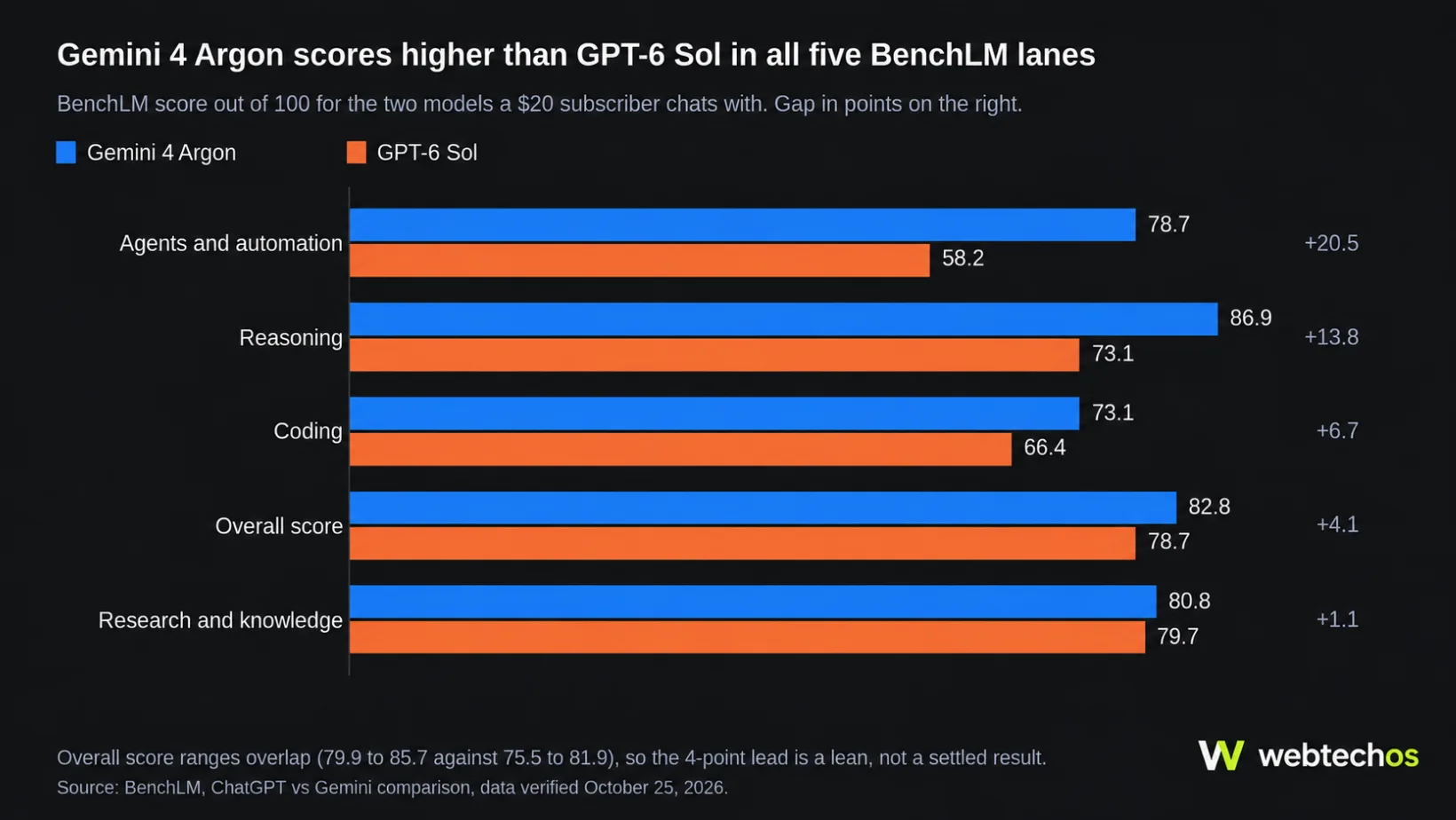
This is the pair a $20 subscriber actually chats with. ChatGPT's stronger GPT-6 Astra sits in Work, Codex and Pro reasoning, which is why the writing and coding sections below test it separately.
What each assistant runs in late 2026
The model names changed twice this year, so start here. A subscriber's matchup depends on the plan, and the best model in each family is not always the one in the chat window.
ChatGPT: GPT-6 Sol in chat, GPT-6 Astra behind the higher doors
Since October 7, ChatGPT Plus, Pro, Business and Enterprise run GPT-6 Sol in the Chat tab, and Free and Go run the lighter GPT-6 Luna, per OpenAI's announcement. The same rollout introduced Intelligent UI, which lets a reply include charts, forms and small working tools instead of text alone.
The strongest OpenAI model is a separate matter. GPT-6 Astra powers the Pro reasoning option, and on a Plus plan it appears only in ChatGPT Work and Codex, where Plus users also get GPT-6.1 Sol. If you read a benchmark for Astra, it does not describe the chat model a $20 subscriber talks to.
Gemini: Gemini 4 Argon, now open to AI Pro
Google added Gemini 4 Argon to the Gemini app on October 13 for AI Pro and Ultra subscribers, per Google's announcement. Coverage adds that it also works in AI Mode in Search, that only the top Ultra tier could use it in the app until then, and that it sits in the model picker beside Gemini 3.1 Pro and 3.8 Flash rather than replacing them.
The same update added a chat-to-tasks toggle, so Gemini can keep working on a job while you are away from the screen, and connections to more than 40 apps including OpenTable, Instacart and Shopify. Google's own Antigravity coding tool still requires AI Ultra for individual users.
One caution applies to both sides. These rollouts are staged, and plan access varies by account, so check your model picker before you trust a review, including this one.
ChatGPT vs Gemini for Writing: What the Benchmarks Show
There is now public writing evidence for both sides, though it is narrow. Lech Mazur's Creative Story-Writing Benchmark has each model write 600 to 800-word stories to the same constrained briefs, each with ten required elements, and judge models compare the stories in pairs. In the October 13 update, GPT-6 Astra ranks 4th of 59 writers and GPT-5.6 Sol 8th, while Gemini 4 Argon ranks 19th and Gemini 3.8 Flash 29th. Argon is still a big step up for Google, because it beat Gemini 3.1 Pro in all 50 matched comparisons.
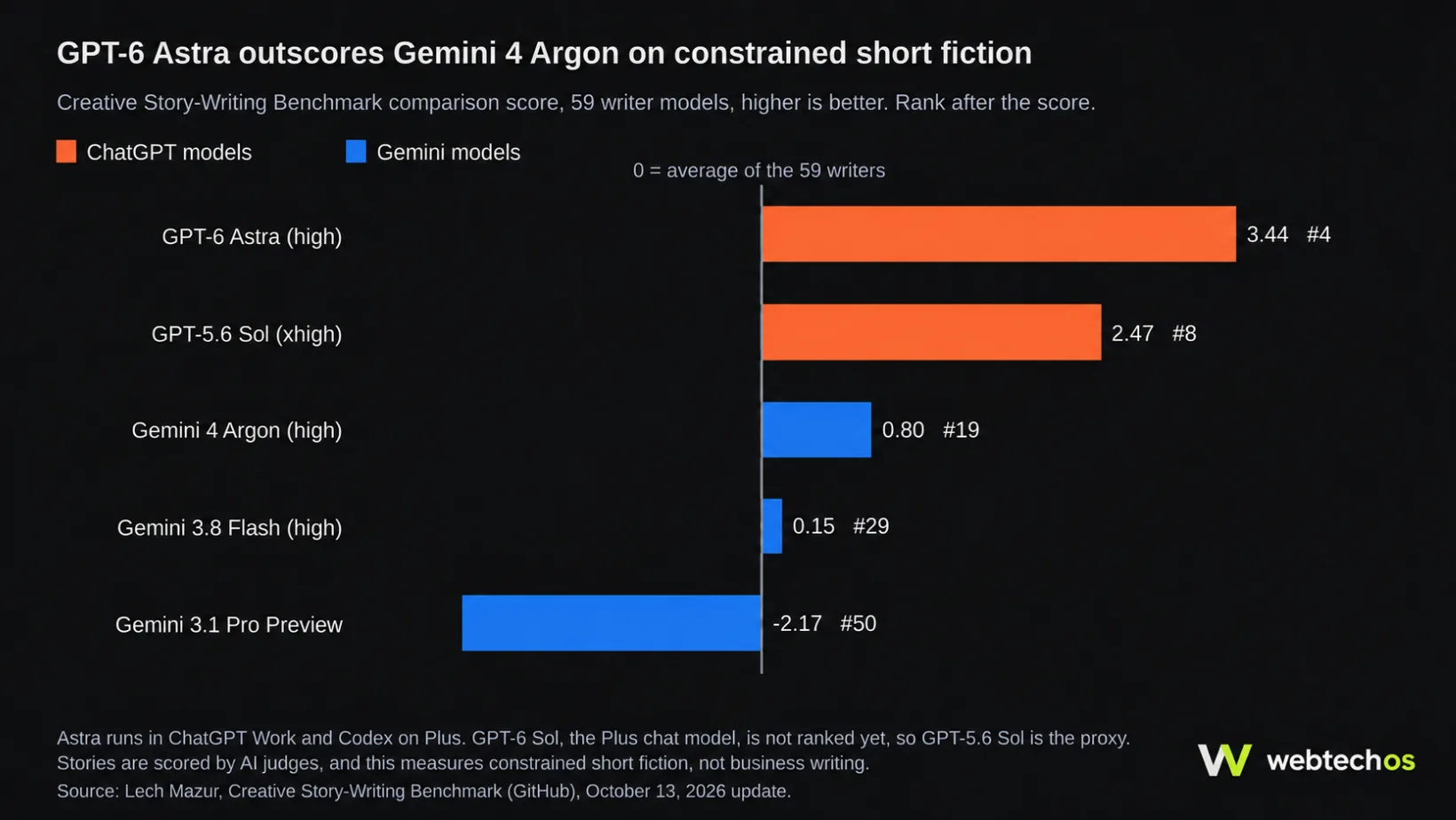
Three caveats keep that result in proportion. First, Astra is not what a Plus subscriber chats with. On Plus it appears only in ChatGPT Work and Codex, and the chat model, GPT-6 Sol, is not ranked yet, so GPT-5.6 Sol is the nearest proxy. Second, the test measures constrained short fiction scored by other AI models, not blog posts, emails or edits. In a separate experiment, the benchmark's author found Astra picked its own story in 692 of 700 comparisons with model names hidden, so judge bias is a real concern. Third, Anthropic's Claude models hold four of the top five places on the same table, so if writing is your main job, a third assistant belongs in your test.
Human preference points the other way. BenchLM's preference ratings put Gemini 4 Argon at 1525 and GPT-6 Sol at 1456 on an independent human-preference index, which suggests people favor Gemini's flagship in general chat. Google also says Argon answers more directly, with less hedging and fewer clichés, a claim from its own release note.
The honest summary is a split. ChatGPT's strongest model writes better constrained fiction, Gemini's flagship is preferred in general chat and sits inside Docs and Gmail, and no benchmark settles business writing. The test kit later in this guide takes about 20 minutes. If you write for search, our test of free SEO AI tools shows how usage limits shape the real answer, and teams that need enforced brand voice and approvals usually outgrow a general chatbot and should look at a dedicated AI writing tool instead.
ChatGPT vs Gemini for Research: Which Is More Accurate?
This is where the independent data leans most clearly toward Google. Vals AI's index of finance, legal, coding and tax work put Gemini 4 Argon first at 68.9%, according to DeepLearning.AI's The Batch. On BenchLM's knowledge table, Argon scores 80.8 and GPT-6 Sol 79.7, but the score ranges overlap, so treat that gap as a lean.
The more useful number is about errors. On the AA-Omniscience test, which penalizes wrong answers but not refusals, Argon had a 15% hallucination rate, against 51% for GPT-6 Astra and 54% for GPT-6.1 Sol, according to Artificial Analysis. A model that says "I don't know" more often is safer for contract summaries and financial research, where a confident error slips through review.
Two caveats keep this honest. Argon also answered fewer questions correctly (50% against 63% for Astra, per The Next Web's summary), so its overall AA-Omniscience score of 42 is level with Astra's 43 and Sol's 42. And Artificial Analysis tested Astra and GPT-6.1 Sol, not the GPT-6 Sol model a Plus subscriber chats with, so the comparison is indirect. In short, Argon guesses less, which is not the same as knowing more.
ChatGPT's research strength is speed and polish. OpenAI says GPT-6 Instant starts answering search-based questions 44% sooner than its predecessor, a company-reported figure that measures time to the first response, not accuracy.
Both apps also offer Deep Research, which runs a multi-step web investigation and returns a cited report. Gemini's version can also draw on Gmail, Drive and uploaded files where available, according to INT Computer Institute's overview, which helps when part of the answer lives in your own documents.
How much context do you actually need?
Google lists a 1M-token context window for Gemini on AI Pro, while OpenAI lists 256K for reasoning models on ChatGPT Plus. As a rough rule, one token is about 0.75 words. That puts 256K tokens near 190,000 words, or roughly 380 pages at 500 words a page, and 1M tokens near 750,000 words.
Most people never fill 256K. The gap matters when you load several long reports, a full codebase or a year of meeting transcripts into one prompt. For a single contract or a 60-page report, both will fit.
If you are putting either model inside a product rather than a chat window, measure its error rate on your own data instead of trusting a leaderboard.
Coding: it depends on where you code
ChatGPT wins if you hand tasks to an agent. Gemini wins if you paste code into the chat window. That split comes from which model sits where, and it is easy to miss.
In the chat window, BenchLM's coding table scores Gemini 4 Argon at 73.1 (6th) and GPT-6 Sol, the model in ChatGPT Plus chat, at 66.4 (12th). The ranges are unvalidated, so read it as a lean toward Gemini. In Codex, though, Plus includes GPT-6 Astra, which ranks 4th at 75.67 and edges Argon on Terminal-Bench 4.0, 57.9 to 57.4.
That 0.5-point gap is small enough to ignore. The bigger story is agent tooling. Google's Antigravity coding environment requires AI Ultra, which starts at $99.99 a month, for individual users. An analyst quoted by VentureBeat said it trails Claude Code and Codex, according to Let's Data Science. A $20 Plus plan already includes Codex.
One more data point from Google's own comparison: on Terminal-Bench 4.0, Anthropic's Claude Opus 5.5 scores 66.4% against Argon's 57.4%. On that benchmark, neither assistant in this article leads the field.
Which should a developer pick?
You work in the browser or app and paste snippets: Gemini on AI Pro, for the higher chat-window score and the 1M-token context.
You want an agent that edits a repository: ChatGPT Plus, because Codex is included and Antigravity is not.
You live in an editor: the assistant matters less than the tool wrapped around it. Our Cursor vs Claude Code comparison weighs an AI-native editor against a terminal agent, and GitHub Copilot remains the incumbent inside GitHub.
Whatever you choose, test it on one real change in your own repository before you commit. A benchmark measures the model, not your build system, your tests or your habits.
ChatGPT vs Gemini API: Pricing, Features and Developer Capabilities
OpenAI and Google offer APIs for building AI agents, automating workflows and integrating AI into applications. Both support function calling, structured outputs and multimodal capabilities, but their models differ considerably in cost.
For developers, the better choice depends on task complexity, context requirements and the cost of generating a usable response.
OpenAI vs Gemini API Pricing in 2026
The following table compares standard API pricing in USD per million tokens, excluding cached-input discounts and additional tool charges.
Provider | API model | Input / 1M tokens | Output / 1M tokens |
|---|---|---|---|
OpenAI | GPT-6 Astra | $10.00 | $50.00 |
OpenAI | GPT-6.1 Sol | $2.00 | $10.00 |
OpenAI | GPT-6.1 Terra | $1.00 | $5.00 |
OpenAI | GPT-6 Luna | $0.10 | $0.50 |
Gemini 4 Argon | $2.00 | $10.00 | |
Gemini 3.8 Flash | $0.75 | $3.75 | |
Gemini 3.5 Flash-Lite | $0.30 | $2.50 |
Sources: OpenAI API Pricing and Google Gemini API Pricing.
Two upcoming price changes matter:
Gemini 4 Argon: Introductory pricing ends November 30, 2026. From December 1, input rises to $4 and output to $20 per million tokens.
Gemini 3.8 Flash: Current pricing runs through December 31, 2026. From January 1, 2027, input rises to $1.50 and output to $7.50 per million tokens.
OpenAI's GPT-6.1 Sol and Gemini 4 Argon currently have identical standard token rates. Among the listed models, GPT-6 Luna has the lowest input and output prices.
These figures do not establish which API is cheaper for every application. Reasoning tokens, caching, repeated requests and additional tools can change the final bill.
API Features Compared
Feature | OpenAI API | Gemini API |
|---|---|---|
Function calling | Supported | Supported |
Structured outputs | Supported | Supported |
Web search | Built-in web search | Google Search grounding |
Code execution | Supported | Supported |
Computer use | Supported on selected models | Preview availability |
Prompt caching | Supported | Supported; method varies by model |
Multimodal processing | Model-dependent | Model-dependent |
Batch processing | Supported | Supported |
OpenAI provides several model options with different pricing and reasoning capabilities. GPT-6 Astra targets complex work, Sol balances capability and cost, Terra focuses on practical visual and computer-use tasks, and Luna supports lower-cost, high-volume workloads.
Google's Gemini 4 Argon targets complex reasoning and agentic workloads, while the Flash family offers lower-cost alternatives. Gemini also supports processing long multimodal inputs, including documents, audio and video, on compatible models.
Which API Should Developers Choose?
Choose OpenAI when you need a broad range of models, integrated agent tools or an inexpensive option for repetitive tasks.
Choose Gemini when your application works heavily with long documents, multimodal inputs or Google Search grounding.
Neither provider is automatically cheaper across all workloads. Test both using the same prompts and measure token consumption, latency, error rates and retries.
One important distinction: ChatGPT Plus and Google AI Pro subscriptions do not include equivalent API usage. API access is billed separately from consumer chat subscriptions.
ChatGPT vs Gemini for Images, Video and Voice
ChatGPT and Gemini offer different strengths across image generation, video creation, and voice interactions. Benchmark results favor ChatGPT for images, while Gemini has the advantage in video generation. Voice capabilities are harder to compare without direct testing.
Images. ChatGPT leads the public blind-vote ranking. On Artificial Analysis's text-to-image arena, GPT Image 2 scores about 1,339 Elo, ahead of Nano Banana 2 at about 1,265, the best Google model in the version we saw. Google's side has strengths a single score does not isolate: a Blendnow comparison credits the Nano Banana family with more consistent character editing. Nano Banana 2.1 became generally available on October 6 and accepts up to 14 reference images, and it may not be reflected in the arena yet. That release is documented for developers, so check which image model your own app uses.
Video. This one is not close. OpenAI closed the Sora app on April 26, 2026 and scheduled the Sora API to end on September 24, so ChatGPT is no longer a video tool. Gemini plans from AI Plus upward include video generation, with Flow credits that scale by tier, according to Nocode MBA's plan summary.
Reading files and images. Neither GPT-6 Sol nor Gemini 4 Argon has a public ranking for reading charts or scanned PDFs, so there is no verified winner. A fair test uses three inputs: a chart whose units you know, a scanned page, and a question the file cannot answer. The better assistant says the answer is not in the document.
Voice. Both apps offer voice conversation. On ChatGPT's free tier, OpenAI says voice has its own usage limit separate from text chat. Plan limits change often, so check the current allowance before you build a habit around it.
ChatGPT vs Gemini Ecosystem: Which Fits Your Workflow Better?
The gap between the two models is small. The gap in what each assistant is wired into is large, and for many teams it is the deciding factor.
Gemini lives inside Google's products. On AI Pro, the Gemini side panel appears in Drive, Docs, Sheets, Slides, Meet and Chat, as 9to5Google's plan breakdown lists it, and Argon also runs in AI Mode in Search. The October update added a chat-to-tasks switch and links to more than 40 outside apps. If your company runs on Gmail, Calendar and Drive, that integration is the strongest single argument for Gemini.
ChatGPT is a separate workbench. Since July 9, one desktop app combines Chat, Work and Codex, and OpenAI says all three are available on every plan, including Free. Work is an agent that connects through plugins to Slack, Microsoft Teams, Google Drive, SharePoint, email, calendars and CRMs, runs Scheduled Tasks, and on desktop can use your computer and a built-in browser. If your stack mixes Microsoft and Google tools, that neutral position is a real advantage. The catch is metering: OpenAI says Work usage varies with the task, and complex jobs use more of your plan's included usage.
Both companies are now pushing agents that act for you, and that raises the stakes. Agents rarely break loudly. They drift, and a quiet model update can change behavior for weeks before anyone notices. Our field guide on why most agent projects fail in month three makes the case for keeping human approval on any action you cannot undo, such as sending email or moving money.
ChatGPT vs Gemini Pricing: Which Offers Better Value?
At the $20 level the price is the same, so the bundle decides. Gemini is cheaper at the entry tier, and the top plans on both sides start near $100. US list prices below were checked by BenchLM on October 23, 2026, and the ChatGPT Go and Google AI Pro prices match OpenAI's Go announcement and Thurrott's report on Google's plans.
Plan level | ChatGPT | Gemini |
|---|---|---|
Free | $0. A Luna model with limited uploads, images and deep research | $0. A lighter Flash model and 15 GB of storage |
Entry | Go, $8/month. More messages and uploads; may show ads | Google AI Plus, $4.99/month. Twice the free usage and 400 GB of storage |
About $20 | Plus, $20/month. GPT-6 Sol in Chat, 256K reasoning context, Codex and Work | Google AI Pro, $19.99/month. Gemini 4 Argon, 1M context, 5 TB storage |
Top | Pro, from $100/month, with higher tiers above it | Google AI Ultra, $99.99/month, or $199.99 for 20x Pro usage |
Three details change the math. Google AI Pro bundles YouTube Premium Lite and other Google perks, so the real price drops if you would buy those anyway. OpenAI said in January that Plus, Pro, Business and Enterprise would stay ad-free while it tests ads in Free and Go in the US. And paying for both $20 plans costs $39.99 a month, which is a fair way to test before you commit to one.
Over a year, the entry tiers cost $59.88 for Google AI Plus against $96 for ChatGPT Go. The $20 tiers cost $239.88 and $240, and holding both costs $479.88.
Developers should note a date. Gemini 4 Argon's API price is $2 per million input tokens and $10 for output through November 30, then doubles to $4 and $20 on December 1, per Let's Data Science. Budget at the higher rate.
Subscription plans hide a second cost: usage caps. Higher tiers mostly sell bigger allowances, which behaves like the credit and consumption models we break down in our analysis of agent billing models. Track how often you hit a limit for a month before you upgrade.
ChatGPT vs Gemini Privacy: How Your Data Is Used and Protected
Neither assistant is private by default on a personal account. Both vendors document their controls, so check them before you paste anything sensitive.
Gemini. Keep Activity is on by default for adults. While it is on, chats are saved to your account (deleted after 18 months unless you change the window), can be used to improve Google's AI, and a subset is read by human reviewers. According to Google's Gemini Apps Privacy Hub, reviewed chats are disconnected from your account, kept for up to three years, and not deleted when you delete your activity. Turning Keep Activity off stops future chats from training Google's models, but chats are still held for 72 hours, and temporary chats follow the same 72-hour rule. The trade-off is features: with Keep Activity off, some connected apps are unavailable, and Google says its remote-browser Tasks feature works only with Keep Activity on.
ChatGPT. OpenAI's Data Controls FAQ explains that you can turn off "Improve the model for everyone" so chats stay in your history but are not used for training. Temporary Chats are deleted from OpenAI's systems after 30 days, and Team, Enterprise and Edu plans have additional controls. OpenAI also documents separate controls for ads, which it has been testing on the Free and Go tiers in the US.
A 20-minute privacy setup for either app:
Turn off training: "Improve the model for everyone" in ChatGPT's Data controls, and Keep Activity at myactivity.google.com/product/gemini. Decide first whether you can live without Gemini's connected apps.
Use temporary chats for anything sensitive, such as contracts, health questions or client data, and remember the retention windows: 30 days at OpenAI, 72 hours at Google.
Move work data to a business plan, where the vendor's terms differ from the consumer ones, and read those terms.
If you connect either assistant to email, calendar or files, connected data adds another layer of settings. Google's notice says it does not monitor or secure custom third-party connected apps.
ChatGPT or Gemini: Which Should You Choose?
Start from the work you do most, not from the leaderboard.
Choose Gemini if
Your company runs on Gmail, Drive, Docs and Calendar, and you want the assistant inside them.
You work with long reports, transcripts or many files at once and need the 1M-token context.
Accuracy matters more than a confident guess, as in research, finance or legal summaries.
You want video generation, or the cheapest paid entry point at $4.99 a month.
Choose ChatGPT if
You hand multi-step coding tasks to an agent, and want Codex included in a $20 plan.
You want replies that include charts, forms and small working tools through Intelligent UI.
Your tools come from several vendors, and a neutral desktop agent with a plugin directory suits you better than one tied to Google.
You need readable text inside generated images, where reviewers currently favor ChatGPT Images.
Still undecided?
Use both free tiers for a week on the same real tasks, and upgrade only the one you reach for first. Switching later costs little, because your prompts and habits transfer. The real lock-in is your documents, connected apps and any custom assistants you build.
How to Spot an Outdated ChatGPT vs Gemini Comparison
Most reviews that rank for this topic compare model pairs that neither app serves by default. Five checks take about two minutes:
Does it name the model for each plan? A review that says only "ChatGPT" or "Gemini" is comparing brand names. Look for GPT-6 Sol, GPT-6 Luna and Gemini 4 Argon, and for the plan that serves each.
Does it date its data? Anything written before October 7 for ChatGPT, or October 13 for Gemini's flagship in the app, predates this matchup.
Does it compare matching tiers? Free against paid, or $20 against $100, measures subscriptions rather than assistants.
Does it separate chat from agents? ChatGPT's strongest models sit in Work, Codex and Pro reasoning, so a benchmark for Astra says little about the Plus chat window.
Does it say what it did not test? A comparison that lists no limits has usually not looked for any.
Questions
Frequently asked questions
Is Gemini better than ChatGPT in 2026?
On the independent evidence we found, Gemini leans ahead at the $20 level. Gemini 4 Argon scores 82.79 against GPT-6 Sol's 78.71 on BenchLM's overall table, but their score ranges overlap, so it is a lean and not a settled result. ChatGPT is stronger for agentic coding in Codex and, with GPT-6 Astra, for constrained creative writing.
Which is better for coding, ChatGPT or Gemini?
In the chat window, Gemini 4 Argon scores higher than GPT-6 Sol on BenchLM's coding table. For agent-style work, ChatGPT Plus includes Codex with GPT-6 Astra, while Google's Antigravity agent needs the $99.99 Ultra plan. Pick by the tool you will actually use.
Which is better for writing?
It splits. On Lech Mazur's creative-writing benchmark, ChatGPT's GPT-6 Astra ranks 4th of 59 and Gemini 4 Argon 19th, but Astra is not the Plus chat model. BenchLM's human-preference rating favors Argon over GPT-6 Sol, 1525 to 1456. For business writing no benchmark settles it, so run the 20-minute test in this guide.
Does ChatGPT still generate video?
No. OpenAI closed the Sora app on April 26, 2026, and scheduled the Sora API to end on September 24. Gemini plans from AI Plus include video generation.
Which AI hallucinates less?
In Artificial Analysis's AA-Omniscience test, Gemini 4 Argon had a 15% hallucination rate against 51% for GPT-6 Astra and 54% for GPT-6.1 Sol. It also answered fewer questions correctly (50% against Astra's 63%), so its overall score is level with theirs. The test does not cover the GPT-6 Sol chat model, so verify important facts in either app.
Is the free version of Gemini or ChatGPT better?
ChatGPT's free plan offers unlimited everyday text chats on a Luna model, with separate caps on images, files and voice. Gemini's free plan runs a lighter Flash model with daily limits. No independent ranking separates the two free tiers, so try both.
How much do ChatGPT Plus and Gemini AI Pro cost?
ChatGPT Plus costs $20 a month and Google AI Pro costs $19.99 a month in the US. AI Pro adds 5 TB of storage and a 1M-token context window, and Plus includes Codex and ChatGPT Work.
Can I use ChatGPT and Gemini together?
Yes. Both have free plans, and paying for both $20 tiers costs $39.99 a month. Many people run the same task in each for a week, then keep the one that needs fewer edits.
Do ChatGPT and Gemini use my chats for training?
On personal accounts, both can unless you opt out. Switch off training in ChatGPT's Data controls and turn off Keep Activity in your Google Account, and use temporary chats for sensitive material.
Is Gemini 4 Argon available on the free plan?
Not yet. Google's announcement lists AI Pro and Ultra subscribers as the people who can use Gemini 4 Argon in the Gemini app, so free accounts do not get it. Its Antigravity coding agent requires AI Ultra for individual users.
Which assistant works better with Microsoft Teams and SharePoint?
ChatGPT, on the documented integrations. OpenAI says ChatGPT Work connects to Microsoft Teams, SharePoint, email and calendars through plugins. Gemini's deepest integrations are Google's own products, so check Google's connected-apps list for your specific tools before you buy.
Conclusion
For most people on a $20 plan, Gemini is the better buy for knowledge work in late 2026. It scores higher on the independent tests we found, shows a lower measured hallucination rate, offers a context window about four times larger than ChatGPT Plus's reasoning limit, and bundles storage and video generation. ChatGPT keeps the lead where you hand work off: Codex for coding agents, Work for tasks across apps, and Intelligent UI for interactive answers. Its top model is also the stronger constrained-fiction writer. Both leads are modest, which is why the 20-minute test matters more than any scoreboard.
Treat that verdict as a snapshot. Gemini 4 Argon is two weeks old, its API price doubles on December 1, and both companies ship changes monthly. Rerun the 20-minute test each quarter, and check your model picker before you trust any comparison, ours included.
If you are weighing other software the same way, our head-to-head comparisons each answer one buying question plainly, with the tradeoffs spelled out.
WebTechOS accepts no payment for coverage, placement or scores. Where a piece references pricing, it reflects published list rates at the date shown.
Keep reading
All insights →Zapier Pricing 2026: What Each Plan Actually Costs
Zapier pricing 2026: see exactly what Free, Professional, Team, and Enterprise cost, how task billing works, and which plan actually fits you.
Claude Opus vs Sonnet: Which Model Should You Pay For?
Is Claude Opus worth double the price of Sonnet? Compare 5.5 pricing, benchmarks and a break-even rule to pick the right model for your work.
10 Best n8n Alternatives for Workflow Automation
Compare 10 n8n alternatives, from Zapier and Make to AI agent platforms like YourGPT, on verified 2026 pricing and who each tool actually fits.
Claude Haiku vs Opus: When the Cheaper Model Is Enough
Haiku 5.5 costs 40x less than Opus 5.5 per token. See which tasks it handles equally well, where Opus pays off, and how to route between them.