Grok 5 vs Claude: Is It Worth Switching?
Grok 5 isn't out yet. See how Grok 4.7 compares with Claude on independent benchmarks, cost per task, coding and plans.
27 Oct 2026·23 min read·General

Grok 5 has not been released, so no one can switch to it yet, however loud the headlines get. What Claude users can switch to is Grok 4.7, and the independent evidence on it favors staying put for most work. Artificial Analysis, an independent benchmarking site, scores Claude's models 10 to 12 points higher on general capability and Claude Code 15 points above Grok Build. Grok costs a third to a half less per task and has native X search.
As of 28 October 2026, xAI's newest model is Grok 4.7, released on 21 September. xAI's only official statement about Grok 5 is that it is in training, made in its January 2026 funding announcement, and Musk has publicly put Grok 4.8 and 4.9 ahead of it. Treat any Grok 5 date you read as a claim, not a schedule.
That makes the real decision Grok 4.7 against Claude's current lineup: Opus 5.5, Sonnet 5.5, Haiku 5.5 and the top-tier Fable 5.1. Our answer for most Claude users is not to switch wholesale. Move a specific workload to Grok when it matches one of the cases below, and keep Claude for the rest.
If your work is mostly | Lean toward | Why |
|---|---|---|
Research that starts with posts, threads and reactions on X | Grok | The Grok API has a native X Search tool for keyword, semantic, user and thread lookups. |
Short, high-volume API calls where cost per call decides | Grok 4.7, or Haiku 5.5 if quality allows | Artificial Analysis puts Grok 4.7 at $3.74 per index task against $5.98 for Opus 5.5, which scores 12 points higher. Haiku 5.5 costs $0.10 in and $0.50 out per million tokens. |
Long, terminal-driven agent runs | Claude | Artificial Analysis scores Claude Code with Opus 5.5 at 62 on its coding-agent index against 47 for Grok Build, and 63% against 33% on Terminal-Bench 4.0. |
A shared team workspace with documents and slides | Claude | Claude's plans list Team seats, Projects, Docs and Slides. |
One bill for chat and an AI code editor | Grok | The X Subscription bundles Grok, Grok Bot, Cursor and X Premium. |
This piece draws on vendor documentation, pricing pages, xAI's launch benchmarks and Artificial Analysis's independent testing. We did not run our own benchmark suite for it, and wherever a figure comes from xAI we say so.
Grok 5 Release Timeline and Current Status
Grok 5 has one confirmed fact and a long trail of missed targets. xAI said in January 2026 that the model was in training. It has published no release date, price, context window or benchmark for it.
Musk's earlier targets, the end of 2025 and then the first quarter of 2026, both passed without a launch, according to reporting collected by Presenc. The same tracker says he said in August that Grok 5 would arrive before the end of 2026. Treat that as a claim. His September timeline for Grok 4.8, a model he described as 2.5 trillion parameters, slipped as well: xAI's model docs still listed Grok 4.7 as the flagship on 13 October.
What you can verify today is the shipping cadence. Grok 4.5 arrived on 8 July, 4.6 on 12 August and 4.7 on 21 September, a gap of roughly five to six weeks per release. If that rhythm holds, a 4.8 release is more likely to land before Grok 5 than after it.
There is one more naming wrinkle worth knowing. xAI now publishes under the SpaceXAI name after SpaceX acquired it, so older articles and newer ones can refer to the same company differently.
Grok vs Claude: Model Comparison
"Grok" is one flagship model right now, while "Claude" is four, spread across a 100x price range. Comparing the two brands without naming the model is how most switching decisions go wrong.
Model | Input per 1M tokens | Output per 1M tokens | Context window | Where the vendor positions it |
|---|---|---|---|---|
$2 ($4 once a prompt reaches 200K) | $6 ($12 at 200K and above) | 500K | Coding and knowledge work | |
$10 | $50 | Up to 1M | Long-running agents | |
$4 | $20 | Up to 1M | Agentic coding and enterprise work | |
$2 | $10 | Up to 1M | Coding and agents at mid price | |
$0.10 ($0.50 above 100K) | $0.50 ($2.50 above 100K) | Up to 1M | Fast, cheap, high-volume work |
Prices are US list rates for short prompts, checked on 28 October 2026. Anthropic's page says context size varies by model. On Grok, the higher long-context rate applies to the whole request, not just the tokens past 200K.
Three things stand out. Grok 4.7 has the same input price as Sonnet 5.5 and an output price 40% lower. Fable 5.1 costs five times as much on input and more than eight times as much on output, so any comparison against it is also a comparison of budgets. And Claude's larger window describes capacity and promises nothing about recall, so test long documents before you assume either vendor handles them well.
Grok 4.7 vs Claude: Benchmark Comparison
On xAI's own launch table, Grok 4.7 beats Fable 5.1 on three of eight benchmarks, and the pattern is worth reading. Grok leads on electrical engineering and legal agent work, while Claude's top model leads on terminal tasks, clinical reasoning and the knowledge-work scores. That table compares Grok against one Claude model, though, and independent testing shows it is not the strongest one.
Benchmark | Grok 4.7 (xHigh) | Claude Fable 5.1 (Max) | Leader |
|---|---|---|---|
Terminal-Bench 4.0, multi-hour terminal work | 37.6% | 57.9% | Fable, by 20.3 points |
CursorBench 4.0, software engineering | 46.3% | 51.8% | Fable, by 5.5 points |
HealthBench Professional, clinical reasoning | 56.7% | 62.1% | Fable, by 5.4 points |
GDPval, professional knowledge work (Elo) | 1,695 | 1,735 | Fable, by 40 |
AA Briefcase v1.1, multi-hour office work (Elo) | 1,657 | 1,678 | Fable, by 21 |
DeepSWE v1.1, software engineering | 71.0% (high effort) | 70.0% | Grok, by 1.0 point |
EEBench, electrical engineering | 64.0% | 56.4% | Grok, by 7.6 points |
Harvey Legal Agent Benchmark | 19.6% | 6.7% | Grok, by 12.9 points |
Source: xAI's Grok 4.7 launch post, 21 September 2026. All figures are self-reported by xAI.
What independent testing adds
Artificial Analysis (AA) runs its own ten-evaluation Intelligence Index and a separate coding-agent index. Both include the Claude models that xAI's table leaves out.
Model (effort) | Intelligence Index | Cost per index task | Output tokens per task | AA-Briefcase (Elo) | GDPval-AA (Elo) |
|---|---|---|---|---|---|
Claude Opus 5.5 (max) | 58 | $5.98 | About 119K | 1,822 | 1,846 |
Claude Sonnet 5.5 (max) | 56 | $5.46 to $7.60 | About 193K | 1,811 | 1,844 |
Grok 4.7 (xhigh) | 46 | $3.74 | About 81K | 1,657 | 1,695 |
Sources: AA's Opus 5.5 article, Grok 4.7 article and Sonnet 5.5 launch post, Intelligence Index v4.3.2. Cost per task comes from AA model pages as reported by Kingy and Codersera. Sonnet's $7.60 is from AA's launch post and $5.46 from its later model page.
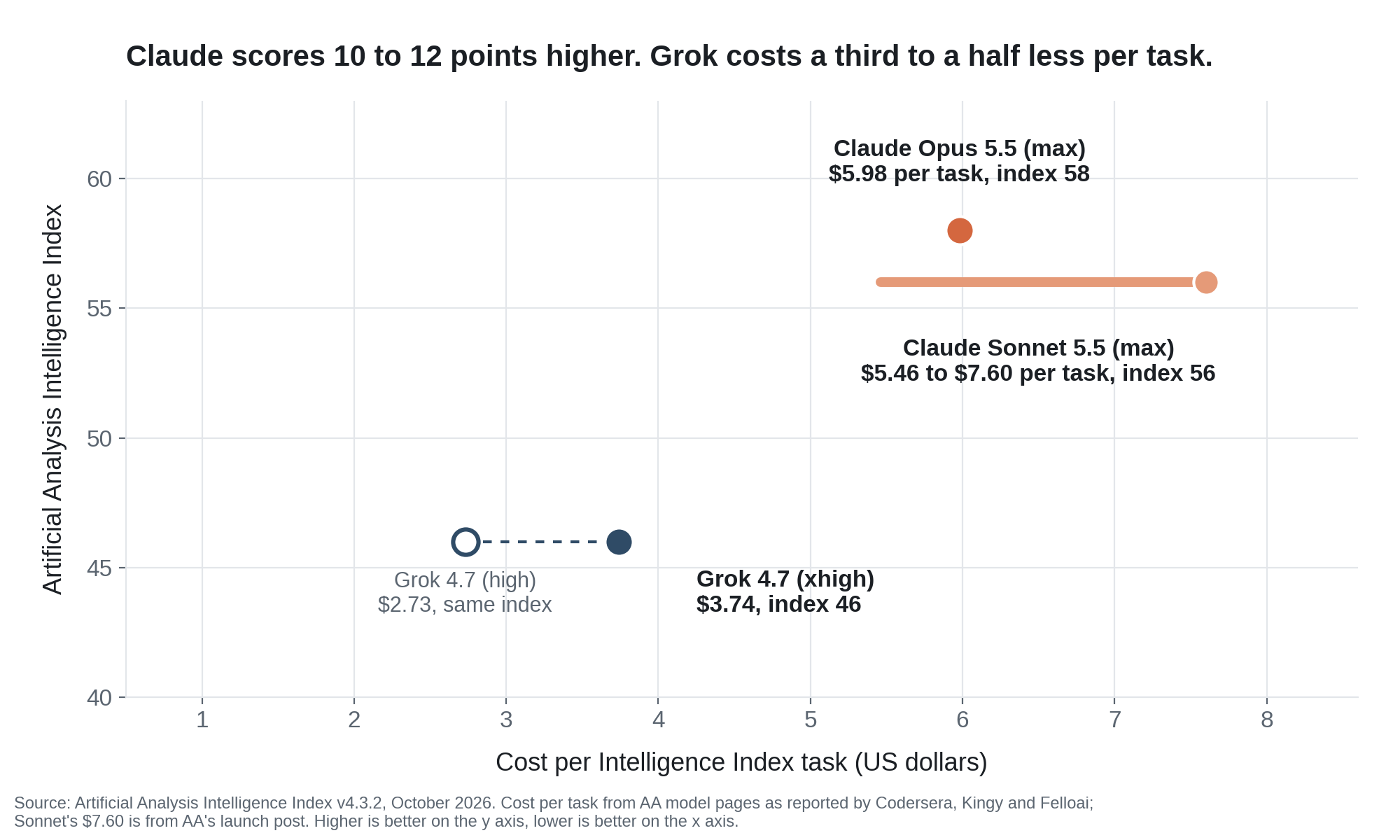
Figure 1. Independent score against cost per task. The hollow marker is Grok 4.7 at high effort, which scored the same 46 for a lower bill.
Claude leads on general capability. Opus 5.5 scores 12 points above Grok 4.7 and Sonnet 5.5 scores 10 points above it. AA calls Opus 5.5's 58 the highest score it has measured by several points, and Fable 5.1, the model xAI chose as its rival, also sits below Opus 5.5 on AA's coding-agent index.
Grok is not the verbose model in this comparison. Its roughly 81,000 output tokens per task is more than double the 36,000 that Grok 4.6 used, but it is well below both Claude models at max effort.
On reliability, Opus 5.5 holds the top score on AA's Omniscience evaluation, one of six of the ten Index evaluations it leads. Grok 4.7's hallucination rate on that evaluation is 29%, improved from 34% for Grok 4.6.
AA also places Opus 5.5 at four of its five effort levels on its intelligence-versus-cost frontier, among models scoring 50 or above. Grok 4.7 scores 46, so that finding does not cover it.
Three caveats on xAI's own table
First, the effort settings are not matched. Coursiv's breakdown points out that xAI compared Grok 4.7 at xHigh, Grok 4.6 at High and the rival models at Max. Higher effort means more reasoning tokens per task, so the gaps mix model quality with spend.
Second, the table omits Opus 5.5 and Sonnet 5.5. The independent table above fills that gap, and it changes the picture: Fable 5.1 is not Claude's strongest option on either of AA's indexes.
Third, the gains xAI highlights are larger than the independent ones. AA scored Grok 4.7 at 46 on its Intelligence Index, two points above Grok 4.6, while xAI's table shows Terminal-Bench nearly doubling from 20.3% to 37.6%. Both can be true, since the benchmarks differ, but a vendor's chosen rows will always move more than a broad index.
Price-adjusted, xAI's case is real but narrower than its chart suggests. In Lindy's reading of xAI's CursorBench chart, Grok 4.7 scores 46.3% at about $6 per task while Fable 5.1 scores 51.8% at about $17. Fable is not Claude's best value, though. Opus 5.5 outscores it on both of AA's indexes at less than half its token prices.
Grok 4.7 vs Claude: Cost Comparison
Grok 4.7 is cheaper per task than Claude's top models, but by roughly a third to a half, not by the multiples the output rate cards imply. Artificial Analysis puts it at $3.74 per Intelligence Index task at xhigh effort. It puts Opus 5.5 at $5.98 and Sonnet 5.5 at $5.46 to $7.60 at max effort, with scores 10 to 12 points higher.
Token use matters as much as the rate. AA measured about 81,000 output tokens per task for Grok 4.7, against about 119,000 for Opus 5.5 and 193,000 for Sonnet 5.5 at max effort. Grok 4.7 is verbose compared with Grok 4.6, but not compared with the Claude models it would replace. AA's cost also counts input and cache tokens, which is why the gap is narrower than output rates alone suggest.
The effort setting moves the bill more than the vendor does. Grok 4.7 scored 46 at both high and xhigh effort, while its cost per task rose from $2.73 to $3.74. Emergent's summary of AA's Sonnet 5.5 data has that model's cost per task running from $0.41 at Low effort to $7.60 at Max. Compare models at the effort that reaches your quality bar, not at matching labels.
To model your own workload, start from the rate card. Here is a hypothetical: 5,000 support tickets a month, each with 3,000 input tokens and 800 output tokens, which is 15 million input tokens and 4 million output tokens in total. It is an illustration built from list prices, not an observed result.
Model | Monthly cost at equal token use | Output multiple at which Grok 4.7 stops being cheaper |
|---|---|---|
Grok 4.7 | $54 | Not applicable |
Claude Sonnet 5.5 | $70 | About 1.7x |
Claude Opus 5.5 | $140 | About 4.6x |
Claude Fable 5.1 | $350 | About 13.3x |
Claude Haiku 5.5 | $3.50 | Already cheaper at equal tokens |
At equal token use, Grok is cheaper than Sonnet, Opus and Fable. The last column shows how much extra output Grok could write before losing that advantage. AA's measured ratios, roughly 0.4 times Sonnet 5.5's output and 0.7 times Opus 5.5's at max effort, sit well inside every threshold. Haiku 5.5 undercuts everything here by an order of magnitude, so if the task is classification or extraction, test it before you test Grok.
Two other levers tilt toward Claude. Cached input costs $0.50 per million on Grok 4.7 and $0.10 on Sonnet 5.5, so long prompts that repeat favor Claude. Anthropic also lists a 50% discount for batch jobs, so check whether xAI offers an equivalent for the model you plan to use. Both vendors sell a faster tier at twice the price: Grok 4.7 Fast, and fast mode for Opus 5.5.
Token billing is the model finance teams find hardest to forecast. We have made that case in how agents are breaking seat-based pricing: token billing suits teams that can model their own usage and frustrates anyone who needs a fixed number to budget. If you cannot say how many tokens a typical task burns, you are not ready to compare rate cards.
Grok vs Claude Code: Coding Performance Compared
For developers, the coding decision is mostly a choice of agent harness, and the model is the second question. That matters because switching models no longer means switching tools.
Grok 4.7 launched inside Cursor and Grok Build on day one, and xAI lets you try Grok Build for free. The X Subscription now bundles Cursor Pro with Grok at $30 a month on its Premium tier. If you already work in Cursor, you can test Grok 4.7 on your own backlog this week without changing editors. Be aware that third-party models in that bundle are billed at API list prices, so running Claude inside Cursor costs extra on top of the plan.
Claude Code is a different bet. It is a terminal agent, included in every paid Claude plan, and it shares one usage pool with your chat activity, so a heavy chat day leaves less for coding. We score it 86 out of 100, level with Cursor in our index. In our Cursor vs Claude Code comparison, Cursor wins on inline editing and onboarding, while Claude Code wins on long multi-file tasks, command execution and extensibility through skills, hooks and MCP servers.
That comparison was last updated in July and predates the Cursor bundle, so read it for working style rather than pricing. Its core point still holds: choose the editor when you want to stay in the loop, and the terminal agent when you want to hand over a whole task and review the result.
What independent testing says about the agents
AA's coding-agent index scores a model and its harness together, so it tests Claude Code and Grok Build as products. On version 2.0, launched on 23 October, Claude Code with Opus 5.5 leads Grok Build by 15 points.
Agent and model (effort) | Coding Agent Index | Terminal-Bench 4.0 | FrontierCode v1.1 | Cost per task | Time per task |
|---|---|---|---|---|---|
Claude Code, Opus 5.5 (max) | 62 | 63% | 56% | $11.42 | 1.0 hours |
Claude Code, Sonnet 5.5 (max) | 59 | 66% | 48% | $13.30 | 1.3 hours |
Claude Code, Fable 5.1 (max) | 58 | 58% | 49% | $11.53 | 35.3 minutes |
Grok Build, Grok 4.7 (xhigh) | 47 | 33% | 44% | $9.48 | 35.8 minutes |
Source: AA's Claude Code vs Grok Build comparison, index v2.0. Costs are pay-per-token API costs, so a flat-rate plan changes your real bill. Version 2.0 grades more strictly than the earlier index and scores fell, so compare only within one version.
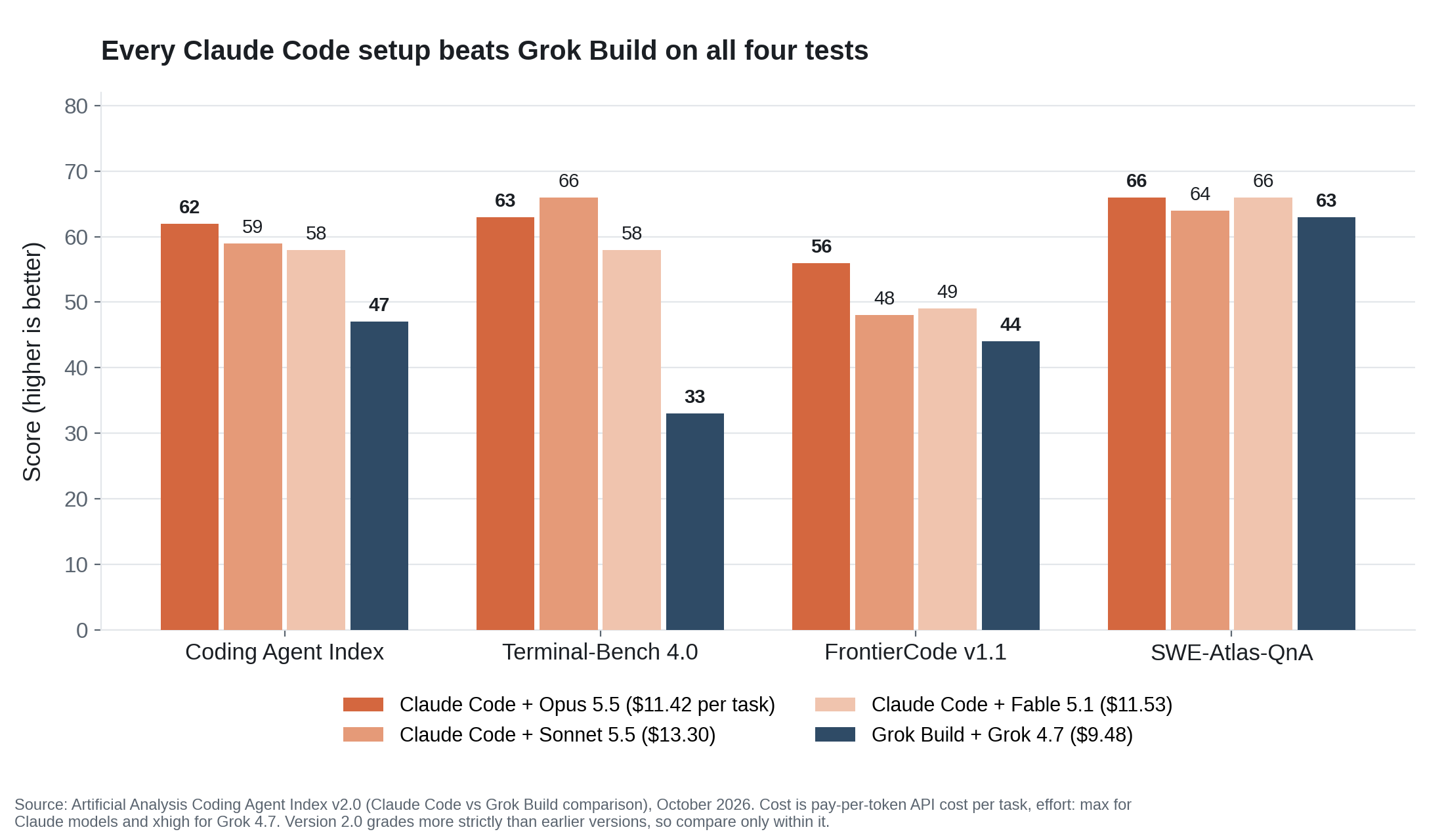
Figure 2. Artificial Analysis Coding Agent Index v2.0. Every Claude Code setup tested scores above Grok Build on every measure, and the widest gap is terminal work.
Grok Build is cheaper and quicker per task, but it scores lower where it counts. Its $9.48 per task is 17% below Claude Code with Opus 5.5, and it finishes in about 36 minutes against an hour. Per index point, Claude Code still costs less, about $0.18 against $0.20.
The widest gap is terminal work, 63% against 33% on Terminal-Bench 4.0. Grok Build comes closest on repository question answering, 63% against 66%. Note also that Fable 5.1, the model xAI benchmarked against, trails Opus 5.5 and Sonnet 5.5 inside Claude Code on the overall index.
Here is how that maps to the switching question.
You delegate long terminal tasks to Claude Code. Stay unless cost or speed is the pain. AA measures Claude Code with Opus 5.5 at 63% on Terminal-Bench 4.0 against 33% for Grok Build.
You work mostly in Cursor. Try Grok 4.7 there first. It costs you a model dropdown, not a migration.
You are cost-sensitive and your tasks are short. Grok 4.7 deserves a trial, with billed tokens tracked per task.
We have not run a repository benchmark for this piece. Take one real maintenance task, such as a bug fix with tests, and compare the diff, the review time and the tokens billed.
Grok vs Claude: Research and Writing
Grok's clearest advantage is live X data. Claude's is the workspace around the deliverable.
xAI's X Search tool lets Grok run keyword searches, semantic searches, user lookups and thread fetches on X, with filters for handles and dates and optional analysis of images and videos in posts. That is useful for a communications lead tracking reaction to a launch, a founder reading complaint threads as they unfold, or an analyst hunting for the original post behind a headline. It is billed per post fetched, so a broad query costs more than it looks.
Claude can search the web on every plan, including Free, and paid plans add Research. It also connects to your own apps. For a proposal, a board update or a recurring report, the useful pieces are Projects, memory, connectors, Docs and Slides, plus shared projects on Team plans. The advantage is continuity: your source files, instructions and drafts stay in one place between sessions.
Both tools can read the open web. Only Grok has first-party access to X's index, and that first-party access is the capability a switch would actually buy you. Two cautions apply anyway. A retrieved post is not a verified fact, and the visible conversation on X is not a representative sample of your customers. Check anything that will reach customers or investors against a primary source.
If image and video generation are part of your daily work, that is a Grok-side feature set, and video generation starts at the $30 Premium tier.
Grok vs Claude: Plans and Usage Limits
Grok's plan menu changed two weeks ago, so many guides are already stale. On 12 October xAI replaced the standalone SuperGrok tiers with The X Subscription, and new self-serve customers now choose from its plans. Existing SuperGrok, Cursor and X Premium subscribers keep their current plans. An article quoting SuperGrok at $30 or Heavy at $300 is describing plans that are closed to new buyers.
Usage level | Grok (The X Subscription) | Claude |
|---|---|---|
Light paid use | Plus, $8 a month, without Grok Bot | Pro, $20 a month or $17 effective when billed annually |
Daily use | Premium, $30 a month, 4x Plus usage, with Grok Bot and Cursor Pro included | Pro covers daily use, with Claude Code and Research included |
Heavy use | Super, $100 a month, 15x Plus | Max 5x, $100 a month |
Heaviest use | Ultra, $200 a month, 50x Plus | Max 20x, $200 a month |
Team seat | $30 Premium, $100 Super or $200 Ultra per seat | Standard $20 per seat billed annually or $25 monthly; Premium seat $100 annually or $125 monthly |
Sources: xAI's pricing docs and Claude's pricing page, checked 28 October 2026. US list prices before tax.
The $100 and $200 rows match in price, but they do not match in allowance. xAI states usage as multiples of its Plus plan and publishes no fixed message counts. Anthropic states Max as 5x or 20x Pro on rolling five-hour windows with weekly limits on top, and it does not publish a fixed message count either. Neither vendor lets you price a plan by the task.
One Claude detail affects the comparison with Fable 5.1. On Pro, the top model is available through usage credits at API rates rather than the plan allowance, and on Max and Team premium seats it draws on half of your weekly limits.
The Grok bundle is strongest when it replaces spending you already have. xAI says Premium covers what SuperGrok, Cursor Pro and X Premium+ cost separately, $90 a month combined. Compared with a Claude Pro plan alone, that is more product than most single-tool users need, so the bundle pays off only if you would otherwise buy two or three of its parts.
Grok vs Claude: Data Privacy and Security
Both Grok and Claude offer protections for business data, but their policies differ in retention, administrative access and compliance controls. For businesses handling sensitive information, these differences matter as much as model performance.
Data Training and Retention
xAI's enterprise FAQ states that enterprise and API inputs and outputs are not used for model training. Conversations are generally deleted within 30 days, except when legal or security requirements apply. Zero data retention is also available for eligible API workloads.
Anthropic similarly excludes commercial customer data from training by default. API data is generally retained for up to 30 days, while Enterprise customers can configure retention policies. Eligible API and Claude Code Enterprise workloads also support zero data retention.
Security and Administrative Controls
Both vendors offer enterprise security capabilities, although availability depends on the product and plan.
Grok: Enterprise options include single sign-on, role-based access controls, audit logging and regional data processing. xAI also offers security certifications and compliance arrangements for eligible customers.
Claude: Enterprise includes SSO, SCIM provisioning, audit logs, custom retention policies and a Compliance API. Anthropic also offers customer-managed encryption keys and HIPAA-ready configurations.
Claude provides more explicitly documented administrative controls for managing users and monitoring AI activity. Grok offers comparable categories of enterprise security, but organizations should confirm the exact controls included in their agreement.
What Businesses Should Consider
The choice depends on your data requirements. Teams working with customer records, proprietary code or regulated information should review each vendor's data processing agreement, storage locations and access permissions.
Connected tools also introduce risks. When an AI assistant accesses internal files or business applications, its permissions and the handling of retrieved data become part of the security assessment.
Both vendors offer business data protections, but the right choice depends on which one can meet your organization's specific compliance and data handling requirements.
Grok vs Claude: Which Should You Choose?
Switch a workload, not your whole stack. Grok 4.7 earns a real trial in three situations.
Your research starts on X and you need threads, reactions and original posts, not summaries of them.
You run many short, uncached API calls, and your own trial shows Grok reaching your quality bar at a lower billed cost per accepted result than Claude at a matching effort level.
You already pay for Cursor and a Grok plan, so The X Subscription replaces spend instead of adding it.
Stay on Claude when your agents run long in a terminal, when your team shares Projects and deliverables, when you reuse long prompts that caching makes cheap, or when you can batch work for the 50% discount. Data terms are closer between the vendors than the marketing suggests, so check them against your own retention requirements.
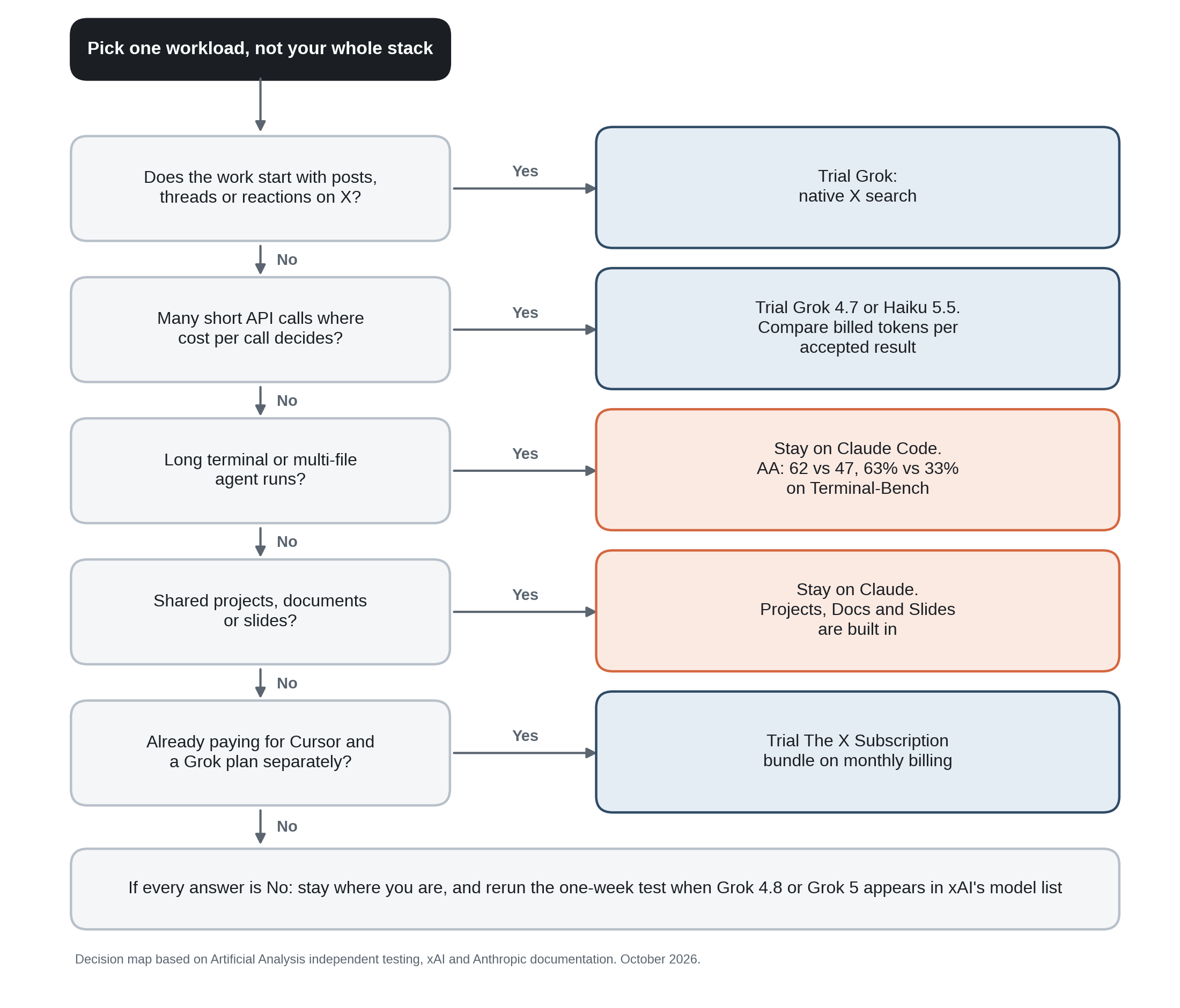
Figure 3. A decision map for moving one workload at a time.
If you are on Grok and weighing Claude
The independent evidence favors this move more than xAI's own table does. AA scores Opus 5.5 and Sonnet 5.5 10 to 12 points above Grok 4.7, and Claude Code 15 points above Grok Build. In return you give up native X Search, the Cursor bundle and the lower cost per task that Grok shows in AA's tests. Claude Pro costs $20 a month against $30 for Grok's Premium tier, although the plans do not include the same things, so run the same one-week test on monthly billing before you commit.
Switching has a cost the rate cards hide. Source files, code and written instructions travel with you. Projects, memory, hooks and connector setups do not, so budget a day to rebuild them and a week to trust the output again. That estimate is our judgment, not a measured figure.
Here is a one-week test that settles most cases.
Pick five real tasks from the last month: a coding task with tests, a document deliverable, a research brief and two high-volume API prompts.
Write the acceptance check for each before you run anything. Tests must pass, every claim must trace to a source, and the output must be usable without rewriting.
Run each model at the lowest effort setting that meets your quality bar. Cost per task swings widely with effort, so matching labels like High against High is not enough, and copying xAI's xHigh against Max setup is worse.
Log billed tokens, elapsed time and the corrections each output needed.
Decide per workload, using billed tokens per accepted result rather than the rate card.
If the workload is an API pipeline, an evaluation tool will do the logging for you. Braintrust starts from the eval and gates changes against it, while LangSmith starts from the trace. Our LangSmith vs Braintrust comparison explains which order suits your team. The scoring behind all of our reviews is laid out in how we review tools.
Grok 5 Launch: What You Need to Know
When Grok 5 launches, ignore the launch week commentary and look for four things on xAI's own pages.
A model ID in the API docs. Until a grok-5 identifier appears in the model list, the release is only an announcement.
A price row. xAI held Grok 4.7 at the same rates as Grok 4.6, so any increase for Grok 5 is a signal about the cost of the model behind it.
Benchmarks at matched effort. Reject any table that compares its own xHigh with a rival's Max, as the Grok 4.7 post did, and wait for Artificial Analysis to publish independent scores.
Rivals that you actually use. A launch table that benchmarks against Fable 5.1 but skips Opus 5.5 and Sonnet 5.5 leaves your real decision unanswered.
Parameter counts and training claims will circulate before any of that. Those figures come from third-party summaries and social posts, and xAI has never published a parameter count for any Grok 4 model, so do not budget around them.
There is also a cheap way to avoid regret in the meantime. Both vendors discount annual billing by about 17%: Claude Pro drops from $20 to roughly $16.67 a month, and The X Subscription's Premium tier from $30 to $25. Stay on monthly billing while you test, because a plan you pay for twelve months in advance is a bet that the next launch will not change your answer.
Claude's lineup keeps moving too, so rerun the one-week test whenever either side ships a new flagship. What would change our view is straightforward: matched-effort results on your own tasks showing Grok at or above your current Claude model for a lower cost per accepted result.
Questions
Frequently asked questions
When is Grok 5 coming out?
No date has been published. xAI has said only that Grok 5 is in training, and Musk has put Grok 4.8 and 4.9 ahead of it. Treat any specific date as a claim until it appears in xAI's model docs.
Is Grok better than Claude?
It depends on the task, but independent testing favors Claude on general capability. Artificial Analysis scores Opus 5.5 at 58 and Sonnet 5.5 at 56 on its Intelligence Index, against 46 for Grok 4.7. Grok leads on cost per task and on X-native research, and xAI's own table shows it ahead of Fable 5.1 on electrical engineering and legal tasks.
Is Grok 4.7 cheaper than Claude?
Yes, per task. Artificial Analysis measures Grok 4.7 at $3.74 per Intelligence Index task against $5.98 for Opus 5.5 and $5.46 to $7.60 for Sonnet 5.5, a saving of roughly a third to a half. Claude scores 10 to 12 points higher in return, and Haiku 5.5 is cheaper than all of them. Costs shift a lot with the effort setting, so compare at the effort that meets your quality bar.
Is Claude Code better than Grok Build?
On Artificial Analysis's coding-agent index, yes. Claude Code with Opus 5.5 scores 62 against 47 for Grok Build, and 63% against 33% on Terminal-Bench 4.0. Grok Build is about 17% cheaper per task and finishes in roughly 36 minutes against an hour, so it can still suit short, cost-sensitive jobs.
Does Grok have a bigger context window than Claude?
No. Grok 4.7 supports 500K tokens, and Anthropic lists up to 1M depending on the model. Grok prompts of 200K tokens or more are billed at twice the standard rate for the whole request.
Can I use Claude models inside Cursor on The X Subscription?
Yes, but they are not covered by the plan's included allowance. Third-party models in Cursor are billed at API list prices, so add that to your budget if Claude is part of your workflow.
Is SuperGrok still available?
Not to new customers. Since 12 October, new self-serve buyers choose from The X Subscription, and existing SuperGrok, Cursor and X Premium subscribers keep their current plans.
Should I wait for Grok 5 before switching?
There is no reason to wait for an undated model. Test Grok 4.7 on your own tasks now, stay on monthly billing, and rerun the test when Grok 4.8 or Grok 5 appears in xAI's model list.
Conclusion
Grok 5 is a headline, and Grok 4.7 is the product you can actually buy. Independent testing puts Opus 5.5 and Sonnet 5.5 10 to 12 points ahead of Grok 4.7 on general capability and puts Claude Code 15 points ahead of Grok Build, while Grok costs roughly a third to a half less per task and finishes agent runs faster than Claude Code with Opus 5.5. That makes Grok 4.7 a fair trial for research that starts on X, for short high-volume work, and for anyone already paying for Cursor and Grok separately. It is a poor reason to leave a Claude workflow built on long agent runs, shared projects and documents.
The best decision is one you can reverse. Run the one-week test on monthly billing, count billed tokens per accepted result, and repeat it when Grok 4.8 or Grok 5 appears in xAI's model list. If Grok wins on your tasks, move that workload. If it does not, you have lost a week and nothing else.
WebTechOS accepts no payment for coverage, placement or scores. Where a piece references pricing, it reflects published list rates at the date shown.
Keep reading
All insights →Claude vs ChatGPT vs Gemini vs Grok: The 2026 Showdown
Claude, ChatGPT, Gemini and Grok compared after October’s launches: which fits coding, writing and teams, what each plan costs, and where benchmarks mislead.
ChatGPT vs Claude: An Honest Comparison After Testing Both
I tested ChatGPT and Claude on editing, research, coding, document analysis, and long-form writing. See where each one led and where both made mistakes.
I tested dozens of free SEO AI tools in 2026
Free SEO AI tools often stop after a few searches or hide the good features behind a paid plan. See what each free plan includes and where the limits are.
Discord pricing 2026: Free vs Nitro Basic
Discord Free, Nitro Basic or Nitro? A plain 2026 comparison of prices, upload limits and perks, so you can pick a plan without overpaying.