Claude vs ChatGPT vs Gemini vs Grok: The 2026 Showdown
Claude, ChatGPT, Gemini and Grok compared after October’s launches: which fits coding, writing and teams, what each plan costs, and where benchmarks mislead.
28 Oct 2026·18 min read·General

Four labs shipped new flagship or mid-tier models within weeks of each other this autumn, and choosing an AI assistant is harder for it. Claude Opus 5.5 arrived on September 22, GPT-6.1 Sol a week later, and Gemini 4 Argon on October 13 for Pro and Ultra subscribers, while xAI replaced SuperGrok with a bundled Grok plan on October 12. Most Claude vs ChatGPT vs Gemini vs Grok comparisons predate all of it, so where your $20 a month or your team's budget should go deserves a fresh look.
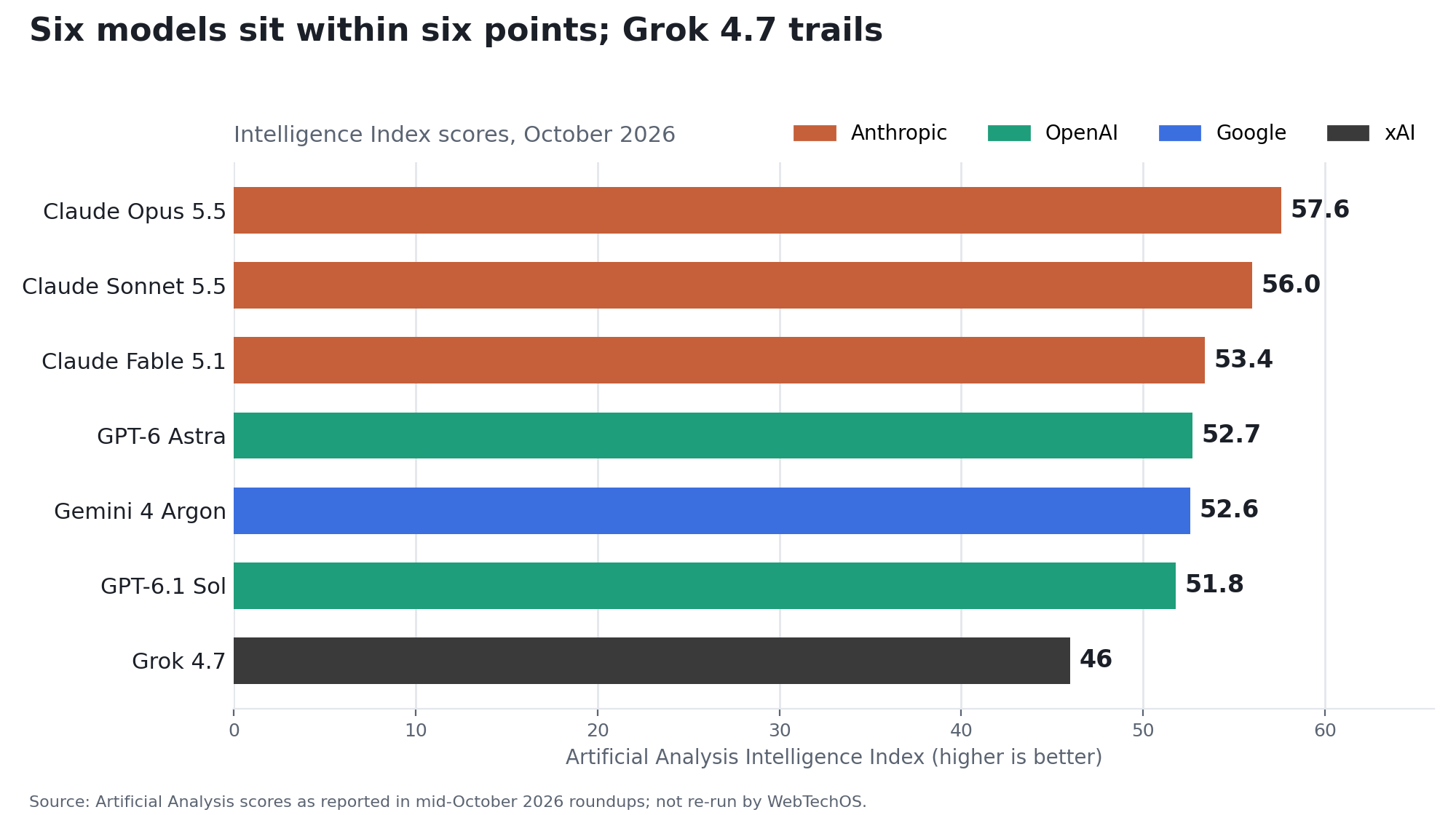
The short answer: no assistant wins every job. On one independent index, the leading models from Anthropic, OpenAI and Google sit within about six points of each other, and Grok 4.7 trails at 46. The choice comes down to your workflow, your ecosystem and what a heavy month costs. Here is how to decide.
A note on method: we did not run our own benchmark for this piece. It combines vendor documentation from Anthropic, OpenAI and Google, independent index scores reported from Artificial Analysis, and hands-on reviewers' reports. Anything we could not verify at the source is labeled as reported, and our own judgment calls are marked as such.
ChatGPT vs Claude vs Gemini vs Grok: Which Should You Choose?
Use this table to shortlist, then read the section behind each row before you pay.
Job | Our pick | Why | Strong alternative |
|---|---|---|---|
Agentic coding and large multi-file changes | Claude (Opus 5.5, Claude Code) | Highest score on the independent index (57.6) and built for long-running agentic work | ChatGPT with Codex |
Everyday assistant with the broadest feature set | ChatGPT | One app covers chat, image creation, voice, Codex and Office add-ins, and it has the lowest cost per index task of the models compared | Gemini |
Teams that live in Google Workspace, plus image and video creation | Gemini | Gemini 4 Argon, Gmail and Drive connections, Chrome, Nano Banana images and Omni video | ChatGPT |
Live news and X conversations | Grok | Direct X search and an $8 entry plan | A search-first assistant |
Very long documents and codebases | Claude, Gemini or ChatGPT | Claude and Gemini advertise 1M-token limits, and Artificial Analysis lists GPT-6 Sol at 1M too; Grok 4.7 stops at 500K | Check app limits per plan |
Lowest monthly cost | Gemini (AI Plus, $4.99) | Cheapest paid tier of the four | ChatGPT Go or Grok Plus ($8) |
If you can fund only one, start with the assistant that already sits next to your documents. Google Workspace companies should lean Gemini. Microsoft 365 companies can pick ChatGPT or Claude, since both ship Office add-ins. Engineering-heavy teams should shortlist Claude first and keep a second model for bulk, price-sensitive work.
ChatGPT vs Claude vs Gemini vs Grok: Latest Models
Six model releases since September 21 reshuffled the field. Here is what each vendor sells today and which tier of the app actually gets it.
Vendor | Current lineup | Newest release | What the app gives you |
|---|---|---|---|
Anthropic (Claude) | Fable 5.1, Opus 5.5, Sonnet 5.5, Haiku 5.5 | Sonnet 5.5 on Sep 28; Opus 5.5 on Sep 22 | Free: Sonnet and Haiku. Opus from Pro. Fable via credits on Pro, within 50% of limits on Max (Claude pricing) |
OpenAI (ChatGPT) | GPT-6 Astra, GPT-6.1 Sol, GPT-6.1 Terra, Luna | GPT-6.1 Terra on Oct 26; GPT-6.1 Sol on Sep 29 | Free and Go run GPT-6 Luna. Plus gets GPT-6 Sol. Extra High reasoning and GPT-6 Pro (Astra) need Pro or Business. GPT-6.1 models are in Work and Codex (OpenAI help center) |
Google (Gemini) | Gemini 4 Argon plus Flash models | Gemini 4 Argon on Oct 13 | Pro and Ultra get Argon in the app. Ultra adds Antigravity, Google's agent-first coding platform (Google announcement) |
xAI (Grok) | Grok 4.7 | Grok 4.7 on Sep 21; new plan family on Oct 12 | The X Subscription: Free, Plus $8, Premium $30, Super $100, Ultra $200. Grok Bot from Premium (plan summary) |
Two things matter more than the version numbers.
First, the number and the name now mean different things. At OpenAI the number marks the generation, while Sol, Terra and Luna are permanent capability tiers, with Astra above Sol. A headline that says "GPT-6" does not tell you which tier you are talking to.
Second, the model that tops a benchmark is rarely the one on a free plan. ChatGPT Free runs Luna, Claude Free runs Sonnet and Haiku, and Gemini keeps Argon for paid tiers. Judge each vendor's free plan by its free model, not by its flagship.
To hear each vendor's own pitch, watch Anthropic's introduction of Claude Opus 5.5 and a Google DeepMind conversation introducing Gemini 4 Argon. Read those alongside the independent numbers below, because a launch video is a sales document.
AI Model Benchmarks Compared
Claude Opus 5.5 leads the Artificial Analysis Intelligence Index at 57.6, Sonnet 5.5 follows at 56.0, and Grok 4.7 is last of the seven models below at 46. The index blends ten evaluations covering reasoning, knowledge, math, coding and agentic work. We did not re-run it. Artificial Analysis's own page confirms Opus 5.5 at 58 and Sonnet 5.5 at 56 among more than 130 models, and the decimals and cost figures here come from mid-October 2026 roundups of its data, such as this one and this leaderboard.
Model | Intelligence Index | Cost to run one index task |
|---|---|---|
Claude Opus 5.5 | 57.6 | $5.98 |
Claude Sonnet 5.5 | 56.0 | — |
Claude Fable 5.1 | 53.4 | $7.63 |
GPT-6 Astra | 52.7 | $3.26 |
Gemini 4 Argon | 52.6 | $1.99 |
GPT-6.1 Sol | 51.8 | $0.72 |
Grok 4.7 | 46 | $3.74 |
The more useful column is the last one. GPT-6.1 Sol scores 51.8 at $0.72 per index task, while Opus 5.5 scores 57.6 at $5.98. That is roughly eight times the cost for about 11% more index score. Gemini 4 Argon sits in between: 52.6 at $1.99, a third of Opus's cost per task for five fewer points.
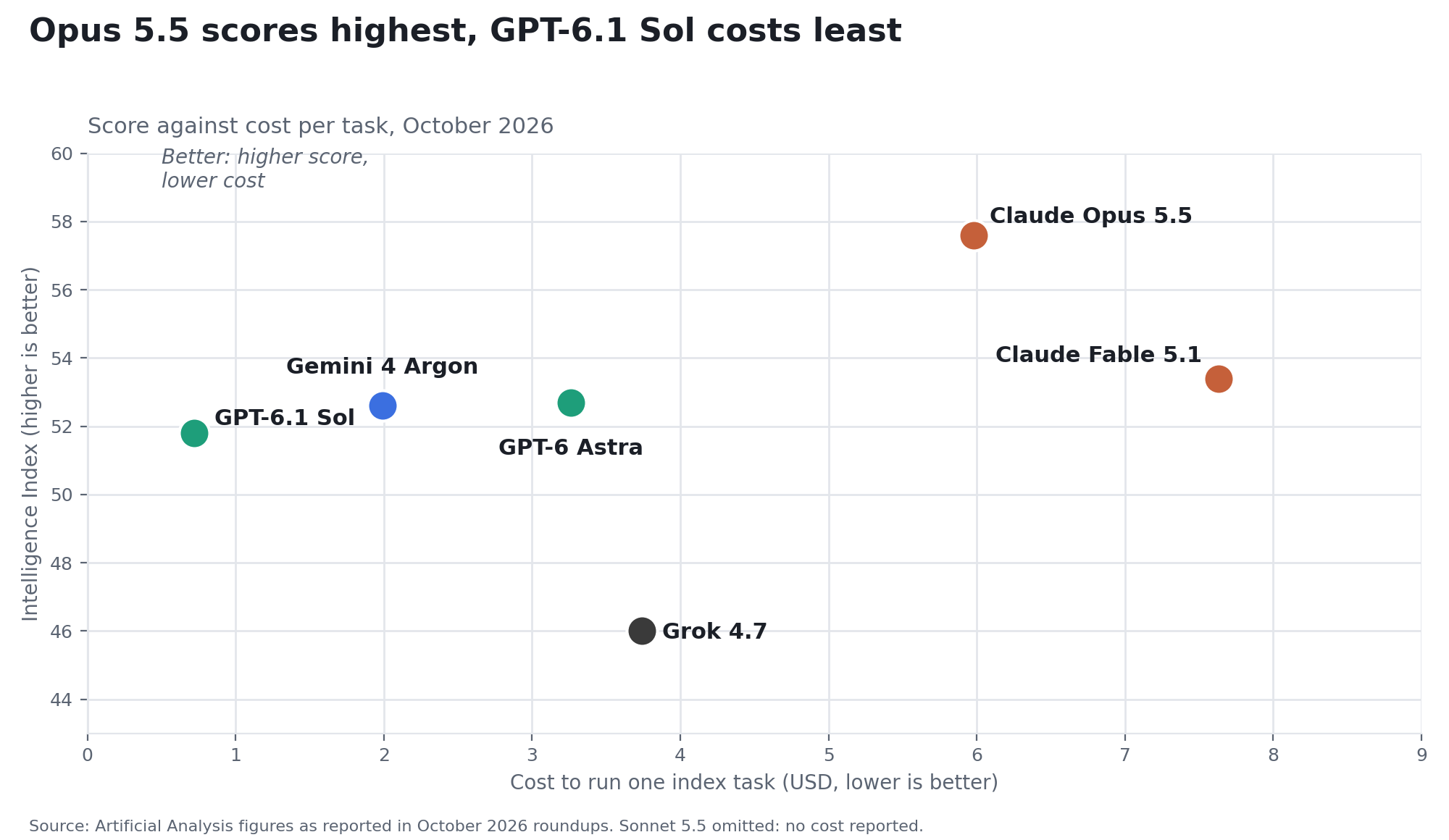
How much those points matter depends on the work. A coding agent that must finish a 40-file refactor without a human nudge benefits from every extra point. A support macro or a meeting summary does not, and there the cheapest tier that clears your quality bar wins.
What the index cannot see
It does not score writing voice, image or video quality, voice mode, how well an assistant plugs into Gmail or Excel, or the model on a free plan. It also hides trade-offs inside the total. One October roundup reports that Argon has the lowest hallucination rate Artificial Analysis has measured, at 15%, yet it answers only 50% of those questions correctly, against 67% for Claude Fable 5.1 (source). Abstaining often and being right often are different strengths.
Vendor benchmarks add a second caution. Google says Argon ranks first on the Vals Index, which is a different test from the one above. Different benchmarks crown different leaders, so treat a gap of a point or two as a tie and decide on your own workload.
The field is also wider than these four vendors. The same index lists Meta's Muse Wonder Full at 56 and Kimi K3.1 Pro at 55, so the top tier is not limited to the assistants compared here.
ChatGPT vs Claude vs Gemini vs Grok: Best Use Cases
A composite score flattens differences that show up on a Monday morning. Here is where each assistant earns its subscription.
1. Coding and agents: Claude leads on capability, ChatGPT on price
Claude is the pick for delegating whole tasks. Anthropic positions Opus 5.5 for long-running agentic coding and knowledge work, and it tops the independent index. Claude Code, the terminal-native coding agent, is included in every paid Claude plan from Pro at $20 a month, and it scores 86/100 in the WebTechOS index. Cursor scores 86 too, but the two start from opposite ends: an AI-native editor versus a coding agent that lives in your terminal.
ChatGPT is the value pick. OpenAI says GPT-6.1 Sol delivers near-Astra intelligence for coding and professional work at one-fifth of Astra's API prices, and Codex now sits inside the ChatGPT app. On the independent numbers above, Sol costs about an eighth as much per task as Opus 5.5 while scoring 51.8 against 57.6.
Gemini and Grok are narrower bets. Argon in Antigravity requires Ultra ($99.99 or more), and Google's headline results, 35% more agentic code submissions and nearly a third fewer rollbacks, are internal Google numbers, not independent tests. Grok 4.7 scores 46 on the index, but the new X Subscription bundles Grok with the AI-native Cursor editor and Grok Build, a terminal agent, from $8 a month.
To see Grok in practice, one independent video tests Grok 4.7 inside Cursor on real coding tasks. Treat any single reviewer's test as an anecdote, not a benchmark.
Whichever you shortlist, test on your ugliest module. What separates coding assistants now is how much of your codebase they can hold, what they are allowed to run and whether a human can review the diff. Models also reach you through other products: GPT-5.6 arrived inside GitHub Copilot at launch, and Cursor's Premium plan bills third-party models at API list price. The model you choose and the product you use are separate decisions.
2. Writing and editing: no clear winner, so test with your own style guide
Writing quality is the hardest thing to benchmark, and the independent evidence is thin. Artificial Analysis recently added AA-PersonalityBench, which rates models on traits such as expressiveness, structure and filler, but it covers only 41 models and its per-model results sit in interactive charts, so check its leaderboard for the models you care about. Until then, every verdict here is partly opinion. Vendors are aiming at it. Google says Argon follows style instructions better than any earlier Gemini model and avoids clichés, and OpenAI's August update to Sol in ChatGPT targeted more direct answers and tighter formatting. Hands-on reviewers still lean Claude for rule-following: Penchan's heavy-use comparison, updated October 14, rates Claude Opus highest for long-form writing and says ChatGPT tends to run long and add sections it was told to skip. That is one reviewer's experience, not a measurement. Google's own launch conversation also covers writing quality and "AI slop" from about the 5:43 mark, which is worth hearing as the vendor's claim.
Raw generation is also the part that general assistants absorbed: dedicated AI writing tools were commoditised, and the remaining value moved to enforcing terminology and approvals. So your rules matter more than the model. Claude and Gemini both support saved skills that carry style instructions between chats. Load your style guide and banned phrases, run the same three briefs through each assistant, and count the minutes of editing each draft needs.
3. Research, real-time information and accuracy
Grok searches X directly, which suits brand monitoring and breaking-news questions, and xAI's developer docs list X search alongside web search. For slower, document-heavy research, all of Claude (Research, from Pro), ChatGPT and Gemini offer deep-research modes, and Claude and Gemini both advertise 1M-token limits for long source material, as does GPT-6 Sol in Artificial Analysis's listing.
None of them is safe to trust unchecked. Penchan reports that Claude, asked to analyze a 30-page PDF, once filled in plausible numbers that were not in the file. The same discipline applies to every assistant here: for anything you will publish, sign or send to a client, ask for the source passage and read it.
4. Images, video and voice: Gemini and ChatGPT lead, Claude sits out
Gemini has the deepest creative stack: Nano Banana for images, Gemini Omni for video, and a Live mode that blends talking and typing. ChatGPT includes image creation and voice, and GPT-6's Intelligent UI can return visuals and interactive elements inside an answer. Grok's Premium tier adds image and video generation through its Imagine tools. Claude has a voice mode and builds slides, docs and designs, but its plan list shows no image or video generation, so creative teams will need a second tool.
OpenAI's introduction of GPT-6 with Intelligent UI shows those interactive answers in action.
5. Working inside your stack
Each assistant has a home turf. Gemini connects to Gmail, Drive and Chrome and lists more than 40 connectable apps. ChatGPT offers Word, Excel and PowerPoint add-ins plus Work and Codex. Claude ships Microsoft 365, Outlook, Chrome and Excel integrations. Grok's home is X, now with Cursor attached.
Customer support is the clearest case where none of the four is the right buy. Purpose-built autonomous customer support agents come with resolution reporting and, increasingly, outcome pricing, which a chat subscription does not. Treat the model as a component there, not the product.
ChatGPT vs Claude vs Gemini vs Grok: Pricing Compared
At the $20 tier the four are nearly identical in price. The differences appear above and below it. All figures are US list prices in USD as of October 28, 2026, and they are changing fast. Local-currency prices, taxes such as GST or VAT, and app-store prices can differ, so confirm on your own region's checkout page.
Vendor | Free | Entry | Standard | Heavy |
|---|---|---|---|---|
Claude | $0 | None | Pro: $20 monthly ($17 billed annually) | Max: $100 (5x Pro) or $200 (20x Pro) |
ChatGPT | $0 | Go: $8, may show ads | Plus: $20 | Pro: $100, $200 or $500 |
Gemini | $0 | AI Plus: $4.99 | AI Pro: $19.99 | AI Ultra: $99.99 (5x Pro) or $199.99 (20x Pro) |
Grok | $0 | Plus: $8 | Premium: $30 | Super: $100 or Ultra: $200 |
Sources: Claude, OpenAI's Pro tiers page for the $100, $200 and $500 plans, and reported pricing for Gemini and Grok. ChatGPT Go and Business prices come from reports quoting OpenAI's pricing page.
Usage is sold as multiples, not message counts
None of the four publishes a fixed number of messages. Claude Max is 5x or 20x Pro. Gemini Ultra is 5x or 20x AI Pro. Grok's Premium, Super and Ultra tiers are 4x, 15x and 50x Plus. ChatGPT Pro tiers are framed against Plus the same way. You cannot compare tiers on paper. Watch how often you hit a limit during a trial month, and upgrade only when you do.
Team seats follow the same pattern. A 10-person team on Claude Team standard seats pays $200 a month billed annually or $250 billed monthly, and ChatGPT Business is reported at the same $20 and $25 per seat. Premium Claude seats cost $100 or $125.
API rates per million tokens
If you build on these models rather than chat with them, price per token matters more than the plan.
Model | Input | Output | Note |
|---|---|---|---|
Claude Haiku 5.5 | $0.10 | $0.50 | For prompts up to 100K tokens; higher above |
GPT-6.1 Terra | $1 | $5 | Reported at launch on Oct 26 |
Claude Sonnet 5.5 | $2 | $10 | 1M-token context |
GPT-6.1 Sol | $2 | $10 | Reported |
Grok 4.7 | $2 | $6 | 500K-token context, reported |
Gemini 4 Argon | $2 | $10 | Introductory through Nov 30, then $4 and $20 |
Claude Opus 5.5 | $4 | $20 | 1M-token context |
Claude Fable 5.1 | $10 | $50 | Top Claude tier |
After Google's introductory period ends on November 30, Argon costs the same as Opus 5.5. Per-token price is also only one input. The reasoning-effort setting changes how many tokens a task burns, which is why the cost-per-task column earlier tells a different story from this table.
How a vendor bills matters as much as the rate. Four billing models are competing to replace the seat, and the one a finance team can forecast usually wins. Ask which unit you are charged for before you compare headline prices.
ChatGPT vs Claude vs Gemini vs Grok: Risks and Limitations
Each AI assistant has its own limitations, from changing model availability and data privacy concerns to inaccurate responses and platform lock-in. Understanding these risks can help you choose a tool that fits your needs beyond performance and pricing.
Models and plans change under you
Model retirement is now routine. OpenAI scheduled GPT-5.4 to shut down on July 23, two weeks after GPT-5.6 reached the public, and its API deprecation schedule moves older GPT-5 models onto the Sol, Terra and Luna tiers. Anthropic publishes retirement commitments: Opus 5.5 will not retire before September 22, 2027, while Opus 5 is already marked legacy. Plans move just as quickly. Grok replaced SuperGrok for new customers on October 12, Google changed what free Gemini accounts can use on October 9, and OpenAI's Pro 200 allowance changes on October 29. Reports also say Google plans to remove its Pro model from the AI Plus tier on November 13, so confirm that with Google before buying that plan for its model.
If you build anything on top of an assistant, put the question in your contract: which model provider is behind this, and what happens if they deprecate it. Get data retention and training terms in writing too, and use the table below to see where each vendor stands.
Your data: all four train on consumer chats by default
On personal plans, every vendor here uses your conversations to improve its models unless you opt out. Business plans are the safer home for client material.
Vendor | Personal plans | Business and API | Watch for |
|---|---|---|---|
Claude | Training is opt-out | Team and Enterprise: off by default | Chats flagged by safety systems may still be used (reported) |
ChatGPT | On by default for Free, Plus and Pro; toggle in Data Controls | Business, Enterprise, Edu and API: off by default | The opt-out covers new chats only; voice has its own control |
Gemini | With Keep Activity on, chats are stored up to 18 months and some are read by human reviewers | Workspace: not human-reviewed or used for training outside your domain without permission | Reviewed chats are kept separately for up to three years, even if you delete your activity |
Grok | "Improve the Model" toggle, reported on by default | xAI's consumer policy does not cover enterprise or API data, so read its business terms | Thumbs up or down after opting out can let xAI use that chat; Private Chat deletes in about 30 days |
Sources: Claude pricing, OpenAI help center, Google's Gemini Apps Privacy Notice and Workspace privacy hub, and Tom's Guide's comparison for Claude's carve-out and Grok.
The working rule is simple. Switch training off on any personal account you use for work, and put client data only on a business or Workspace plan whose contract excludes training. Setting names differ, so check each one at signup.
Confident wrong answers
Every assistant here can fabricate. The failure to watch is not the obvious error but the plausible one: a number that fits the table but is not in the source. Test it directly. Ask each candidate something whose answer is missing from the document you give it, and see whether it abstains or invents.
Lock-in is lower than it looks
Switching costs fell this year. Gemini added a tool to import memories and chat history from other assistants in March, and Claude offers a memory import of its own. That is a reason not to agonize over the first choice: pick one, learn what it gets wrong, and move if a competitor pulls ahead.
Which AI Assistant Works Best for You?
The best AI assistant is not necessarily the one leading the benchmarks. It is the one that handles your tasks accurately, fits your workflow and offers good value.
Before choosing between ChatGPT, Claude, Gemini and Grok, spend a week testing them with real work.
Test Each Assistant With Your Own Tasks
Choose three real tasks. Include work such as coding, document analysis, research or writing. Make sure at least one task is challenging.
Compare similar plans. Test ChatGPT Plus ($20), Claude Pro ($20), Gemini AI Pro ($19.99) and Grok Premium ($30) if you need X integration.
Use identical inputs. Give each assistant the same prompts, files and instructions for a fair comparison.
Score the results. Rate accuracy, instruction-following and editing effort on a scale of 1 to 5.
Check reliability. Ask a question whose answer is missing from the source and see whether the assistant admits uncertainty or invents information.
Track usage limits. Record how often you reach usage caps and whether upgrading would be worthwhile.
Compare Results Before Choosing
If two assistants perform similarly, choose the one that works better with your existing tools.
Gemini suits Google Workspace users, ChatGPT covers a wide range of everyday and creative tasks, Claude is strong in complex coding and document work, and Grok offers direct access to X conversations.
Testing all four standard paid plans for one month costs approximately $89.99, based on US monthly prices. This gives you a practical way to compare their value before committing.
For businesses integrating AI into products, tools like Braintrust can help monitor performance as models change.
The right choice is the assistant that consistently produces accurate, usable results with fewer corrections and reasonable costs.
Questions
Frequently asked questions
Which AI is best overall in 2026?
None wins every job. Claude Opus 5.5 leads the independent index at 57.6, ChatGPT offers the broadest app and the lowest cost per task, and Gemini 4 Argon fits Google-centered teams. Grok 4.7 trails at 46. Pick by workload and by which ecosystem you already use.
Is Claude better than ChatGPT?
For long agentic coding and big multi-file tasks, the evidence favors Claude. For everyday breadth (image creation, voice, Codex inside the app) and price per task, ChatGPT has the edge. For writing, the independent evidence is thin, so test both on your own briefs.
Is Gemini better than ChatGPT for Google Workspace users?
Usually yes for integration, because Gemini connects to Gmail and Drive and ships in Chrome. Note that Gemini 4 Argon is limited to AI Pro and Ultra, so the free and Plus tiers do not get Google's newest model.
Is Grok worth paying for?
Only if live X conversation is central to your work or you want its bundled Cursor and Grok Build tools. On the independent index it scores 46, well below the other three, and Grok Bot starts at the $30 Premium tier.
Which assistant has the best free plan?
ChatGPT's free plan gives unlimited everyday text chats on GPT-6 Luna, though images, voice and uploads have separate limits. Claude's free plan runs Sonnet and Haiku but excludes Claude Code and Research. Reports say Gemini's free plan was cut to its lightest model on October 9, and Grok's free tier is limited. Judge each by its free model, not its flagship.
Which is best for coding?
Shortlist Claude (Opus 5.5 with Claude Code) for delegating whole tasks and ChatGPT with Codex for value. Gemini's best coding tools sit behind the Ultra tier. Test on your largest, messiest module.
Can I use more than one?
Yes, and many teams do. A $20 tier from two vendors costs less than one heavy plan. Cursor's Premium plan also bills third-party models at API list price, so the product and the model are separate choices.
Do these assistants train on my chats?
On personal plans, yes by default, unless you opt out. ChatGPT, Claude and Grok offer a training toggle, and Gemini ties it to its Keep Activity setting, which also lets human reviewers read a subset of chats. Business, Enterprise and Workspace plans exclude training by default, though Grok's business terms need checking. The data table above has the detail.
How often should I re-evaluate?
Whenever a vendor ships a new tier or changes a plan, and at least quarterly. Six model releases landed in five weeks this autumn, so a choice made in August was already out of date by October.
Conclusion
The four assistants are closer than their marketing suggests, and the real differences are practical. Claude leads the independent index and makes the strongest case for delegating long coding tasks. ChatGPT is the broadest and cheapest to run per task. Gemini is the natural choice if Google is where your work lives, and Grok is a specialist for X-driven work that trails on general capability.
Your next step is not to crown a winner. Run the one-week bake-off on a real task, keep your style guide and prompts portable, and plan to repeat the test in a quarter. By then at least one of these vendors will have changed its lineup again, and the assistant that fits your work today should be the one you can still justify then.
WebTechOS accepts no payment for coverage, placement or scores. Where a piece references pricing, it reflects published list rates at the date shown.
Keep reading
All insights →ChatGPT vs Claude: An Honest Comparison After Testing Both
I tested ChatGPT and Claude on editing, research, coding, document analysis, and long-form writing. See where each one led and where both made mistakes.
Grok 5 vs Claude: Is It Worth Switching?
Grok 5 isn't out yet. See how Grok 4.7 compares with Claude on independent benchmarks, cost per task, coding and plans.
I tested dozens of free SEO AI tools in 2026
Free SEO AI tools often stop after a few searches or hide the good features behind a paid plan. See what each free plan includes and where the limits are.
Discord pricing 2026: Free vs Nitro Basic
Discord Free, Nitro Basic or Nitro? A plain 2026 comparison of prices, upload limits and perks, so you can pick a plan without overpaying.