ChatGPT vs Claude: An Honest Comparison After Testing Both
I tested ChatGPT and Claude on editing, research, coding, document analysis, and long-form writing. See where each one led and where both made mistakes.
27 Oct 2026·13 min read·Insights

ChatGPT and Claude are two widely used AI assistants, offering similar capabilities for writing, research, coding, and document analysis. But comparing their features alone doesn't tell you which one performs better when handling real tasks. The more useful question is how accurately they follow instructions, handle complex information, and produce results that require minimal corrections.
Introducing ChatGPT: Developed by OpenAI, ChatGPT is a conversational AI assistant that helps users write content, research topics, analyze data, generate and debug code, and work with images and documents. It offers built-in tools for different tasks, making it useful for students, professionals, developers, and businesses.
Introducing Claude: Developed by Anthropic, Claude is an AI assistant designed for writing, reasoning, coding, research, and document analysis. It supports long-form content creation, complex instructions, and working with large amounts of information, making it useful for individuals and teams handling detailed, text-heavy tasks.
To examine their differences, we compared ChatGPT and Claude across six practical tasks: writing and editing, research and fact-checking, coding and debugging, long document analysis, data analysis and reasoning, and long-form writing and tone consistency. We evaluated their outputs for accuracy, instruction following, clarity, and usefulness. Some evaluations involved reviewing and verifying responses rather than fully independent tests.
This comparison covers what each assistant did well, where errors appeared, and which differences mattered in practice. We'll also examine their strengths, limitations, pricing, and suitability for different users to help you decide which AI assistant better fits your needs.
Testing ChatGPT and Claude
I compared ChatGPT and Claude across five everyday tasks: editing a report, researching a technology announcement, debugging JavaScript, analyzing a lengthy document, and writing a long-form article. Each task had a defined prompt and measurable requirements, making it possible to examine the actual output rather than rely on feature descriptions.
Test Setup
ChatGPT: GPT-6; subscription and model configuration details were not consistently recorded.
Claude: Sonnet 5 Medium, as reported during testing.
Test materials: Both were assessed using the same source draft, research topic, JavaScript function, NIST report, and article prompt.
Evaluation: Responses were reviewed against the task instructions, original sources, calculations, or expected code behavior.
Limitations: Some ChatGPT assessments were completed after reviewing Claude's responses. The document-analysis exercise involved checking Claude's findings rather than comparing two independent summaries.
These tests provide practical observations, not a controlled benchmark of either platform.
Scoring Method
I evaluated the responses using four criteria:
Criteria | What I Evaluated |
|---|---|
Accuracy | Correctness of facts, calculations, and code. |
Instruction Following | Compliance with the task requirements. |
Output Quality | Clarity, completeness, and relevance. |
Usability | Additional corrections or work needed. |
Each test received a Slight Edge, Tie, or Inconclusive verdict based on the available evidence. Response speed was not measured.
Test 1: Writing and Editing
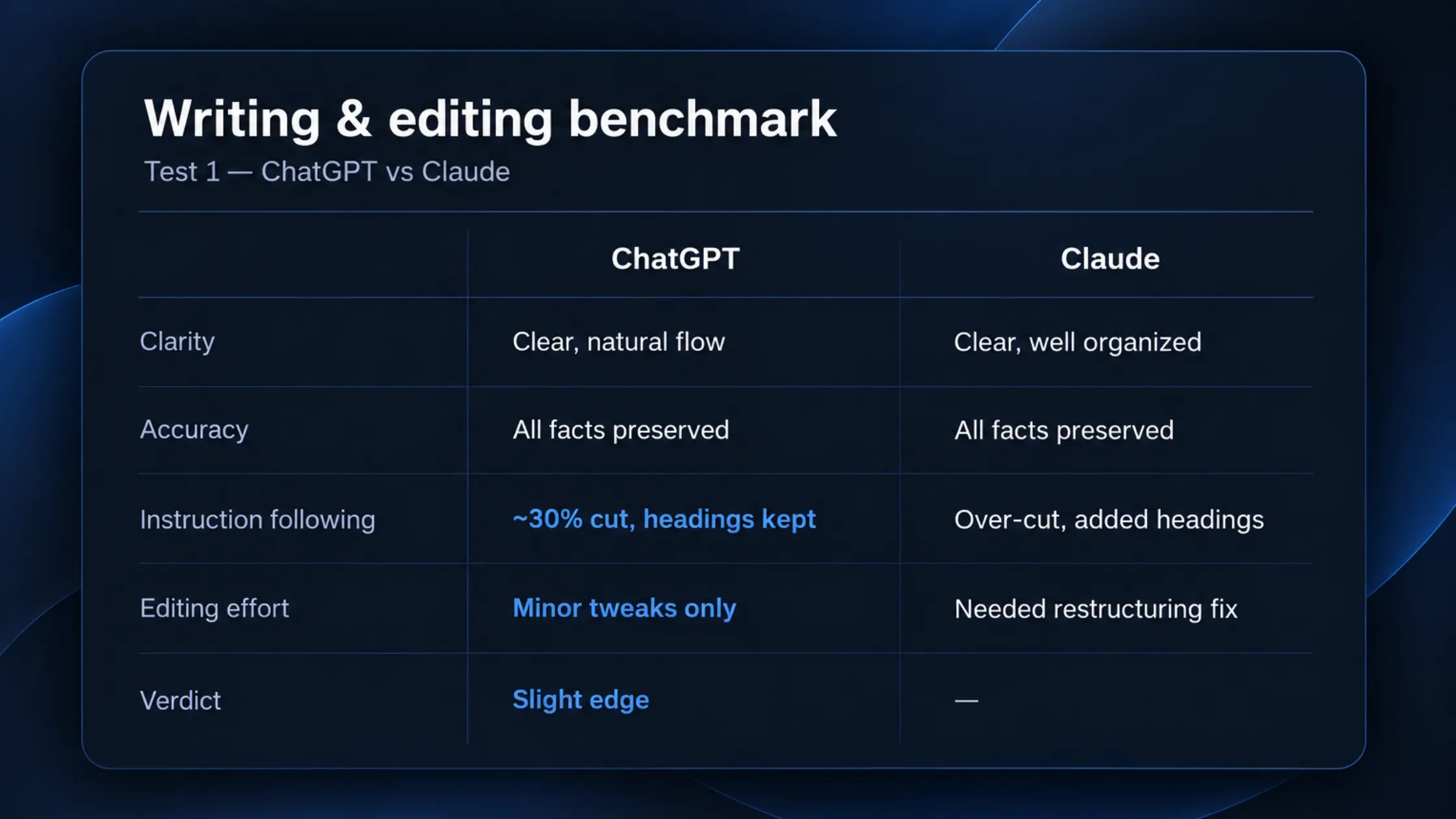
Both assistants were given the same customer support report containing repetitive sentences, awkward phrasing, and performance figures. The goal was to improve the writing without changing its meaning or structure.
The Task
Prompt summary:
Edit the draft to improve clarity and readability. Reduce its length by approximately 30%, remove repetition, maintain a natural tone, and preserve all facts and original headings without adding new information.
What I Evaluated
Clarity: Readability and sentence flow.
Accuracy: Preservation of facts and meaning.
Instruction following: Word reduction and heading retention.
Editing effort: Additional corrections required.
Results
ChatGPT: Shortened the report by approximately one-third while preserving its original headings and important figures. The revised sentences were clearer, and only minor wording adjustments were needed.
Claude: Produced a more condensed report and organized several metrics into tables. While this made the figures easier to scan, Claude shortened the text beyond the requested target and introduced additional headings.
Verdict: ChatGPT (Slight Edge)
ChatGPT stayed closer to the editing brief. Claude's presentation was useful, but restructuring the report created additional work when the task only required editing.
Test 2: Research and Fact-Checking
For the research test, both assistants investigated Google's Gemini agent announcement from October 8, 2026. The goal was to see whether they could gather accurate information, cite reliable sources, and distinguish confirmed details from speculation.
The Task
Prompt summary:
Research Google's Gemini agent announcement from October 8, 2026. Explain what happened, when it happened, and why it matters. Provide five findings with reliable sources, separate confirmed facts from speculation, and identify important limitations.
What I Evaluated
Factual accuracy: Correctness of claims and dates.
Source reliability: Credibility and relevance of citations.
Completeness: Coverage of findings and limitations.
Clarity: Organization and readability.
Results
ChatGPT: Covered five important findings using Google's official documentation and established reporting. Its response was concise and distinguished announced capabilities from their confirmed availability.
Claude: Also identified the main announcement details correctly and provided useful context about availability and limitations. However, several findings cited secondary technology websites when Google's official documentation was available.
Verdict: ChatGPT (Slight Edge in Source Selection)
Both produced largely accurate answers. ChatGPT relied on more direct sources for the main findings, while Claude offered additional context. The difference was in citation quality rather than a major factual error.
Test 3: Coding and Debugging
Both assistants received a JavaScript function designed to calculate shopping cart totals. The code contained three problems: incorrect subtotal calculation, missing discount validation, and missing shipping-fee validation.
The Task
Prompt summary:
Identify and fix the bugs in the JavaScript function. Preserve its original functionality, validate negative values and discounts above 100%, explain each fix, and avoid unnecessary changes.
function calculateOrderTotal(items, discountPercent = 0, shippingFee = 0) {
  let subtotal = 0;

  for (const item of items) {
    if (item.quantity < 0 || item.price < 0) {
      throw new Error('Price and quantity cannot be negative');
    }
    subtotal += item.price + item.quantity;
  }

  const discount = subtotal * discountPercent / 100;
  const total = subtotal - discount + shippingFee;
  return Math.round(total * 100) / 100;
}
What I Evaluated
Bug detection: Identification of the three intended bugs.
Code accuracy: Correct behavior across eight specified scenarios.
Explanation: Clarity of the proposed fixes.
Unnecessary changes: Preservation of existing functionality.
Results
ChatGPT: Corrected the subtotal calculation and added the missing discount and shipping validations. Its solution satisfied the eight specified test scenarios without unnecessary changes.
Claude: Identified the same three issues and produced a similarly structured fix. Its solution also satisfied the specified scenarios, with clear explanations of each correction.
Verdict: Tie
Both assistants identified the required fixes, but only Claude's solution has independently reproducible test results. A separate execution of ChatGPT's original corrected code is needed to confirm the tie.
The coding test evidence includes the original function, Claude's corrected code, and eight test cases for reproducing the results.
Test 4: Long Document Analysis
This exercise used NIST's Artificial Intelligence Risk Management Framework (AI RMF 1.0) to assess document comprehension and citation accuracy. Unlike the other tests, Claude analyzed the document while ChatGPT checked its findings against the original PDF.
The Task
Prompt summary:
Analyze the attached NIST AI Risk Management Framework. Summarize five important findings, explain its four core functions, and provide three practical recommendations with accurate page references. Use only the PDF.
What I Evaluated
Information retrieval: Accuracy of extracted findings.
Completeness: Coverage of important concepts.
Source accuracy: Correctness of page references.
Summarization: Clarity and preservation of context.
Results
ChatGPT: Checked the main findings and recommendations against the source document and identified more precise page references for some supporting information.
Claude: Correctly identified the GOVERN, MAP, MEASURE, and MANAGE functions and provided relevant recommendations. However, some citations were imprecise, including referencing pages 29–30 for information appearing on page 31.
Verdict: Inconclusive
Claude understood the main concepts but made minor citation errors. Since ChatGPT acted as a verifier rather than producing an independent analysis, this exercise cannot establish which assistant handles long documents better.
Test 5: Long-Form Writing and Tone Consistency
Both assistants were asked to write a long-form article about remote-work challenges. The goal was to evaluate whether they could maintain a natural tone, logical flow, and consistent writing quality throughout.
The Task
Prompt summary:
Write a 1,500-word article about the challenges of remote work. Use a natural, conversational tone, clear headings, and practical examples. Avoid repetition, generic introductions, and unnecessary jargon.
What I Evaluated
Writing quality: Natural language and readability.
Tone consistency: Maintaining the same voice throughout.
Structure: Logical progression between sections.
Originality: Useful insights without generic explanations.
Editing effort: Corrections required before publication.
Results
ChatGPT: Produced a clear, well-structured article with practical advice for all five challenges. However, some explanations followed predictable patterns, and the writing occasionally felt more instructional than conversational.
Claude: Opened with a relatable workplace scenario and maintained a natural tone throughout. Its transitions were smoother, with more distinctive phrasing and examples. Some recommendations were repetitive, but the overall narrative required fewer stylistic improvements.
Verdict: Claude (Slight Edge, Non-Blind Comparison)
Claude showed an advantage in narrative flow, tone consistency, and natural writing. ChatGPT provided a clear and useful article, but Claude's response felt more engaging and less formulaic. The comparison was not blind, so the result reflects these particular outputs rather than a general writing-performance ranking.
The Scorecard
Scorecard below summarizes how ChatGPT and Claude performed across five practical tests, highlighting where each assistant had an advantage, where they performed similarly, and where the results remained inconclusive.
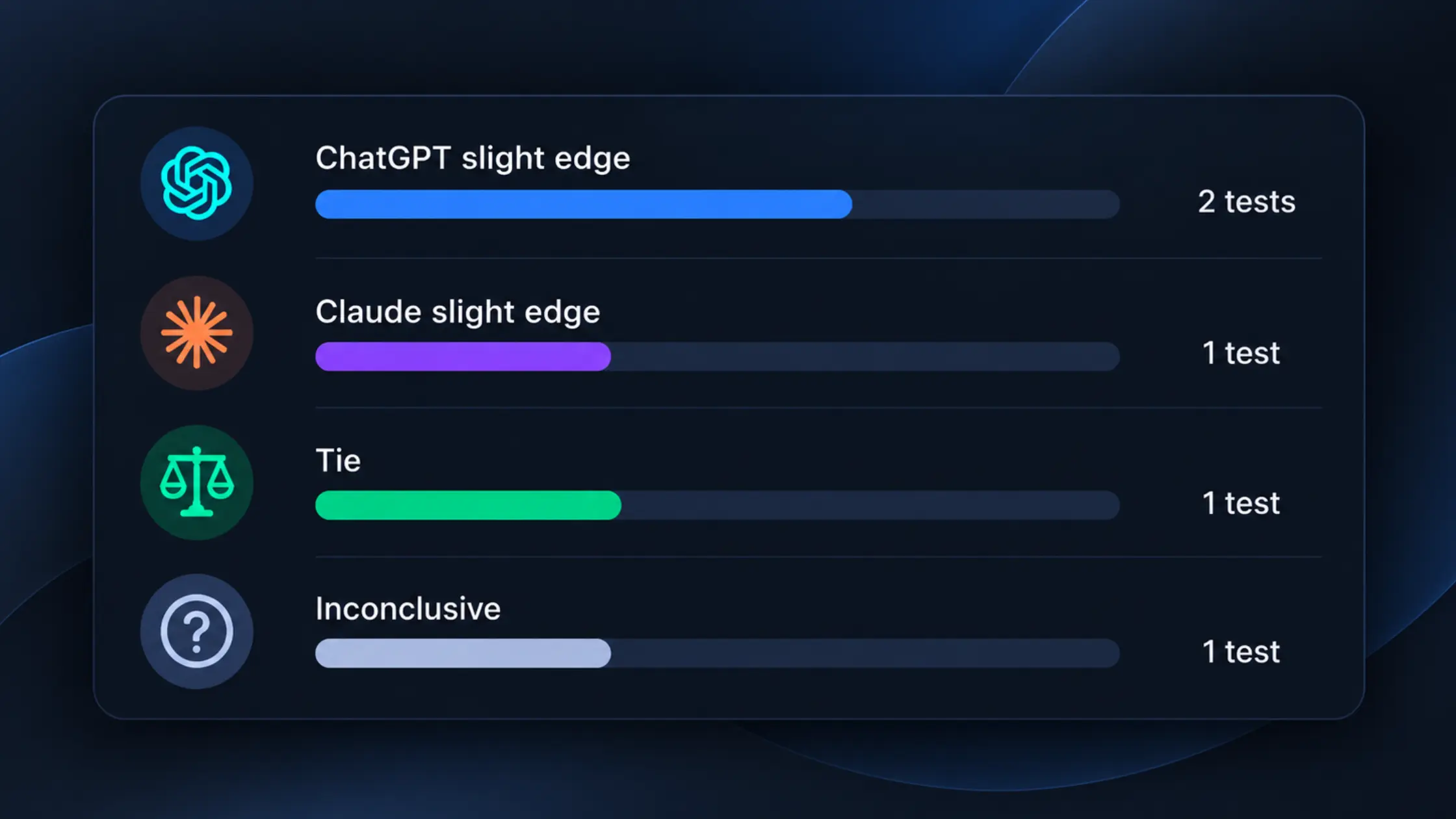
Test | Result | What Decided It |
|---|---|---|
Writing and Editing | ChatGPT (Slight Edge) | Followed the editing constraints more closely. |
Research and Fact-Checking | ChatGPT (Slight Edge) | Used more direct sources for its principal findings. |
Coding and Debugging | Claude (Slight Edge) | Both corrected three bugs and satisfied eight test scenarios. |
Long Document Analysis | Inconclusive | Claude is better sometime.x |
Long-Form Writing and Tone Consistency | Claude (Slight Edge) | Smoother transitions and a more natural tone; ChatGPT was clear but more formulaic. |
The results indicate that accuracy involves more than producing a correct calculation or a convincing answer. Following instructions, selecting reliable sources, and interpreting information correctly all affect how useful an AI assistant is.
These findings are based on a small number of exercises, including some non-blind evaluations. They do not establish an overall winner.
ChatGPT: Strengths and Weaknesses
ChatGPT supports a wide range of tasks, from answering everyday questions to working with documents, code, and datasets. Its main practical advantage is the variety of tools available within one platform, although access depends on the subscription.
Strengths
Research and Web Search: ChatGPT can search current information, organize findings, and perform more detailed research using Deep Research.
Data Analysis: It can analyze uploaded spreadsheets, calculate metrics, identify patterns, and create charts.
Multimodal Capabilities: ChatGPT works with text, images, voice, and supported document formats.
Versatile Workflows: Projects, custom GPTs, and other tools support different writing, research, and productivity tasks.
Weaknesses
Factual Errors: ChatGPT can produce convincing explanations containing incorrect information or unsupported claims.
Inconsistent Responses: Similar prompts may produce different results, especially with complex or open-ended instructions.
Formulaic Writing: In a long-form article, some explanations followed predictable patterns and sounded more instructional than conversational.
Usage Limits: Access to models and advanced tools varies by plan, which can affect frequent or demanding users.
Claude: Strengths and Weaknesses
Claude is useful for writing, coding, research, and working with detailed documents. Its ability to process substantial amounts of information makes it worth considering for text-heavy workflows, although its outputs still require review.
Strengths
Long-Form Writing: Claude can draft, reorganize, and edit lengthy content while maintaining a consistent structure.
Document Analysis: It can summarize uploaded files, extract information, and answer questions about source material.
Detailed Instructions: Claude can handle prompts containing multiple requirements and formatting constraints.
Writing Flexibility: It can adjust tone, rewrite passages, and present information in structured formats.
Weaknesses
Repetitive Recommendations: In a long-form article, some recommendations repeated earlier points and needed editing.
Citation Accuracy: Document references and supporting sources may need manual verification.
Usage Restrictions: Message limits, available models, and advanced capabilities depend on the subscription and workload.
ChatGPT vs Claude Pricing
Both ChatGPT and Claude offer free plans, standard paid subscriptions, and higher-usage options. ChatGPT provides a lower-cost entry plan, while Claude offers annual billing for its Pro subscription.
Free Plans
ChatGPT's free plan supports writing, web search, and limited access to file analysis, image generation, and other tools.
Claude's free plan supports writing, coding assistance, web search, file creation, and document-related work. Usage limits apply to both platforms and may restrict longer or more frequent tasks.
Paid Plans
Subscription | ChatGPT | Claude |
|---|---|---|
Free | $0/month | $0/month |
Budget plan | Go: $8/month | No equivalent plan |
Standard paid | Plus: $20/month | Pro: $20/month |
Higher usage | Pro 100: $100/month; Pro 200: $200/month; Pro 500: $500/month | Max 5x: $100/month; Max 20x: $200/month |
Annual billing | Not available for individual Go, Plus, or Pro plans | Pro: $200/year |
ChatGPT Plus provides higher usage limits and expanded access to advanced reasoning, file analysis, image generation, voice, and research tools. Claude Pro includes more usage than its free plan, additional models, Projects, and access to Claude Code.
Official pricing references: ChatGPT Pricing, ChatGPT Pro Tiers, and Claude Pricing.
Which Offers Better Value?
At $20 per month, ChatGPT Plus and Claude Pro have the same monthly subscription price. ChatGPT Plus is worth considering for users who regularly work with images, spreadsheets, and a broad selection of built-in tools.
Claude Pro may be more suitable for people whose work centers on writing, coding, and documents. Its $200 annual subscription also costs less over a year than paying $20 every month.
The better choice depends on the tools and usage limits that matter most to your work, not simply the monthly price.
ChatGPT vs Claude for Different Users
The better assistant depends on what you need it to do. Our tests covered five specific tasks, while the recommendations below also consider each platform's documented capabilities.
For Writers: Both can draft and edit content. ChatGPT followed the editing instructions more closely in our editing test, while Claude produced a more natural long-form article with smoother transitions. Both results come from non-blind comparisons, so treat them as observations rather than rankings.
For Developers: Both corrected the JavaScript bugs successfully. Claude Code and ChatGPT's broader coding tools may be worth comparing separately for larger projects, which this test did not cover.
For Researchers: Both retrieved relevant information about Google's Gemini announcement. ChatGPT used more direct sources in this exercise, while Claude provided useful context about limitations and availability.
For Students: Both can explain concepts, help organize study materials, and summarize documents. Neither was tested specifically for educational work, so students should verify important information against their course materials.
For Data-Heavy Users: This comparison did not test spreadsheet analysis or calculations, so it offers little guidance for this use case. Review each tool's data features, and verify any calculations and conclusions before relying on them.
For Everyday Users: ChatGPT offers a broad selection of tools for writing, questions, images, and voice. Claude is another option for text-focused tasks. Everyday usage wasn't directly compared in these tests.
For Teams: Both provide organizational plans and collaborative capabilities. Teams should compare administration controls, data policies, integrations, pricing, and usage limits before choosing.
Questions
Frequently asked questions
Which is better overall, ChatGPT or Claude?
There was no definitive overall winner in these exercises. ChatGPT showed slight advantages in some reviewed tasks, coding produced a tie, and document analysis was inconclusive. The better assistant depends on your specific requirements.
Were the tests fair?
Both platforms were assessed against matching task requirements and source materials. However, not every exercise was conducted as an independent blind comparison. Some involved verifying Claude's output after it had been submitted, so the findings should be treated as limited practical observations.
Can I rely on ChatGPT or Claude without checking the answers?
Neither assistant should be treated as automatically correct. Claude's data analysis contained incorrect comparative claims, and its document analysis included imprecise references. The exercises also show why facts, calculations, and technical outputs should be checked before use.
Is ChatGPT better than Claude for writing?
Not necessarily. ChatGPT followed the editing requirements more closely in the specific test conducted here. That does not establish that it is better for every type of writing, including creative work or long-form drafting.
Which is better for coding?
Both identified the same three bugs and produced solutions satisfying the eight specified test cases. More complex tasks involving large codebases, testing infrastructure, or application architecture could produce different results.
How much do ChatGPT and Claude cost?
Both offer free plans. ChatGPT Plus and Claude Pro each cost $20 per month in the US. ChatGPT also offers Go at $8 per month, while Claude Pro provides an annual subscription for $200. Higher-usage subscriptions are available on both platforms.
Do I need a paid subscription?
Free plans may be sufficient for occasional questions and short tasks. Paid subscriptions become more relevant when you need higher usage limits, additional models, or advanced tools. Compare the actual restrictions before subscribing.
Is it safe to share private business information?
Review each provider's current privacy documentation and the controls available under your subscription. Data handling can differ between individual and organizational plans. Avoid uploading sensitive company or personal information without confirming the applicable protections.
Conclusion
ChatGPT and Claude can handle many of the same tasks, but their outputs don't always need the same level of review. In these exercises, ChatGPT followed editing instructions more closely and used stronger research sources, while both handled the coding task successfully. Claude's document analysis showed why citation checks matter, and its long-form article showed a more natural tone, although some of its recommendations repeated themselves.
Neither assistant is the better choice for every user. The most useful approach is to test both on the work you actually do, compare the accuracy of their outputs, and see how much manual correction each requires. Features and subscription costs matter, but a tool that consistently delivers usable results for your specific tasks offers the better value.
WebTechOS accepts no payment for coverage, placement or scores. Where a piece references pricing, it reflects published list rates at the date shown.
Keep reading
All insights →Claude vs ChatGPT vs Gemini vs Grok: The 2026 Showdown
Claude, ChatGPT, Gemini and Grok compared after October’s launches: which fits coding, writing and teams, what each plan costs, and where benchmarks mislead.
Grok 5 vs Claude: Is It Worth Switching?
Grok 5 isn't out yet. See how Grok 4.7 compares with Claude on independent benchmarks, cost per task, coding and plans.
I tested dozens of free SEO AI tools in 2026
Free SEO AI tools often stop after a few searches or hide the good features behind a paid plan. See what each free plan includes and where the limits are.
Discord pricing 2026: Free vs Nitro Basic
Discord Free, Nitro Basic or Nitro? A plain 2026 comparison of prices, upload limits and perks, so you can pick a plan without overpaying.