Best 7 Tidio alternatives in 2026
Tidio bills three separate meters and caps self-serve teams at 10 seats. Compare 7 Tidio alternatives on real 2026 pricing, AI and live chat.
12 Sept 2026·20 min read·General
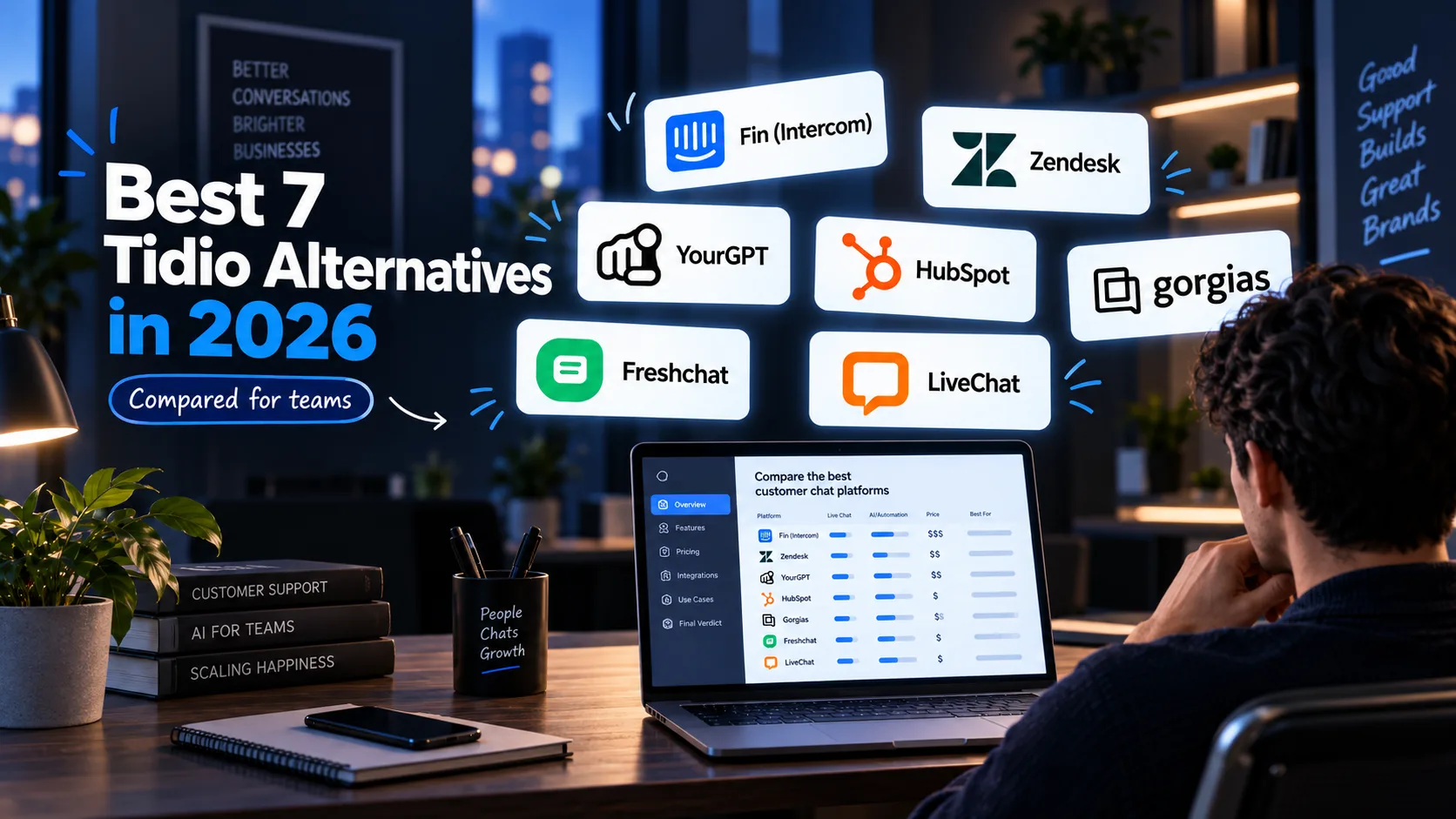
Tidio is easy to like in the first month and hard to price after that. The plan on the pricing page is one number. The bill is three: billable conversations, Lyro AI conversations and Flows visitors, each with its own quota and its own add-on. Self-serve stops at 10 seats, and the step up from Growth is a jump to $300 a month plus usage. If that is the wall you have hit, or you need an AI agent that does more than answer from a help centre, these are the seven alternatives worth a shortlist slot in 2026.
Prices below are published list rates on annual billing, checked on 28 September 2026 unless we say otherwise. Where a tool is in our index we give its WebTechOS score. Where it is not, we say so rather than invent one.
In short: no single tool replaces everything Tidio does, so pick by the job. Fin (formerly Intercom) suits teams that want a full suite and will pay per resolution. Zendesk wins on ticketing depth. YourGPT is the closest all-round replacement on a flat monthly plan for teams that don't need deep ticketing. HubSpot gives you free chat on top of a CRM. Gorgias is the pick for Shopify stores, Freshchat for the biggest free seat count, and LiveChat for sales-led chat teams.
Why look for a Tidio alternative?
Tidio earns its reputation: the free plan is real, setup takes an afternoon, and the Shopify tooling goes deeper than most rivals. The reasons teams leave are specific, and worth knowing before you start comparing.
1. Three meters, one bill. A billable conversation only counts when a human agent replies, which is a fair rule. But Lyro (the AI agent) and Flows (the scripted automations) are metered separately. On annual billing, the entry Lyro add-on starts at $32.50 a month for 50 conversations, the Flows add-on at $24.17 for 2,000 visitors reached, and removing Tidio branding on Growth is another $16.67. Stack the smallest of each on Growth at $49.17 and you are at $122.51 a month before a single extra conversation. That is our arithmetic from the published starting prices, and it assumes the add-ons combine the way Tidio's FAQ describes. It is not a scandal. It is also not the $24 headline. This stacking of small meters is the pattern behind the agent pricing reckoning we wrote about earlier this year.
2. The free Lyro allowance does not renew. Every account gets 50 Lyro conversations once. Getting a monthly Lyro quota means buying the AI add-on, so a store that tested Lyro on the free plan hits the ceiling faster than expected.
3. Ten seats, then a cliff. Self-serve plans allow up to 10 agents. Past that, or past 2,000 billable conversations, you move to Plus at $300 a month plus usage, with no self-serve tier in between.
4. The only contractual AI number sits at the top. Tidio advertises that Lyro solves up to 67% of customer problems. The one figure it will put in a contract, a guaranteed 50% Lyro resolution rate with pay-per-resolution billing, belongs to Premium, which is quote-only.
None of this makes Tidio the wrong tool for a small store that wants live chat this week. It does explain why the question "what else is there?" keeps coming up.
Quick glance
Platform | Best for | Starting price | How AI is billed | WebTechOS score |
|---|---|---|---|---|
Fin (Intercom) | Full support suite with an AI resolution agent | $29/seat/mo | $0.99 per resolution | 83/100 |
Zendesk | Ticketing depth with live chat and AI agents | $19/agent/mo (chat and AI agents from $55) | Per automated resolution | 80/100 |
YourGPT | One AI agent across many channels, flat plans | $39/mo (Professional, $79, unlocks actions) | Credits included in the plan | 86/100 |
HubSpot | Free chat on a CRM record | $0 for up to 2 users | HubSpot Credits, $0.01 each after the allowance | 82/100 |
Gorgias | Shopify and ecommerce support | About $10/mo for 50 tickets | Per AI resolution, around $1 | Not yet indexed |
Freshchat | Biggest free tier, up to 10 agents | Free; Growth $19/agent/mo | Freddy AI: $49 per 100 sessions | Not yet indexed |
LiveChat | Live chat for sales-led teams | $19/person/mo | AI Agent sits in the separate Text product | Not yet indexed |
What a Tidio replacement actually has to cover
Tidio is four products under one widget: live chat with a shared inbox and ticketing, Lyro for AI answers, Flows for scripted and proactive messaging, and native Shopify actions on Growth and above. Almost nothing on the market matches all four, so the useful split is between full replacements and specialists.
Closest to a full replacement: YourGPT, Freshchat, Fin, Zendesk and HubSpot each cover live chat, an inbox and an AI agent, with different strengths on top.
Specialists: Gorgias is built around ecommerce order work. LiveChat is built around the human side of chat, with AI added through a separate product.
Whichever you shortlist, test the same three things: one question answered from your help content, one request that needs a system lookup or change, and one conversation that has to reach a person with its context intact. It matters more than any feature grid, and it lines up with what we found when support metrics moved past deflection: the handoff is where deployments succeed or fail.
1. Fin (formerly Intercom)
Intercom renamed itself Fin in May 2026 to match its AI agent, and Salesforce completed its acquisition of Fin on September 10. What you buy is still a full support workspace (Messenger, Inbox, Tickets, Help Center) with Fin as the AI layer, answering across chat, email, WhatsApp, SMS, voice and Slack. Fin publishes an average resolution rate of 76% across its customers, and Fin Procedures handle multi-step requests with conditions and tool calls, which goes well past what Tidio's Flows can do.
Our Intercom review still scores it 83/100. The ownership change is the new variable: pricing, packaging and roadmap will move over the next few quarters more than they would at an independent vendor.
That per-resolution model rewards a team that actually gets Fin working and penalizes one that doesn't: the fee only lands on a successful outcome, unlike Tidio's flat monthly add-on that keeps charging whether Lyro resolves anything or not. Three seats on Essential already runs $87 a month before Fin resolves a single conversation, so the entry cost sits well above Tidio's Growth tier before AI enters the picture at all. Whether Salesforce's ownership changes the roadmap in the buyer's favor or its own is still an open question this early into the acquisition, and worth watching before locking into a multi-year contract. Ask directly about contract length and price-lock terms before signing, given how recently the ownership changed.
Beats Tidio when: the team has outgrown a widget and wants a mature support suite with an AI agent that reasons through multi-step requests.
Tidio wins when: volume is low and unpredictable. Per-resolution billing punishes spikes, and Tidio's free and Starter tiers cost far less to sit on.
Pros
Full helpdesk and AI in one workspace, with clean escalation to a human
Procedures and data connectors for actions beyond answering questions
The highest published resolution rate in this list, at 76% on Fin's own customer base
Deep integration options across Salesforce, Shopify, Slack, Stripe and HubSpot
Cons
Seat fees and per-resolution charges are two cost drivers that grow independently
No free tier
Fresh under Salesforce ownership, so pricing and roadmap priorities may shift
A bigger implementation than a widget swap
Pricing: Essential $29, Advanced $85, Expert $132 per seat a month, plus $0.99 per Fin resolution. Three seats on Essential is $87 a month before any resolutions. If you are weighing it against an agent-first platform, our YourGPT vs Intercom comparison runs the two head to head.
2. Zendesk
Zendesk is what many teams move to when Tidio's inbox stops being enough. Live chat and AI agents start on Suite Team at $55 per agent a month; the $19 Support Team tier is email and ticketing only. AI agents are included in every plan, but billed on outcomes: you pay per automated resolution, roughly $1.50 to $2.00 depending on commitment, and the Copilot add-on for agent assistance is another $50 per agent a month on Professional and above. We worked through that math in our Zendesk AI alternatives roundup.
Our Zendesk review scores the platform 80/100: excellent routing, reporting and marketplace depth, with AI pricing that grows in three directions at once.
That "three directions" is the real complexity: seat cost, Copilot cost and resolution cost move independently, so a team that adds headcount and automation at the same time sees all three lines climb together rather than one offsetting another. Compare that to Tidio, where the equivalent stack, tickets, Lyro and Flows, is at least confined to three named meters rather than an open-ended per-resolution fee with no visible ceiling. Zendesk earns the switch when ticketing and routing depth is the actual bottleneck, not when live chat with some AI on top would do. For a team under a dozen agents, the jump from Tidio's $49 Growth tier to Zendesk's $55-per-seat Suite Team is a materially bigger monthly commitment before any AI usage is even added.
Beats Tidio when: you need real routing, SLAs, skills-based assignment and reporting, with live chat as one channel of many.
Tidio wins when: you are under a dozen agents. Per-seat cost plus per-resolution AI is a heavy structure for a small team.
Pros
The deepest ticketing, routing and reporting in this list
A 1,800-app marketplace and mature APIs
Action Builder for multi-step flows across Zendesk and third-party systems
Enterprise security and compliance documentation
Cons
Chat and AI agents need Suite Team or above, so the entry price is $55, not $19
Seat, Copilot and per-resolution charges stack
Setup is a project, not an afternoon
Pricing: Support Team $19, Suite Team $55, Suite Professional $115 per agent a month on annual billing, enterprise on quote. For how it stacks up against Fin on outcome-priced AI, see our Intercom vs Zendesk comparison.
3. YourGPT
YourGPT puts one agent on web chat, WhatsApp, email, SMS, Slack, Telegram, LINE, Discord, Instagram and voice, and keeps the thread when a human takes over. You start with a site URL and a pile of documents, no engineering ticket. It holds the top composite score in our customer support category at 86/100.
For a Tidio buyer, the relevant difference is the billing shape: one monthly plan with credits included, rather than three separate meters for conversations, Lyro and Flows. YourGPT states its Autonomous AI resolves up to 90% of repeated queries in production, a ceiling rather than a guaranteed average, and the figure is vendor-reported rather than independently audited.
Unresolved conversations feed back into the agent's knowledge base rather than repeating the same miss indefinitely, which is the mechanism behind that resolution figure rather than the figure itself. Multi-agent handoffs, where a specialist agent takes the complex case instead of one generalist bot, is the structural difference from Tidio's single-flow Lyro, and it matters most once volume climbs past a few hundred conversations a month. The trade is billing shape for ticketing depth: YourGPT's monthly credit plan absorbs a traffic spike without rewriting the invoice, but it doesn't include the native ticket management Tidio ships on every plan. Treat the 90% figure the same way as Fin's 76% or Tidio's own 67%: a number worth testing against your own queue, not a spec to build a budget on.
Beats Tidio when: you want one agent on WhatsApp, web chat and email at once, with actions in your own systems and a predictable monthly invoice.
Tidio wins when: you rely on its built-in ticketing or its native Shopify cart and order tools, or you need a free tier to start on.
Pros
One agent, every channel, one thread after handoff
Live from a site URL and a document pile, no code
Monthly plan rather than a per-resolution meter, so a traffic spike does not rewrite the invoice
Unresolved conversations feed back into the agent, so it improves after launch
Cons
Credits follow the model, not the message, so a frontier-model reply burns far more than a small one. Cap spend in the first week
The $39 Essential plan is a widget. Studio, functions and the API start on Professional
Inbox and handoff only: no native ticket management, shift scheduling or deep SLAs
Cloud only, and fewer native integrations than Fin or Zendesk
Pricing: Essential $39, Professional $79, Advanced $349 a month on annual billing, enterprise on quote. Month-to-month runs higher. Seven-day trial, no card. Paired with an inbox, it is the agent-first setup in our lean AI support stack.
4. HubSpot
HubSpot is the alternative when chat is a feature of the customer record rather than a product of its own. The free tools include live chat (with HubSpot branding), limited conversational bots and a shared inbox for up to two users, all attached to the same contact your sales team already sees. Paid Service Hub adds a help desk workspace and the Customer Agent, HubSpot's AI agent, which draws on HubSpot Credits at $0.01 each after the included monthly allowance of 500 on Starter and 3,000 on Professional.
HubSpot scores 82/100 in our index. Its strength is one contact record across marketing, sales and service. Its weakness is that leaving gets harder as you adopt more of it.
That lock-in is worth naming plainly: once tickets, deals and marketing contacts live on the same record, moving support elsewhere means untangling data that Tidio, YourGPT or Zendesk never touched in the first place. The Customer Agent's credit model is more transparent than Tidio's per-meter add-ons, since every action has a fixed $0.01 cost, but it still meters AI separately from the seat price, so the total isn't the free-tier headline either. HubSpot is the right call only when support is genuinely secondary to the CRM relationship, not when it's the primary job the tool has to do.
Beats Tidio when: the same people chat with leads and close them, and you want conversations logged against the CRM without an integration.
Tidio wins when: you need a lightweight standalone widget, or you want to avoid a suite commitment.
Pros
A free live chat and bot builder on a real CRM
Chat, tickets, sales and marketing on one contact record
Credit-based AI you can cap, with a 14-day free Customer Agent trial on Professional or Enterprise seats
More than 2,000 integrations
Cons
Professional starts at $90 per seat a month, plus a one-time $1,500 onboarding fee
Free chat carries HubSpot branding, and the bot features are limited
Costs escalate once you add hubs and marketing contacts
Pricing: Free for up to two users; Service Hub Starter from $7 per seat, Professional from $90, Enterprise from $150 on annual billing.
5. Gorgias
Gorgias is a specialist. It is an ecommerce helpdesk with an AI agent built around store data, and it is the alternative that answers Tidio's Shopify tools with something deeper. Agents and the AI can look up orders and carry out supported order actions such as edits, cancellations and refunds from inside the conversation. Helpdesk plans scale by monthly ticket volume from 50 to 5,000 and are never priced per agent, and the AI agent is billed only when it resolves a conversation.
Gorgias is not in our index yet, so there is no WebTechOS score.
That's the opposite cost curve from Tidio's per-seat cap: a five-person team and a fifteen-person team pay the same Gorgias bill if their ticket volume matches, while Tidio's 10-seat wall forces the larger team into a $300 Plus plan regardless of volume. The tradeoff is scope, not depth: Gorgias barely functions outside ecommerce, so a SaaS company evaluating it purely on AI quality is comparing the wrong axis. Because it isn't in the WebTechOS index yet, the ticket-volume and per-resolution figures above are vendor-published rather than independently confirmed. For a Shopify store specifically, the live order-lookup inside the conversation is the one feature Tidio's own native tools don't fully match.
Beats Tidio when: the queue is dominated by "where is my order", returns, refunds and subscription changes on Shopify.
Tidio wins when: you are not on Shopify, or you want live chat and sales flows as much as support tickets.
Pros
Live order and customer data beside every conversation
Supported order actions from the ticket or the AI agent
No per-agent pricing, so growing the team does not move the bill
Voice and SMS available as add-ons
Cons
Built for ecommerce. A SaaS or services team gets little from it
Ticket volume and AI resolutions are two separate meters
No free live chat tier comparable to Tidio's
Pricing: helpdesk plans start around $10 a month for 50 tickets, with AI resolutions billed on top at roughly $1 each. Confirm the plan and overage rates in your account before you commit.
6. Freshchat
Freshchat is Freshworks' live chat and messaging product, sold alongside Freshdesk's ticketing suite rather than as a standalone widget. The free plan covers up to 10 agents with a shared inbox, web and mobile chat, and email integration, the most generous free tier on this list, wider even than Tidio's own. Paid tiers add channels and structure rather than AI by default: Growth brings in social messengers and text messaging plus reporting, Pro adds multilingual conversations and multiple SLA policies, and Enterprise layers on skill-based routing and audit logs.
The AI agent, Freddy, is metered separately from the seat price and only unlocks on Growth and above. It is priced per 100 sessions rather than per resolution, a coarser meter than Tidio's per-conversation Lyro add-on or Fin's per-resolution fee, and one that can run up a bill on sessions that never actually needed AI. A second layer, Freddy Copilot, assists human agents rather than customers and is priced separately again, at $29 per agent a month on Pro and Enterprise.
For a Tidio buyer, Freshchat is the closest like-for-like swap in shape: a shared inbox, a chat widget and a metered AI add-on, just wrapped inside a bigger sister product, Freshdesk, instead of standing alone. The free tier alone is reason enough to shortlist it before Tidio's own Starter plan kicks in a $24.17 charge for the same basic feature set. None of Freshchat's figures are in our index yet, so the WebTechOS score below reads as not yet indexed rather than a number we've verified ourselves.
Beats Tidio when: you want the biggest free seat count on this list and can live without AI until you're ready to pay for it separately.
Tidio wins when: you want AI included in an entry-level paid plan rather than metered as a per-100-session add-on on top of it.
Pros
The largest free tier on this list: up to 10 agents, not just 2 or 4
Backed by Freshdesk's ticketing suite if support needs grow past chat
Growth-tier channels (social messengers, SMS) arrive before AI does, so you can start small
Multilingual conversations and SLA policies from Pro, useful for global teams
Cons
Freddy AI Agent is a separate per-100-session meter, not included at any seat price
Freddy Copilot is a second, separate AI charge on top of Freddy AI Agent
Enterprise-grade access controls (JWT auth, audit logs) require the top tier
Pricing shown is annual-billing; a comparable month-to-month rate isn't published on the same page
Pricing: Free for up to 10 agents; Growth $19, Pro $49, Enterprise $79 per agent a month on annual billing. Freddy AI Agent adds $49 per 100 sessions from Growth up, and Freddy Copilot adds $29 per agent a month on Pro and Enterprise.
7. LiveChat
LiveChat is the alternative for teams whose chat is done by people, and done for sales. The widget is polished, routing rules can work by URL and geography, and campaigns and goal tracking are built in. The AI story is the catch: LiveChat's own plans do not include an AI agent. Its AI Agent, ticketing and one-inbox experience live in the separate Text product, from $19 per user a month. Treat LiveChat as the human-chat specialist and price the AI side separately.
LiveChat is not in our index yet, so there is no WebTechOS score.
That split is worth doing the arithmetic on before comparing sticker prices: a 10-person team on LiveChat Team plus Text runs close to $700 a month before any Tidio-style AI meter is added, which puts it well past Zendesk's Suite Team tier for a narrower feature set. It is the right pick specifically when the team already runs a sales-led chat motion and AI is a nice-to-have rather than the point. The Text product's pricing above is current as published; confirm it directly before building a shortlist around it, since it sits on its own release cycle separate from LiveChat proper.
Beats Tidio when: a sales or success team handles live conversations all day, and routing, campaigns and reporting matter more than automation.
Tidio wins when: AI answers are the point. Tidio bundles a Lyro quota that LiveChat does not.
Pros
Strong routing rules, proactive campaigns and sales tracking
Up to 400 users on Team and Business
A large marketplace, with WhatsApp, Instagram and email available as apps
Enterprise options include HIPAA support and SSO
Cons
Per-person pricing grows with the team, and every user account is charged
No free plan, only a 14-day trial
AI, tickets and help desk are separate products with separate bills
Pricing: Starter $19, Team $49, Business $79 per person a month on annual billing (one user on Starter), enterprise on quote.
Feature-by-feature comparison
Platform | Live chat and inbox | AI agent | Actions in other systems | Ticketing |
|---|---|---|---|---|
Tidio (for reference) | Yes, 10 seats self-serve | Lyro, quota by add-on | Native Shopify actions on Growth and above | Yes, all plans |
Fin (Intercom) | Messenger and Inbox | Fin, per resolution | Procedures and data connectors | Yes |
Zendesk | Messaging from Suite Team | AI agents, per resolution | Action Builder | Yes, the core product |
YourGPT | Native live chat | Yes, plan credits | Functions (API, code, MCP) from Professional | No native ticket management |
HubSpot | Free live chat, up to 2 users | Customer Agent, on credits | Through the HubSpot platform and Agent Builder | Paid Service Hub |
Gorgias | Chat plus helpdesk | AI Agent, per resolution | Shopify order actions | Yes |
Freshchat | Chat plus shared inbox | Freddy AI, per-100-session add-on | Bots and workflows from Growth | Via Freshdesk |
LiveChat | Yes, the core product | Via the separate Text product | Marketplace apps | Via HelpDesk.com |
How to choose the right Tidio alternative
The best tool removes your actual bottleneck. Use this as a first cut, then check it against the pros, cons and pricing above.
You want one AI agent on WhatsApp, web chat and email, live this week, on a flat monthly plan. Choose YourGPT.
You want a full helpdesk with an AI agent, and you accept per-resolution billing. Choose Fin.
Routing, SLAs and reporting are the requirement. Choose Zendesk.
Your chat is tied to leads and a CRM. Choose HubSpot.
You sell on Shopify and the queue is orders and refunds. Choose Gorgias.
You need the biggest free seat count and can add AI later. Choose Freshchat.
People staff the chat, and it is a sales channel. Choose LiveChat.
Before you sign anything, ask each vendor what "resolved" means. It is the definition, not the percentage, that decides whether a number on a sales page matches what your team sees, and it is the subject of our look at how autonomous support agents are measured and priced.
Questions
Frequently asked questions
What is the best free alternative to Tidio?
Two of the seven have a genuine free tier, and Freshchat's is the largest by seat count. HubSpot's free tools include live chat and a limited bot builder for up to two users, with HubSpot branding on the widget. Freshchat's free plan covers up to 10 agents with a shared inbox, but no AI. Tidio's own free plan is still the more generous of the three on AI, with its 50 one-off Lyro conversations.
Is Tidio's Lyro AI free?
Only once. Every Tidio account gets 50 Lyro conversations, and that allowance does not refresh monthly. A recurring Lyro quota needs the paid AI add-on, which starts at $32.50 a month on annual billing for 50 conversations.
Which Tidio alternative is cheapest for a small team?
It depends on what you count. HubSpot is free for two users, Freshchat is free for up to 10 agents (Growth adds channels and AI from $19/agent), and LiveChat Starter is $19 a month for a single user. Gorgias helpdesk plans start around $10 a month for 50 tickets. Cheapest on paper is rarely cheapest in use, so model your real volume of chats, AI conversations and seats.
What is the best Tidio alternative for Shopify?
Gorgias, if support is the job. It shows live order data and carries out supported order actions beside the ticket. Tidio itself has native Shopify actions from Growth upward, so if you already use them, the case for leaving rests on price or on the rest of the platform.
Which alternative has the best AI resolution rate?
Nobody has an audited number you can compare directly. Fin publishes an average of 76% across its customers, YourGPT reports up to 90% on repeated queries in production, and Tidio guarantees 50% only on Premium. All of these are vendor-reported, and the definitions of "resolved" differ, so ask for the reopen rate on AI-resolved conversations and run your own test.
Can I keep Lyro but switch my inbox?
Yes. Lyro is sold as a standalone product, and Lyro Connect on Plus and Premium lets it run inside another helpdesk such as Zendesk or Salesforce. That is the reverse of the usual move, but it works if the AI is the part you like and the inbox is the part you do not.
How do I switch from Tidio without losing conversations?
Run the new platform alongside Tidio for a short overlap. Put the new widget on a subset of pages or traffic, replay a set of real questions from your current queue (one knowledge answer, one system lookup, one human handoff), and compare failures as closely as successes. Move everything only when the new setup handles the handoff correctly.
Final verdict
Tidio remains the fastest way to get live chat working this week, and its free plan is still real. But the three-meter billing (conversations, Lyro, Flows) turns a $24 headline into $120+ a month once a Growth-tier store turns on AI and removes branding, and the self-serve ceiling at 10 seats forces an all-or-nothing jump to $300 a month with no tier in between.
If you're optimizing for one flat bill and one AI agent across channels, YourGPT is the strongest like-for-like swap on rate. If you need a mature suite and can absorb per-resolution billing, Fin is the deepest bench, especially post-Salesforce. For a pure ticketing upgrade, Zendesk. Everyone else on this list, HubSpot, Gorgias, Freshchat and LiveChat, is a better fit for a narrower job than a full Tidio replacement.
Score the decision on your own numbers, not the vendor's average: run 90 days of your actual chat volume through each finalist's pricing calculator before you sign anything.
WebTechOS accepts no payment for coverage, placement or scores. Where a piece references pricing, it reflects published list rates at the date shown.
Keep reading
All insights →Designing Zero-Downtime Database Migration Frameworks
Design a zero-downtime database migration framework with expand and contract, safe backfills, lock budgets, sync, cutover gates and rollback.
Gorgias Alternatives for Small Ecommerce Teams in 2026
Compare the 7 best Gorgias alternatives for small ecommerce teams in 2026. Review pricing, AI automation, features, and support capabilities.
Is ChatGPT or Claude Worth Paying For? 2026 Pricing Breakdown
ChatGPT Plus and Claude Pro both cost $20. Compare Free, Go, Pro, Max and Ultra plans, usage limits and hidden costs to see which is worth paying for.
Best AI chatbot.com alternatives compared in 2026
Compare 7 AI chatbot alternatives for 2026 on resolution claims, pricing, channels and handoff. See where YourGPT, Intercom, Zendesk and Tidio fit.