Gorgias Alternatives for Small Ecommerce Teams in 2026
Compare the 7 best Gorgias alternatives for small ecommerce teams in 2026. Review pricing, AI automation, features, and support capabilities.
20 Nov 2026·20 min read·General
Customer support costs at a small ecommerce store rarely become a problem because the team is too large. More often, the issue is how the software charges for each conversation.
Gorgias uses ticket-based pricing, which can work well for stores with predictable support volume. But when a Black Friday campaign doubles customer enquiries, the monthly bill can increase quickly.
AI automation adds another consideration. Gorgias charges separately for AI resolutions, while those conversations can also count toward the ticket allowance.
For a small team, that creates an important question: Are you paying for the support your customers need, or for the volume of conversations your store generates?
The best Gorgias alternatives approach pricing differently. Some charge per agent, others per conversation or AI resolution, and a few use monthly credit allowances.
This blog compares seven Gorgias alternatives for small ecommerce teams in 2026, including their pricing, AI capabilities, limitations, and the types of stores they suit.
What small ecommerce teams pay Gorgias in 2026
Gorgias is a strong ecommerce helpdesk, particularly for Shopify merchants.
Its shared inbox brings together customer messages, while its Shopify integration gives agents access to order details, refunds, and other store actions.
The pricing model is where smaller businesses need to pay attention.
Gorgias charges primarily by ticket volume rather than agent count.
Here is the pricing snapshot used for this comparison.
Plan | Monthly price | Included tickets |
|---|---|---|
Starter | $10 | 50 |
Basic | $60 | 300 |
Pro | $360 | 2,000 |
Advanced | $900 | 5,000 |
Enterprise | Custom | Custom |
Annual billing provides an approximate 16% discount.
Additional tickets cost around $0.32–$0.40 each, depending on the plan. AI Agent resolutions are billed separately at approximately $0.90–$1.00 per resolution.
Voice and SMS may introduce additional charges.
Consider a store on a plan that exceeds its ticket allowance by 800 tickets during a seasonal campaign.
At $0.36 per additional ticket, that creates $288 in overage charges before any separate AI resolution fees.
The issue becomes more noticeable when automation increases.
A conversation resolved by the AI Agent can count toward both the ticket allowance and the AI resolution bill.
That doesn't mean AI automation provides no value. It can still reduce manual workload and improve response times.
But it does mean a higher automation rate doesn't automatically produce a lower software bill.
Gorgias held a G2 rating of approximately 4.6/5 from 575 reviews in the September 2026 snapshot used for this article.
For businesses comparing helpdesk costs, the better starting point is the total monthly expense, not the advertised subscription price.
7 main limitations of Gorgias for small ecommerce teams

Gorgias is a good product, and this section is not an argument that it isn't. The Shopify sidebar, revenue attribution, and macro engine are best in class, it holds 4.6 out of 5 across roughly 575 G2 reviews, and Shopify lists it as a Premier Partner for CX. But seven gaps come up again and again in verified reviews, and they hit a small team harder than a brand with a dedicated CX ops person.
Ticket-based pricing is hard to forecast. There is no free tier at all, only a 7-day trial, which makes Gorgias one of the few tools in this category you cannot evaluate on live traffic for free. Bundles are sized for an average month, and once you pass yours, overages run $0.32 to $0.40 each. Eight hundred extra tickets in Black Friday week adds $288 nobody budgeted, and seasonal stores routinely see bills double overnight. Voice and SMS sit outside the plan entirely, billed at roughly $0.40 to $1.20 per ticket, and annual billing carries no refund on cancellation.
AI resolutions get billed twice. When the AI Agent fully resolves a conversation, it counts as a resolution at $0.90 to $1.00 and as a ticket against your allowance. A widely cited worked example puts a $360 Pro plan running 50% automation near $960 a month. One Advanced-plan brand reported roughly $14,000 in automation fees on top of an annual contract near $13,500. Automating more raises the bill instead of lowering it.
The AI Agent is effectively Shopify-only. Gorgias handles ticketing for BigCommerce, Magento, and WooCommerce, but the AI Agent is not supported there, and Shopping Assistant, intent-based discounting, and Order Management automation all lean on an active Shopify connection. AI also covers email and chat only, so phone volume stays manual. Amazon, eBay, Walmart, and TikTok Shop messages need a third-party bridge such as ChannelReply.
Real automation lands below the marketing claim. Gorgias's own published case studies span 26% to 56% resolution against an "up to 60%" marketing line, and a third-party benchmark put AI response accuracy at 59% against a 71% category average. Worth noting that most analyses circulating these figures are published by vendors selling Gorgias alternatives, so treat the framing with suspicion even where the underlying numbers hold. Since you pay per resolution, where your store lands in that range decides whether automation saves money or costs it, which is why you test on your own tickets rather than anyone's blog.
There is no native customer self-service portal. Shoppers cannot track an order, start a return, or cancel a subscription without opening a conversation, and every one of those becomes a billable ticket. On a per-ticket meter, the [cheapest conversation is the one that never starts](INTERNAL: how to reduce WISMO tickets), which is exactly the lever Gorgias does not give you.
Reporting is shallow and custom analytics are gated. Missing custom reporting is one of the most repeated complaints in G2's own aggregated review data. Reviewers want richer team-performance tracking over time, and some report stats folding in out-of-business-hours time in ways that distort response numbers. Advanced analytics start at the $360 Pro tier, not the $60 Basic one.
Setup is steep and vendor support draws complaints. A steep learning curve is the single most-mentioned drawback in G2's aggregated review data, and long-term users describe a rules builder that gets complicated fast with limited conditional logic. Scores also split by platform, sitting at 4.6 on G2 and Capterra and 4.3 across roughly 629 Shopify App Store reviews, while Trustpilot runs materially lower across its roughly 147 reviews. Published Trustpilot averages vary by source and capture date, so read the reviews rather than the number. A June 2026 reviewer of one to two years described the software as buggy with missing features, rare releases, 404s in the support documentation, and a Shopify integration that does not distinguish B2B from retail customers. A seven-year customer wrote that support had deteriorated to the point where an open issue sat unresolved for months. Gorgias responds publicly to most of these and has issued refunds in several documented billing cases.
None of this makes Gorgias the wrong choice. For a Shopify store under about 1,000 tickets a month where refunds and order edits dominate the queue, it is still the strongest option on the market. The question is whether your store actually looks like that one.
How We Compared These Gorgias Alternatives
This comparison focuses on the requirements of small ecommerce teams rather than simply ranking software by feature count.
The seven alternatives were assessed using five practical criteria.
Pricing structure: Whether costs depend on agents, tickets, conversations, resolutions, or included credits.
Ecommerce integrations: Support for Shopify, WooCommerce, and relevant marketplaces.
AI capabilities: Whether automation answers questions, completes actions, or primarily assists human agents.
Ease of use: The setup and maintenance work required from a small team.
Scalability: How costs and workflows change as support volume increases.
The pricing and G2 review figures reflect the September 2026 snapshot used in the original research.
The list contains both conventional helpdesks and AI-first support platforms. They are not identical products, and businesses should consider those differences before replacing an existing system.
For additional context, WebTechOS's analysis of autonomous customer support agents examines why vendors' resolution claims and billing definitions need careful comparison.
Top Gorgias alternatives worth knowing in 2026
These seven are ordered by how well they fit a small ecommerce team specifically, not by raw feature count. A platform that costs $600 a month before you hire a second agent ranks below one that does 80% as much for $59, however good its product is.
One ordering choice needs explaining. Two entries here are AI-first platforms rather than traditional help desks, and they rank high because of what a small store's queue actually looks like. If most of your tickets are order status, shipping, sizing, and returns policy, you are buying an answer engine and paying help-desk prices for an action layer you touch a few times a week. If your tickets are mostly refunds, cancellations, and order edits, invert this list and stay with a native help desk. Sort your own tickets before you trust anyone's ranking, including this one.
Prices reflect published rates checked in September 2026 and this category reprices often, so confirm on each vendor's page before you commit.
1. Re:amaze
Re:amaze is the closest thing to a straight swap for a small Shopify or BigCommerce store, and it is the only tool here with a genuinely flat option. The Starter plan is $59 a month for unlimited staff members and 500 active conversations, which means a five-person team handling moderate volume pays one predictable number regardless of headcount. Everything else runs per seat.
Key features
Shared inbox across email, live chat, social, SMS, and voice, with Shopify, BigCommerce, WooCommerce, and Adobe Commerce integrations
Flat Starter plan at $59 a month with unlimited staff, capped at 500 active conversations
AI Agent resolutions bundled per seat, 20 on Basic, 50 on Pro, 100 on Plus, with extra resolutions around $0.85
Multi-store support, live visitor view, custom domains, and advanced reports on Pro
Staff shifts, departments, satisfaction surveys, and co-browse on Plus
Pricing Basic $29, Pro $49, and Plus $69 per user per month, with roughly 10% off on annual billing. Flat Starter at $59 a month. Enterprise from $899 a month. SMS and voice run through Twilio or Aircall and are billed separately.
G2 4.6 out of 5 across 140 reviews. g2.com/products/re-amaze/reviews
Best for You, if your team size is stable, your volume is under about 500 conversations a month, and you want one flat bill instead of a meter.
2. YourGPT
YourGPT is an AI-first platform rather than a ticket-first help desk, and it is the clearest pricing contrast with Gorgias here. Instead of charging per AI resolution, it sells a monthly pool of credits, so automation cost is fixed before the month starts. Full disclosure, I have a professional relationship with the team behind YourGPT, so weigh this entry accordingly.
Key features
AI chatbot for Shopify stores) trained from a URL, sitemap, help center, Notion docs, or uploaded PDF, DOCX, and CSV files
AI Helpdesk with live chat, human escalation, and lead capture from Professional up
WhatsApp, Instagram, Messenger, Telegram, Slack, and Discord on every plan
Model choice changes credit burn, where GPT-4o-mini costs 0.5x and GPT-4o costs 5x
100+ languages, SOC 2 Type II, and GDPR compliance
Pricing Essential $39 a month annually ($59 monthly), 10 million credits, 3 seats. Professional $79 ($129 monthly), 30 million credits, 5 seats. Advanced $349 ($499 monthly), 100 million credits, 20 seats. No per-message or per-resolution charge.
G2 4.7 out of 5 across 22 reviews, a small review base compared with the older platforms here. g2.com/products/yourgpt-chatbot/reviews
Best for You, if repetitive pre-sale and order-status questions dominate your queue and you want automation cost locked in. Two trade-offs. Credit budgeting takes a month of real traffic to calibrate, and native storefront actions such as issuing a refund are shallower than Gorgias, so a returns-heavy queue is the wrong fit.
3. Tidio
Tidio comes at ecommerce support from live chat rather than ticketing, and its Lyro AI agent is the fastest thing here to get answering questions on a storefront. It is also the only tool on this list with a free tier you can realistically launch on, though the 50-conversation cap goes quickly.
Key features
Live chat widget with visitor targeting, plus a shared inbox covering email, WhatsApp, Messenger, and Instagram
Lyro [AI agent](INTERNAL: best AI chatbots for ecommerce), which Tidio reports resolving up to 64% of conversations
Flows, a visual builder for rule-based automations such as cart-abandonment prompts and lead capture
Free plan covering 50 billable conversations, up to 10 seats, the widget, and REST API access
Shopify and WooCommerce integrations with order lookup inside the chat
Pricing Free, then Starter $29 a month (100 conversations), Growth $59 (up to 2,000), Plus from $749, and Premium custom, with roughly 17% off annually. Lyro AI is a separate add-on from about $32.50 a month and Flows from about $24, so budget $105 to $150 all in on Growth. Self-serve plans cap at 10 agents, and the jump from $59 to $749 is the structural gap to watch.
G2 4.6 out of 5 across 1,961 reviews. g2.com/products/tidio/reviews
Best for You, if chat is where most of your customers reach you and you want AI deflection running within an afternoon.
4. eDesk
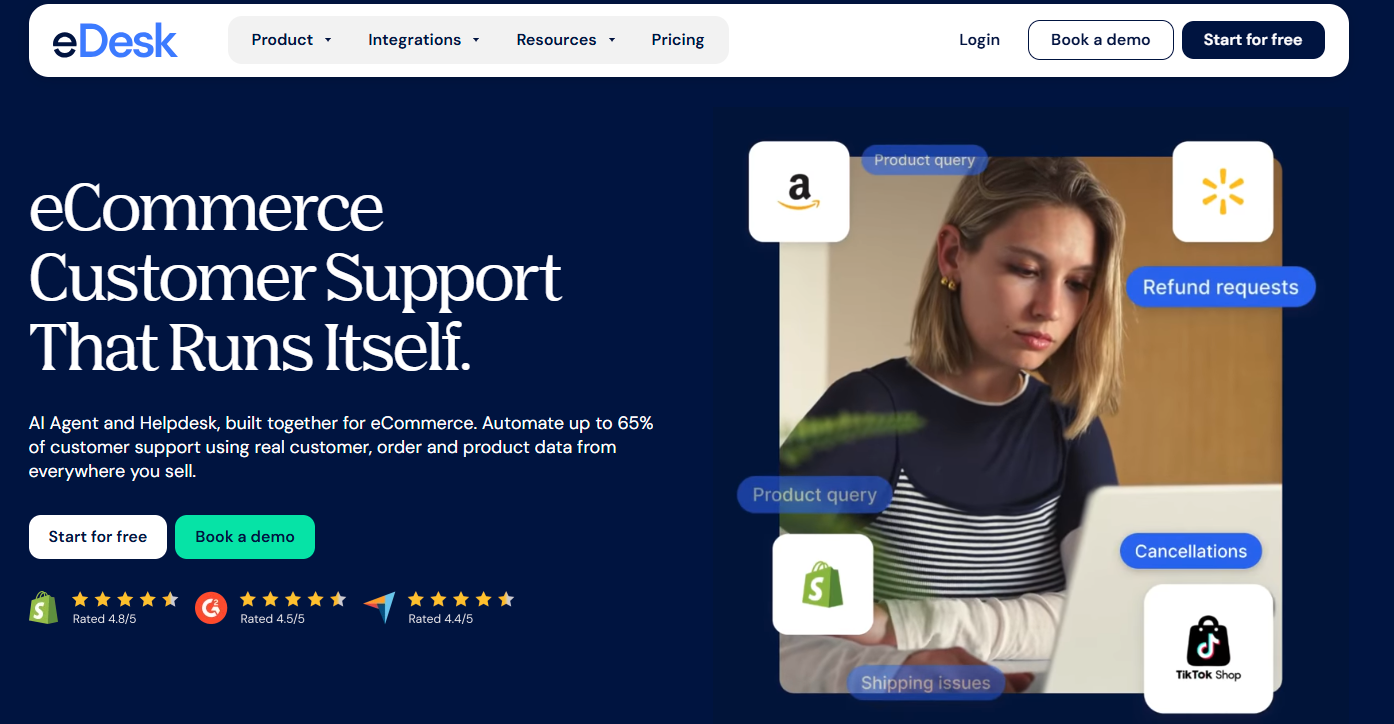
eDesk is the specialist. If a meaningful share of your revenue runs through Amazon, eBay, Walmart, or TikTok Shop, no Shopify-tuned tool matches its channel coverage, and marketplace SLA compliance is built into the workflow rather than bolted on.
Key features
250+ channel integrations spanning Amazon, eBay, Walmart, TikTok Shop, Shopify, WooCommerce, and Magento (see also [multichannel selling basics](INTERNAL: multichannel ecommerce selling guide))
Smart Inbox that groups and prioritizes messages with order and buyer context attached to each ticket
Marketplace SLA tracking, so agents stop logging into Seller Central to answer buyer messages
AI summaries and suggested replies, with autonomous AI automation as a paid add-on
Ticket, agent, and channel performance reporting oriented around marketplace metrics
Pricing Published rates vary by source and region, generally starting around $39 per agent per month on Essential with annual billing, roughly $89 on Growth, and $119 to $149 on Professional. AI Automation is an add-on at about $0.99 per resolution and AI Assist adds roughly $39 per user. A 14-day trial runs without a card. Confirm current numbers directly, since eDesk's public pricing has moved more than once this year.
G2 4.6 out of 5 across 75 reviews. g2.com/products/edesk/reviews
Best for You, if you sell across marketplaces as well as your own store and the tab-switching is the actual bottleneck.
5. Help Scout
Help Scout is the least ecommerce-specific tool here and that is the point. It looks and behaves like email, which means a seasonal hire is productive on day one instead of week two. There are no order-action macros to configure because there are barely any macros to configure.
Key features
Shared inbox that threads conversations like email rather than tickets, with collision detection and internal notes
Docs knowledge base and the Beacon embeddable help widget on every paid plan
AI drafting, summarizing, and inbox assistance included in the plan price
AI Answers chatbot as a separate add-on at $0.75 per resolution, with a three-month free trial
Salesforce, Jira, and HubSpot integrations on Plus, plus SSO and HIPAA compliance on Pro
Pricing Standard $30, Plus $54, and Pro $90 per user per month, with about 16% off annually. A free plan covers up to 5 users, 1 inbox, and 100 contacts a month. Extra inboxes and Docs sites carry additional fees. Shopify connects through third-party apps rather than a native order-action layer.
G2 4.4 out of 5 across 431 reviews. g2.com/products/help-scout/reviews
Best for You, if conversation quality matters more than order lookups and you want the least training overhead of anything on this list.
6. Zoho Desk
Zoho Desk is the budget answer, and the gap is not small. A three-agent team pays nothing on the free plan and $42 a month on Standard, against $60 for a Gorgias Basic bundle that runs out at 300 tickets. What you give up is ecommerce nativeness.
Key features
Genuine free tier for up to 3 agents covering email ticketing, a help center, and basic reports
Multichannel ticketing with WhatsApp, live chat via SalesIQ, and a knowledge base from Standard upward
Blueprints and process automation for routing, SLAs, and multi-department workflows
Zia AI for ticket summaries, sentiment analysis, and the answer bot, with the full suite on Enterprise
Deep integration with the wider Zoho suite, including CRM and Inventory
Pricing Free for 3 agents, then Express $7 (capped at 5 agents), Standard $14, Professional $23, and Enterprise $40 per agent per month on annual billing. Monthly billing runs roughly 30% to 50% higher. Light agents cost about $6 each. There are no native Amazon, eBay, or Walmart integrations, and Shopify order syncing needs third-party tooling.
G2 4.4 out of 5 across 7,858 reviews. g2.com/products/zoho-desk/reviews
Best for You, if cost is the binding constraint or you already run other Zoho products and want one login.
7. Richpanel
Richpanel's differentiator is the customer-facing self-service portal, an Amazon-style interface where shoppers handle returns, order tracking, and cancellations without opening a ticket. That is deflection at the source rather than automation after the fact, and Gorgias has no native equivalent. It ranks last here on fit rather than quality. After a 2026 repricing it is the most expensive option on this list, and a genuinely small team will not clear its entry cost, so treat it as the tool you graduate into.
Key features
Self-service portal for returns, exchanges, cancellations, and order status, driving deflection before a conversation starts
Autonomous AI agent that resolves refunds, WISMO, cancellations, and returns end to end, with a 50% resolution guarantee inside 30 days
Model choice across Claude, GPT, and Gemini with a configurable token budget
Unified inbox spanning email, chat, social, SMS, WhatsApp, and voice
One-click import from Gorgias or Zendesk, which materially shortens migration
Pricing Richpanel repriced upmarket during 2026. Current published rates start around $100 per helpdesk seat per month, with the AI Agent from $500 a month at roughly $0.25 per conversation, and Enterprise custom. Older third-party guides still quote $29 to $99 per seat, so verify before budgeting. Reviewers also flag missing internal notes and collision detection.
G2 4.7 out of 5 across roughly 95 reviews. g2.com/products/richpanel/reviews
Best for You, if self-service deflection is the goal and your budget sits closer to Gorgias Pro than Gorgias Basic.
Side-by-side comparison
Tool | Billing model | Entry price | AI cost | G2 rating |
Gorgias | Per ticket | $10/mo, 50 tickets | $0.90 to $1.00 per resolution, plus a ticket | 4.6 |
Re:amaze | Per seat or flat | $29/user or $59 flat | Bundled per seat, then ~$0.85 | 4.6 |
YourGPT | Flat, credit pool | $39/mo annual | Included in plan credits | 4.7 |
Tidio | Per conversation | Free, then $29/mo | Lyro add-on from ~$32.50/mo | 4.6 |
eDesk | Per agent | ~$39/agent annual | ~$0.99 per resolution | 4.6 |
Help Scout | Per seat | Free, then $30/user | $0.75 per AI Answers resolution | 4.4 |
Zoho Desk | Per agent | Free, then $7/agent | Bundled, full suite on Enterprise | 4.4 |
Richpanel | Per seat plus AI | ~$100/seat | ~$0.25 per conversation | 4.7 |
What each tool actually costs at three store sizes
Monthly ticket volume can change which platform offers the best value.
The original comparison modeled three support agents, with 40% of conversations resolved by AI.
It compared stores receiving 300, 1,000, and 2,500 support requests per month.
The estimated totals were:
Platform | 300 requests | 1,000 requests | 2,500 requests |
|---|---|---|---|
Gorgias | $180 | $740 | $1,540 |
Re | $110 | $376 | $886 |
YourGPT | $39 | $79 | $499 |
Tidio | ~$98 | ~$150 | $749+ |
Help Scout | $180 | $390 | $840 |
eDesk | $236 | $513 | $1,107 |
Zoho Desk | $42 | Not modeled | Not modeled |
Richpanel | $800 | $800 | $800+ |
These figures are illustrative estimates reproduced from the original research, not vendor quotes or independently validated billing calculations. They should not be used for purchasing decisions without recalculating the assumptions, including ticket definitions, plan allowances, AI usage, and discounts.
Several important lessons emerge from the different billing structures.
Ticket-Based Costs Become More Noticeable at Higher Volumes
Gorgias can remain affordable when ticket volume stays within an included allowance.
But as requests increase, overage and AI resolution fees can become a larger part of the monthly bill.
Businesses with seasonal traffic need to model busy months separately from average months.
AI Usage Can Become a Major Cost
Platforms charging per AI resolution may reduce human workload while increasing usage-based software expenses.
The final result depends on whether automation saves enough staff time and resolves enough customer problems to justify those fees.
A low resolution rate can make the economics less attractive.
Subscription and Credit Models Have Different Trade-Offs
Monthly credit allowances can make budgeting easier because businesses begin with a defined amount of usage.
However, model selection and task complexity affect how quickly credits are consumed.
A fixed subscription price does not necessarily mean every possible workload is covered.
Higher Entry Costs Need Enough Usage to Make Sense
Richpanel's self-service capabilities may provide value for stores with substantial order-related support demand.
But a small store receiving relatively few conversations may struggle to justify a higher minimum subscription.
The important question is not which platform costs less in isolation.
It's which pricing structure matches your store's real support workload.
How to Choose the Right Gorgias Alternative
For small ecommerce teams, software selection should begin with the problems consuming the most time and money.
A platform with advanced AI features may not be useful if the main requirement is simply managing customer emails.
Likewise, a low-cost helpdesk may not be enough if the business needs complex integrations.
Here is how to approach the decision.
Identify Your Most Common Customer Requests
Export one month of support conversations and group them into categories.
For example:
Order tracking and delivery questions.
Refunds and exchanges.
Product availability and sizing.
Payment and billing issues.
Account management.
Technical problems.
The distribution matters.
If most requests involve simple information retrieval, knowledge-based AI assistance may be appropriate.
If most involve refunds, cancellations, and order edits, native ecommerce workflows may matter more.
Match the Billing Model to Your Workload
A business with stable ticket volume may benefit from a conversation-based plan.
A business with several support agents but fewer conversations might prefer flat or per-ticket pricing.
A store with unpredictable sales peaks should pay particular attention to usage limits and overage charges.
Check What AI Actually Resolves
Vendors frequently advertise AI resolution rates, but those numbers are not always defined consistently.
Some systems count conversations completed without a human. Others use stricter definitions that include whether the customer returns or the issue reopens.
This is why WebTechOS's customer support software evaluation criteria emphasize resolution definitions, knowledge grounding, handoff quality, and migration costs.
For a fair comparison, test each shortlisted tool using the same real customer requests.
Evaluate the Handoff to Human Agents
A chatbot may answer common questions successfully but struggle with unusual requests.
When that happens, customers should be able to reach a person without repeating their problem.
Check whether the system transfers the conversation history, relevant customer details, and actions already attempted.
Account for Setup and Maintenance
Small teams often lack dedicated support operations staff.
A platform that takes several weeks to configure may create more work than expected.
Evaluate how easily the team can update knowledge sources, adjust workflows, and troubleshoot incorrect AI responses.
WebTechOS's lean AI support stack illustrates one approach to combining AI assistance, human conversations, business knowledge, and issue tracking without relying on a large support operations team.
Test Before Migrating
Select two or three alternatives and run the same practical scenarios through each.
Use real examples, such as a delayed order, a return request, and a customer who needs human assistance.
Record whether the platform provides accurate information, completes the necessary action, and transfers the request appropriately when it cannot finish.
A short controlled test often reveals more than a long feature comparison.
Questions
Frequently asked questions
Why is my Gorgias bill higher than the plan price?
Two reasons usually. Overage tickets run $0.32 to $0.40 each once you pass your bundle, and every AI Agent resolution is billed at $0.90 to $1.00 on top of counting as a ticket. Voice and SMS are also charged separately from your plan.
What is the cheapest real Gorgias alternative for a small store?
Zoho Desk, at $7 per agent per month on Express with a free tier for up to 3 agents. Tidio's free plan covers 50 conversations a month and Help Scout's covers 5 users, which is enough to run a trial without spending anything.
How much does Gorgias cost at 1,000 tickets a month?
Modelled on published 2026 rates with three agents and 40% AI resolution, roughly $740 a month. That is $340 of plan and overage plus about $400 of AI resolution fees. The same store lands near $376 on Re:amaze and $42 on Zoho Desk, though the cheaper options trade away Shopify order actions.
What are the main limitations of Gorgias?
There is no free plan, and ticket overages plus per-resolution AI fees make bills hard to forecast. The AI Agent works only on Shopify and only covers email and chat. There is no native customer self-service portal, so order tracking and returns still generate billable tickets. Marketplace channels need a third-party bridge like ChannelReply, advanced analytics start at the $360 Pro tier, reporting depth draws consistent complaints, and Starter caps at three seats.
Which alternative keeps AI costs predictable?
YourGPT and Zoho Desk bundle AI into the plan rather than metering it per resolution. Re:amaze includes a monthly allowance per seat before overages start. Help Scout, eDesk, Richpanel, and Gorgias itself all charge per resolution in some form.
Do any of these match Gorgias on Shopify order actions?
Richpanel comes closest, with refunds, cancellations, and subscription edits handled natively. Re:amaze and eDesk cover order lookup and common actions. Help Scout and Zoho Desk reach Shopify through integrations rather than a native action layer.
Is migrating off Gorgias difficult?
Richpanel offers a one-click Gorgias import. Most others require exporting tickets, contacts, tags, and macros, then rebuilding your automations by hand. Budget one to four weeks depending on how customized your rules are.
What should a marketplace seller use instead of Gorgias?
eDesk. Its 250+ channel integrations cover Amazon, eBay, Walmart, and TikTok Shop alongside Shopify, which no Shopify-first tool matches.
Conclusion
Gorgias remains a capable ecommerce helpdesk, especially for Shopify businesses that depend on native order actions and centralized ticket management.
But its pricing model may not suit every small team.
Re provides a more predictable flat-rate option for certain workloads. YourGPT focuses on AI-powered support across channels. Tidio offers an accessible starting point, while eDesk, Help Scout, Zoho Desk, and Richpanel address different operational priorities.
The right decision depends on what customers ask, which actions support agents need to perform, and how the software charges for that work.
Before switching, review a month of real conversations, estimate the full cost of each platform, and test common requests in a trial environment.
The best Gorgias alternative isn't necessarily the cheapest helpdesk or the one with the most AI features. It's the platform that resolves your customers' most common problems without creating unnecessary work or unpredictable costs.
WebTechOS accepts no payment for coverage, placement or scores. Where a piece references pricing, it reflects published list rates at the date shown.
Keep reading
All insights →Is ChatGPT or Claude Worth Paying For? 2026 Pricing Breakdown
ChatGPT Plus and Claude Pro both cost $20. Compare Free, Go, Pro, Max and Ultra plans, usage limits and hidden costs to see which is worth paying for.
Best AI chatbot.com alternatives compared in 2026
Compare 7 AI chatbot alternatives for 2026 on resolution claims, pricing, channels and handoff. See where YourGPT, Intercom, Zendesk and Tidio fit.
9 Best AI Auto Caption and Subtitle Generators in 2026
Nine AI caption and subtitle generators compared on languages, free-plan limits, export formats and annual pricing, from Kapwing to Whisper.
7 Best HeyGen Alternatives in 2026
Compare 7 HeyGen alternatives for 2026 by price, limits and fit. Synthesia, AI Studios, Colossyan, D-ID, Creatify, VEED and CoAnimator.