The State of Autonomous Customer Support Agents in 2026
Autonomous customer support agents in 2026: the $3.6B Fin deal, real resolution rates, outcome pricing, and a 16-point vendor checklist.
23 Sept 2026·15 min read·General
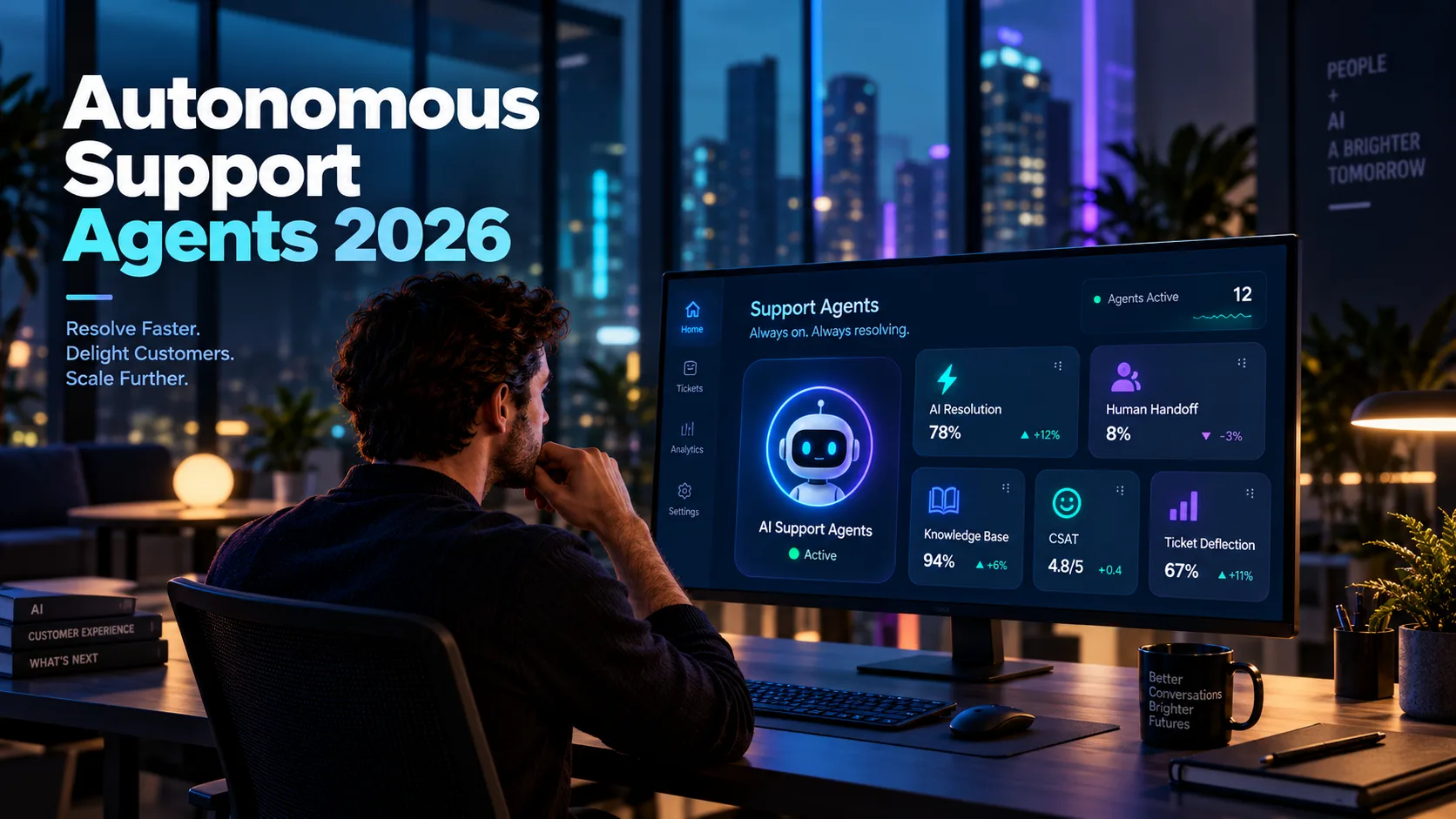
An AI agent checks the shipping manifest, applies the refund policy, and closes the ticket, all before a human on the support team even opens it. The customer's holiday order was stuck at a regional hub with the gift inside needed by yesterday, the kind of ticket that used to sit in a queue until someone had time for it. In 2026, there's a real chance nobody on the team saw it. That shift stopped being a sales pitch this year. In June, Salesforce paid $3.6 billion for the company most of its own prospects still call Intercom, betting that autonomous resolution isn't a phase.
Quick take:
Salesforce agreed to buy Fin, formerly Intercom, for $3.6 billion in June 2026, the clearest signal yet that this category has staying power beyond the hype cycle.
Named vendor resolution rates cluster between 62% and 90%, but the definitions behind those numbers vary enough that they aren't directly comparable.
Pricing has shifted from per-seat to outcome-based. $0.99 to roughly $1.75 per resolution is now typical at the enterprise tier.
Modeled against a realistic escalation rate rather than zero humans, autonomous resolution typically cuts cost per ticket by more than half.
Gartner expects 40% of agentic AI projects to be canceled by 2027, mostly on cost overruns and unclear ROI, not on the technology failing outright.
What is an autonomous customer support agent?
An autonomous customer support agent is software that resolves a customer's issue end-to-end, without a human drafting the reply, routing the ticket, or approving the action. It reads the ticket, checks the customer's account in connected systems, applies policy, and takes the action itself, a refund, a cancellation, an account update, a KYC check, then closes the loop.
Most products marketed as "AI agents" in 2026 actually sit somewhere on a maturity ladder rather than at either end of it:
Answers only. Responds to questions from a help center or FAQ page. Cannot take any action.
Deflection. Keeps a ticket out of the human queue by resolving simple, well-documented requests like order status or password resets.
Workflow automation. Executes multi-step processes, but a human still reviews or approves before anything is final.
Full resolution. Reads, verifies, acts, and closes the ticket with no human in the loop, backed by an audit trail on every action.
Where a vendor actually sits on that ladder matters more than what they call themselves, and the gap between the bottom two rungs and the top one is most of this category's story.
Ticket deflection | Autonomous resolution | |
|---|---|---|
What it does | Answers a question from help content | Takes the action and closes the ticket |
Typical tickets | FAQs, order status, how-to questions | Refunds, cancellations, account changes, KYC checks |
What it needs | A well-maintained help center | Integrations into billing, order, and account systems, plus policy rules |
How it's measured | Tickets that never reached a human | Tickets closed correctly that did not reopen |
The split matters because PwC's 2025 Customer Experience Survey found that 70% of executives say customer expectations are evolving faster than their company can adapt. A platform stuck on deflection widens that gap. One built for resolution is the only kind that can actually close it.
In 2026, that distinction is worth more to a buyer than any feature list. One camp is still priced and measured on deflection. The other is priced and measured on resolution, refunds included, and it's the one this piece spends most of its time on.
The Salesforce-Fin acquisition: proof this market is real
Intercom renamed itself Fin in May 2026, taking the name of its own AI agent. Three weeks later, Salesforce signed a definitive agreement to acquire the company for approximately $3.6 billion in cash, with the deal expected to close in Salesforce's fourth fiscal quarter of 2027 pending regulatory approval.
How Fin got here:
2011. Founded in Dublin as Intercom
2023. Pivots hard into AI as modern LLMs make an agent that can actually resolve tickets possible
May 2026. Rebrands from Intercom to Fin, taking the name of its own AI agent
June 15, 2026. Salesforce signs a definitive agreement to acquire Fin for approximately $3.6 billion in cash
Expected in Q4 of Salesforce's fiscal year 2027. Deal closes, pending regulatory approval
The number matters less than the logic behind it. Salesforce's own Agentforce Help Agent resolves a reported 62% of cases on its own. Fin, running on its purpose-built Apex model, claims an average resolution rate of 76% across live deployments and already serves more than 30,000 customers. Rather than close that 14-point gap through more engineering, Salesforce bought the company that had already closed it. Agentforce itself is not a side project either. It reached $1.2 billion in ARR last quarter, up 20% year over year.
Fin's own pricing tells you where the market is headed even faster than the acquisition does. It charges $0.99 per resolution, backed by a $1 million performance guarantee if the agent's claimed accuracy does not hold up. Nobody structures a guarantee like that around a feature they are not confident in.
AI customer support resolution rates in 2026: what the numbers actually hide
Every vendor in this category now publishes a headline number, and these numbers are good. Decagon, which closed a $250 million Series D in January at a $4.5 billion valuation. Sierra, which raised $950 million in May at a $15.8 billion valuation.
Here is the part the pitch decks leave out. None of these numbers are measured the same way.
Vendor | Headline number | What it actually measures |
|---|---|---|
Decagon | 80%–90% | Customer-reported resolution or deflection rate |
YourGPT | 90% | Resolution rate reported across production deployments |
Sierra | Up to 80% | Reported resolution rate, with the definition not publicly specified |
Fin | 76% | Average resolution rate across its customer base |
Salesforce Agentforce Help Agent | 55% | In-house case resolution rate |
Three numbers in the 75 to 90% range can represent different customer experiences, making the definition more important than the percentage during a sales call.
Once every vendor's containment number converged into roughly the same fifty-to-seventy range on well-documented queries, containment stopped being the number worth arguing about. What separates a good deployment from a bad one now is what happens in the 20 to 40% of conversations the agent cannot close. That is where cost and churn both live, and it is the question to ask before the resolution rate.
AI agent adoption statistics for 2026, and the gap nobody's closing
Salesforce's own State of Service research puts AI agent adoption in customer service organizations at 66% in 2026, up from 39% the year before, a 1.7x jump in twelve months. Of the companies that deployed one, 70% reported measurable value inside 60 days, and customer satisfaction, not cost, came out as the top-improved metric. Cisco's 2025 enterprise survey projects that 56% of support interactions will run through agentic AI by mid-2026, climbing to 68% by 2028.
Those numbers describe adoption, not maturity, and Forrester's 2026 research on agentic AI draws exactly that line. Roughly three in four enterprise leaders say they are adopting agentic AI, but only a small share have it running in meaningful production beyond what Forrester calls "agentish" chatbots, and genuinely scaled multi-agent systems are rarer still. Everyone is chasing the same outcome. Very few have caught it.
The risk of moving too fast is not hypothetical either. Forrester estimates that three in ten firms will actively damage their customer experience in 2026 because of poorly implemented AI self-service, and 49% of security decision-makers in a separate Forrester survey now name agentic AI itself as a security concern.
How autonomous customer support agents are priced in 2026, now that seats are gone
The clearest signal that this category has matured is what vendors are charging for. We mapped four billing models fighting to replace the per-seat license earlier this year, and customer support is where that fight is furthest along. Fin charges $0.99 per resolution. Sierra's contracts work out to roughly $1.50 per resolution on deals that typically start near $150,000 a year. Decagon runs a hybrid of a roughly $50,000 annual platform fee plus usage on top.
Outcome pricing aligns the vendor's incentive with the customer's, which is the honest part of the pitch. It also means a product incident that triples ticket volume in a bad month triples the bill in the exact month a team can least afford it, which is the part sales calls skip over. Zendesk, still the enterprise system of record for a lot of support teams, has moved the same direction, now billing its AI layer per resolution rather than folding it into the seat price.
Not every buyer needs enterprise-scale outcome pricing to get a working agent. YourGPT sits at the more accessible end of the same market, starting at $39 a month with a no-code setup that scales into fully custom deployments, which is a large part of why it holds the top composite score in our customer support category right now. If you are choosing between an outcome-priced resolution agent and a full support suite built around one, that is exactly the trade-off we ran head-to-head.
AI agent vs. human support team: the real math
A resolution percentage on a slide is easier to argue with than a number on a spreadsheet. Here's a worked model for a team handling 8,000 conversations a month, using the per-resolution rates already covered above. Swap in your own headcount cost and resolution rate to check whether the case holds for your queue.
All-human | AI plus a smaller team | |
|---|---|---|
Assumptions | $65,000 a year fully loaded per agent, about 500 conversations closed per agent per month | The agent resolves 70% of the volume at a blended $1.25 per resolution; escalations go to a smaller human team. |
Conversations handled by people | 8,000 | 2,400 |
Agents needed | 16 | 5 |
Monthly people cost | About $86,700 | About $27,100 |
Monthly platform cost | $0 | About $7,000 |
Total monthly cost | About $86,700 | About $34,100 |
That's roughly a 61% reduction in this specific model, which is in the same range as Salesforce's own research reports for teams running agents at scale. Two assumptions decide whether it holds for your queue. The resolution rate has to be the real, audited number, not the headline one, because a reopened ticket gets paid for twice, once as an AI resolution and again as the human fix that follows it. And the fully loaded agent cost must include tooling, management, and turnover, not just base salary; otherwise, the human column looks artificially cheap next to the platform bill.
Why Gartner expects 40% of AI agent projects to fail by 2027
Gartner's numbers cut against the hype in one important way. It expects 40% of agentic AI projects to be canceled by the end of 2027, on cost overruns, unclear ROI, or risk controls that were never built in the first place. That is a big number for a technology every vendor is describing as inevitable.
In our own coverage of production agent deployments, the failure mode is rarely a lack of capability. It is the kind of silent degradation that kills trust in an agent months after launch, where the agent keeps answering just as confidently after the knowledge base underneath it went stale, and nobody notices until a customer complains. Support agents are especially exposed to this risk because the "ground truth" they answer against—pricing pages, policy documents, refund windows, and changes—constantly and rarely comes with a change notification.
The mitigation Forrester recommends is blunt and correct. Treat AI self-service as a knowledge management problem first, not just a software purchase. A deployment is only as good as the documentation it is grounded in, and documentation decays the moment nobody owns it, keeping it current.
Three models are emerging in AI customer support
The market is splitting around a simple question: what are you actually buying when you buy an AI support agent?
Some vendors sell an enterprise agent as a separate product, with pricing tied to the outcomes it delivers. Others add AI resolution to an existing support platform and charge on top of the software you already use. Then there are AI support platforms that give teams the agent, workflows, integrations, and controls to build their own support operation around AI.
Model | Examples | How it's priced | Built for |
|---|---|---|---|
Enterprise-Only Platforms | Decagon, Sierra | Quote-only, with outcome-based pricing tied to resolved conversations plus platform fees | Large support teams with high conversation volumes and complex requirements |
AI added to support suites | Fin, Zendesk | AI resolution priced on top of an existing support platform | Companies already committed to the underlying support suite |
AI-led support platforms | YourGPT | Subscription plus AI credits, starting at $39/month | Teams that want to deploy and configure AI agents. |
The first model is built for companies that want to hand a large volume of support work to an AI agent and buy it as an enterprise system. Pricing and implementation are typically structured around larger deployments.
The second model puts AI inside a support platform the company already uses. The advantage is that the AI can work alongside the existing inbox, ticketing, customer records, reporting, and other support infrastructure. The tradeoff is that AI adds another layer to the existing platform and its pricing.
The third model takes a different approach. The AI is the support layer, while the rest of the stack can remain in place. Teams can connect their data and systems, configure workflows, define how the agent should handle different requests, and add human handoff when AI should not act alone.
That distinction also changes how Fin fits into the market after becoming part of Salesforce. Fin started as an independent AI support product, but it now sits within a much broader enterprise service platform. For Salesforce customers, that makes Fin part of an existing software ecosystem rather than a standalone AI support purchase.
If you are comparing these approaches, our comparison of YourGPT and Fin looks at how the two differ in resolution, workflows, integrations, configuration, and the surrounding support stack.
For teams that do not need a complete enterprise suite, a leaner AI agent combined with a shared inbox and documentation layer can provide an AI-first support setup without replacing the rest of the support stack.
How to evaluate an autonomous customer support vendor before you buy
The first four questions decide most contracts. The remaining questions fill in the gaps that the first four do not cover.
Ask for the resolution definition, not just the resolution number. "Resolved" means something different at every vendor, and the gap between "the bot closed the ticket" and "the customer did not reopen it within a week" is what determines whether the number on the sales deck matches what your team actually experiences.
Model your real conversation volume against the specific billing structure. The same workload can cost dramatically different amounts depending on whether escalations, retries, and multi-turn conversations count as one billable event or several, and that detail rarely surfaces before page four of the contract.
Ask what happens in the conversations the agent cannot close. Obtain a real number for time-to-human on a failed handoff and how much context survives the transfer. A customer who spends four minutes with a bot, gets nowhere, and then has to explain the whole problem again to a person has had a worse experience than if there had been no bot at all.
Weigh acquisition risk into the decision. A tool that just changed owners, like Fin, isn't a bad choice on its own. Its roadmap, pricing, and support will simply change more over the next few quarters than those of a standalone vendor.
Where autonomous customer support is headed by 2029
Gartner's own trajectory points toward roughly 80% autonomous resolution across enterprise support by 2029, up from a small fraction just three years ago, and it expects 40% of enterprise applications to embed task-specific agents by the end of this year alone, versus under 5% in 2025. Nobody's still debating the direction. What's actually unresolved is how fast a specific team should move toward it, and moving before your knowledge base can support the claim is a worse mistake than moving too slowly.
The headcount story is also getting more honest. Gartner projects that half of the companies that cut support staff and credited AI for it will rehire people to do similar work under different titles within the next year, and Salesforce's own research found 83% of service professionals report better career prospects since AI tools entered their workflow, not worse.
The question worth asking in 2026 is no longer whether an autonomous agent can resolve tickets. Most well-implemented ones can resolve tickets in the 60 to 90% range, depending entirely on how narrowly you define "resolved." The question that actually separates a good deployment from an expensive mistake is what happens in the fraction it cannot close, what that costs when it goes wrong, and whether the vendor you are about to sign with will still be the same company in eighteen months.
Questions
Frequently asked questions
What is an autonomous customer support agent?
It resolves an issue end to end, including the action, not just the answer. A regular chatbot tells a customer how to get a refund. An autonomous agent issues the refund. That line, whether the software can act on a system of record or only talk about it, is the fastest way to tell a real agent from a chat widget with a new label.
Is Fin the same company as Intercom?
Yes, and if you're already an Intercom customer, the practical question isn't the name. It's whether your contract includes protection if pricing, resolution SLAs, or support quality change once Salesforce completes the acquisition in its fourth fiscal quarter of 2027. Ask your account team for that in writing now, while the deal is still pending.
What is a realistic AI resolution rate to expect in 2026?
Treat any number you can't get a definition for as roughly 15 to 20 points lower than quoted. Vendors that lead with deflection (a ticket that never reached a human) rather than verified resolution (no reopen within a set window) are almost always sitting on the low end of that gap, because deflection is the easier number to make look good.
How is autonomous customer support priced now?
Run the outcome-based number against your worst month, not your average one. A vendor charging $1 per resolution on 5,000 conversations a month looks like $5,000. The same vendor during a product incident that doubles your ticket volume is $10,000 that month, with no seat count to renegotiate down. Ask for a monthly cap before you sign, not after your first spike.
Will autonomous agents replace human support teams entirely?
The more likely shift is what the job becomes, not whether it disappears. Teams running agents at scale are reporting that their remaining headcount spends less time answering routine questions and more time reviewing what the agent got wrong, which is a different skill set than the one most support hires were trained for.
Conclusion
A resolution rate only tells you what a vendor already gets right. It says nothing about the tickets it gets wrong, and that fraction is where next year's actual support budget gets decided, not the headline percentage on the sales deck. The number worth demanding before you sign is the reopen rate, how many of the tickets marked "resolved" come back within a set window. Most vendors in this piece will show you the first number without you having to ask. Far fewer will hand over the second.
There's a second question worth asking before the price ever comes up. Can you actually leave? Ask whether you can export your conversation history and training data in a usable format and how long a transition takes if you switch to a different agent. A vendor confident in its resolution numbers has no reason to make that exit hard. A vendor that hedges on this is counting on switching costs to do the retention work; its accuracy doesn't help.
Both questions matter more this year than usual, given how many of the names in this piece just changed hands, are folding into a bigger suite, or are still burning venture money at a valuation that assumes today's growth rate holds. None of that makes any of them a bad choice. It just means the contract terms matter as much as the product demo, maybe more.
WebTechOS accepts no payment for coverage, placement or scores. Where a piece references pricing, it reflects published list rates at the date shown.
Keep reading
All insights →Modern Web Performance Optimization Techniques in 2026
INP, AVIF, edge rendering, and AI crawler load: the web performance techniques that actually move Core Web Vitals in 2026
Comparing Vector Databases for Enterprise: Pinecone vs Qdrant
Pinecone bills per query, Qdrant bills per box. We compare 2026 pricing, compliance, and filtered-search speed for enterprise RAG buyers.
6 Best AI Alternatives to Zendesk in 2026 (Tested and Scored)
Zendesk now bills AI per resolution, not per seat. Compare 6 Zendesk AI alternatives on real pricing, G2 ratings, and resolution rates.
Customer Service Sentiment Analysis Tools: The 2026 Buyer's Guide
customer service sentiment analysis tools compared on G2 ratings, real pricing, and what each one does with a negative signal. 2026 picks.