Web Framework Benchmarks 2026: React 19 vs Svelte 5 vs Vue 3.5
React 19, Svelte 5, and Vue 3.5 compared on bundle size, memory, and real update speed — plus which one to pick for your next build in 2026.
4 Nov 2026·13 min read·General

React shipped a stable compiler. Vue rewrote its reactivity engine from the inside out. Svelte replaced its entire state model with runes. Three of the biggest architectural shifts in frontend frameworks in years landed within about twelve months of each other, right while you're trying to make a real call, a new build, a migration, a hiring plan, and most of what you're finding online hasn't caught up. Half the "2026" comparisons out there are 2024 benchmarks with the year swapped in the title. The other half come from a vendor with the answer already picked before the testing started.
We're not going to hand you a single number and call it settled. We looked at what actually changed in each framework this cycle, React's compiler going stable, Vue's reactivity core getting rewritten, Svelte's runes replacing its old implicit magic, and we're telling you where the real gaps are, where they're closing, and where a "benchmark" you've seen is measuring something that won't show up in your app at all.
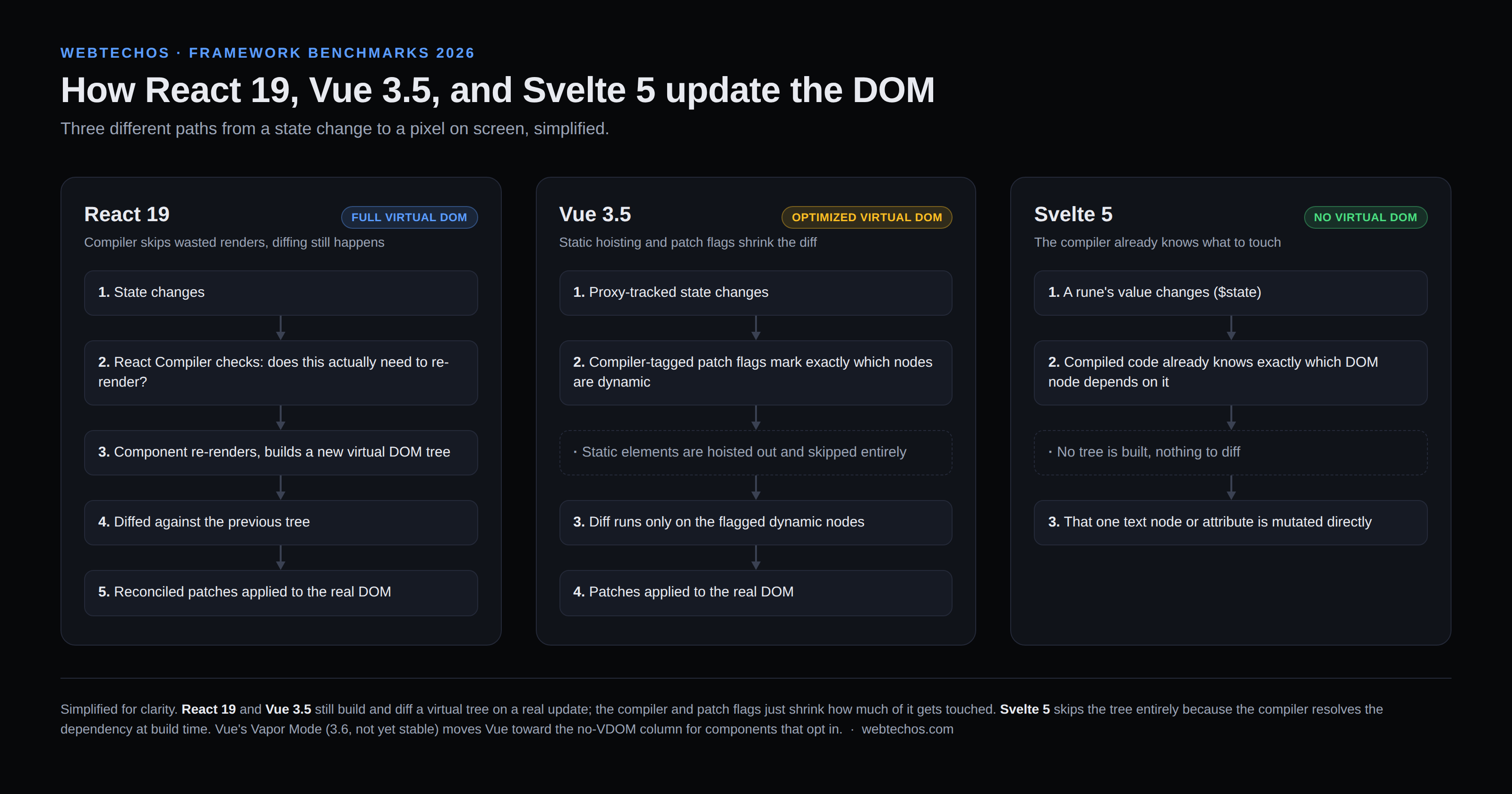
React 19 vs Svelte 5 vs Vue 3.5 at a glance
Factor | React 19 | Svelte 5 | Vue 3.5 |
|---|---|---|---|
Reactivity model | Compiler-inserted memoization on top of hooks | Runes ( | Proxy-based reactivity plus compiler optimizations |
DOM update approach | Full virtual DOM: build, diff, reconcile | No virtual DOM: compiles to direct, targeted DOM mutations | Virtual DOM with static hoisting and patch flags |
No-VDOM option today | No | Yes, it's the default architecture | Not yet. Vapor Mode is opt-in and still in the 3.6 release candidate |
Typical bundle weight | Heaviest fixed cost: React plus ReactDOM gzipped runs low-to-mid 40KB before your code | Lightest: a small signals runtime (roughly 3-4KB) plus compact compiled components | Middle ground: lighter than React, heavier than Svelte |
Memory and GC behavior | Compiler cuts unnecessary re-renders, but real updates still allocate a virtual tree | No intermediate objects to collect; lowest footprint of the three | Reactivity refactor cut memory use by 56% and sped up array tracking up to 10x |
Raw update speed (JS Framework Benchmark pattern) | Narrows the historical gap with the Compiler, still trails on the geometric mean | Lands within a small margin of the vanilla JS baseline | Sits between React and Svelte thanks to patch-flag filtering |
Migration cost for the gains | Drop-in: install the Compiler, keep your code | Rewrite required, though incremental and side-by-side with legacy components | Drop-in: automatic on upgrading to 3.5, no breaking changes |
Learning curve | Lowest: familiar to the widest hiring pool | Steepest: explicit reactivity replaces the old implicit model | Gentle: same mental model as 3.4, just faster |
Ecosystem and hiring depth | Largest by a wide margin | Smallest of the three, growing quickly | Solid and mature, particularly strong outside North America |
SSR / streaming support | Mature: Server Components, streaming, well-worn in Next.js | Mature via SvelteKit | Mature via Nuxt; Vapor Mode's SSR story is still catching up |
Production readiness of the newest perf feature | Stable: Compiler reached 1.0 in October 2025 | Stable: runes are the default model, not a preview | Preview only: Vapor Mode is a Vue 3.6 release candidate, not shipped in 3.5 |
Best fit | Large teams, existing React codebases, apps that aren't update-heavy | New builds where interaction performance is a hard requirement | Teams wanting VDOM ergonomics with a meaningfully lighter footprint |
What actually shipped in 2026, not what got announced
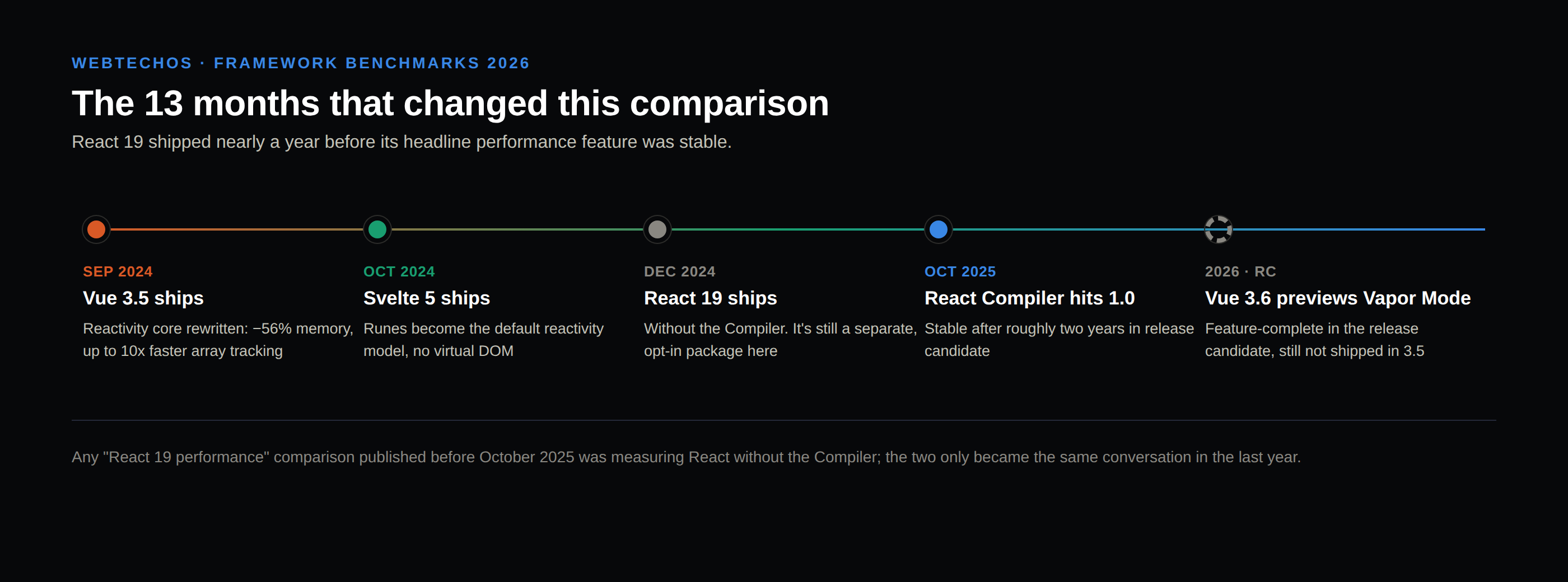
Framework marketing moves faster than framework code. Here's what's actually true, shipping, and stable right now.
React 19: the compiler is finally not a beta
React 19 itself landed in late 2024, but the piece everyone was waiting for, React Compiler, only reached a stable 1.0 release in October 2025, after roughly two years sitting in release candidate. That gap matters, because for most of 2025 "React 19 performance" and "React Compiler performance" were two different conversations.
The compiler is a build-time tool: a Babel plugin (with an SWC path in progress for faster builds) that inserts memoization automatically, the same job useMemo, useCallback, and React.memo used to do by hand. The React team's own case studies pointed to missing or incorrect memoization as the root cause behind the large majority of the re-render regressions they'd traced internally, a very specific class of bug, and the compiler is aimed squarely at it.
What it does not do is change React's underlying model. React 19 with the compiler still builds a virtual DOM tree, still diffs it, still reconciles. The compiler stops you from over-rendering; it doesn't remove the render-and-diff step itself. That distinction is the whole ballgame for the rest of this piece.
Vue 3.5: the reactivity rewrite nobody outside the Vue community noticed
Vue 3.5 shipped as what Evan You called a minor release with no breaking changes, which undersold it. Under the hood, the reactivity system got a full refactor: Vue's own numbers put it at a 56% reduction in memory usage and up to 10x faster dependency tracking on large, deeply reactive arrays, with identical behavior. It also fixed a long-standing class of stale-computed and memory-leak bugs tied to hanging computed properties during SSR.
Vue still renders through a virtual DOM. What's changed is how much work that VDOM has to do to figure out what changed: static hoisting pulls unchanging elements out of the render function entirely, and patch flags tag dynamic nodes so the diffing engine can skip straight to what actually moved instead of walking the whole tree. It's not a new architecture; it's the existing one getting meaningfully more efficient at avoiding wasted work.
Worth flagging since it comes up in every comparison thread: Vapor Mode, the opt-in compilation path that drops the virtual DOM per-component, is not a Vue 3.5 feature. As of this writing it's the headline of the Vue 3.6 release candidate, described by the core team as feature-complete and matching Solid- and Svelte-level performance in third-party testing for the components that opt in. If an article tells you "Vue 3.5 ships without a virtual DOM," that's Vue 3.6 they're describing, prematurely.
Svelte 5: runes turn implicit reactivity into an explicit one
Svelte 5's headline change is runes ($state, $derived, $effect) replacing the old model where reactivity was inferred from how you wrote plain assignments inside a .svelte file. The practical upgrade: reactive state built with runes now works in ordinary .svelte.ts files too, so you can write and unit-test a state machine without ever rendering a component.
Architecturally, nothing changed about the core idea Svelte has run on for years: it's a compiler, not a runtime framework. Templates compile down to direct, surgical DOM mutations at build time: when a rune's value changes, the compiled code updates exactly the text node or attribute that depends on it. There's no tree to diff because there's no tree; the compiler already worked out which DOM node needs touching.
One honest caveat that's easy to miss in the hype: Svelte 5 does ship a small signals runtime under the hood (community estimates put it around 3-4KB) to power runes, so the "literally zero runtime" claim that was true of Svelte 3/4 needs an asterisk now. It's still tiny compared to a full framework, but it's not nothing.
How we're actually measuring this
Before the numbers: a disclosure most comparison posts skip. The most credible open reference for raw DOM-update speed is the community-run JS Framework Benchmark project. It builds the same app (create 1,000 and 10,000 rows, update every 10th row, select a row, swap two rows, remove a row, clear the table) in every framework under test. It runs each in Chrome with CPU throttling, and measures against a hand-written vanilla JS baseline. It's updated with almost every new Chrome release, which means any specific number we quoted here today would already be stale by the time you're reading this.
So rather than reprint a table that expires in a few weeks, here's the pattern that has held consistently across releases: compile-time and fine-grained-signal frameworks, Svelte 5 and Solid, land within a small margin of the vanilla JS baseline, because there's no intermediate tree being built and thrown away. Vue's optimized VDOM, with static hoisting and patch flags doing most of the filtering before the diff even runs, sits closer to that baseline than a naive virtual DOM would. React with the Compiler enabled narrows its historical gap noticeably versus uncompiled React 18, but on the geometric mean across all operations it still tends to trail the other two, because a full component re-execution and reconciliation pass is still the mechanism doing the work. Check the live table yourself before you cite a number from anyone, including us.
Bundle size: what actually ships to the browser
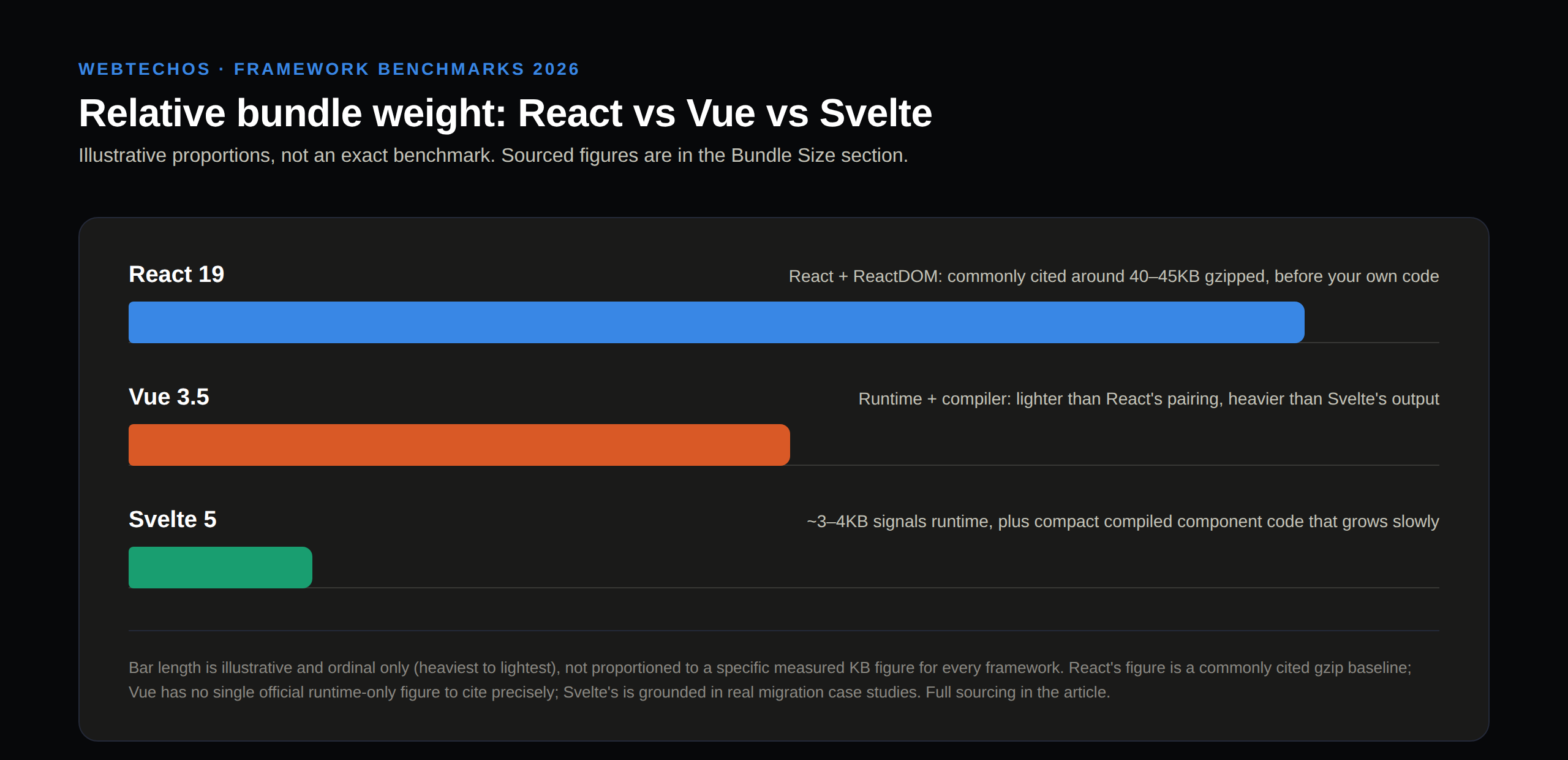
This is where the architecture differences get concrete for a user on a phone.
React ships a framework runtime with every app: React plus ReactDOM gzipped has hovered in the low-to-mid 40KB range for several major versions now, and that's before your component code. Vue's runtime plus compiler lands in the middle of the pack: noticeably lighter than React's pairing, heavier than what Svelte ships for an equivalent app, because Vue still needs to carry its reactivity system and VDOM renderer regardless of app size.
Svelte inverts the model: instead of shipping a runtime that interprets your components, the compiler turns each component into its own compact, imperative JavaScript. There's a small shared signals runtime for runes, but no framework "core" sitting between your code and the DOM. That's also why Svelte's bundle-size story is more about growth curve than a single number; real migrations tell the story better than a spec sheet. One production app tracked by a Svelte contributor went from 261KB to 181KB of shipped JavaScript just by upgrading from Svelte 4 to Svelte 5, with zero code changes. A separate 147-component migration reported by Strapi's engineering team saw a 55% reduction, from 382KB down to 171KB. Your mileage depends entirely on how many components you have and how much they share, but the direction is consistent: more components in Svelte tends to add less weight than the same growth would in React or Vue.
Memory and INP: the part that actually shows up in Lighthouse
Bundle size affects the first paint. What happens after that (every click, every keystroke, every row a user adds to a table) is where memory and Interaction to Next Paint (INP) tell the real story, and it's the same INP-first thinking behind the Core Web Vitals work we've covered on modern performance techniques that applies just as much to framework choice as it does to image formats or edge rendering.
Every time a classic VDOM framework re-renders, it allocates a fresh in-memory representation of whatever changed, diffs it against the old one, and then the browser's garbage collector has to clean up the discarded objects. Under light interaction that's invisible. Under a busy dashboard, a live collaboration surface, or a data grid with thousands of rows updating in real time, that allocate-diff-collect cycle is exactly what produces the visible stutter and INP regressions teams chase for weeks.
Svelte's compiled updates skip that cycle entirely: no intermediate objects, so there's nothing extra for the garbage collector to clean up beyond what your own code allocates. That's the practical reason Svelte 5 and Solid consistently post lower memory footprints on the JS Framework Benchmark's memory columns. Vue's 3.5 reactivity refactor directly targets this: less memory held per tracked property means fewer, smaller GC pauses even though the VDOM step is still there. React Compiler's contribution is different again: it doesn't touch the GC story, but it prevents whole subtrees from re-rendering (and therefore re-allocating) when nothing they depend on actually changed, which is where most of its INP wins come from in practice.
Developer experience and the cost of getting there
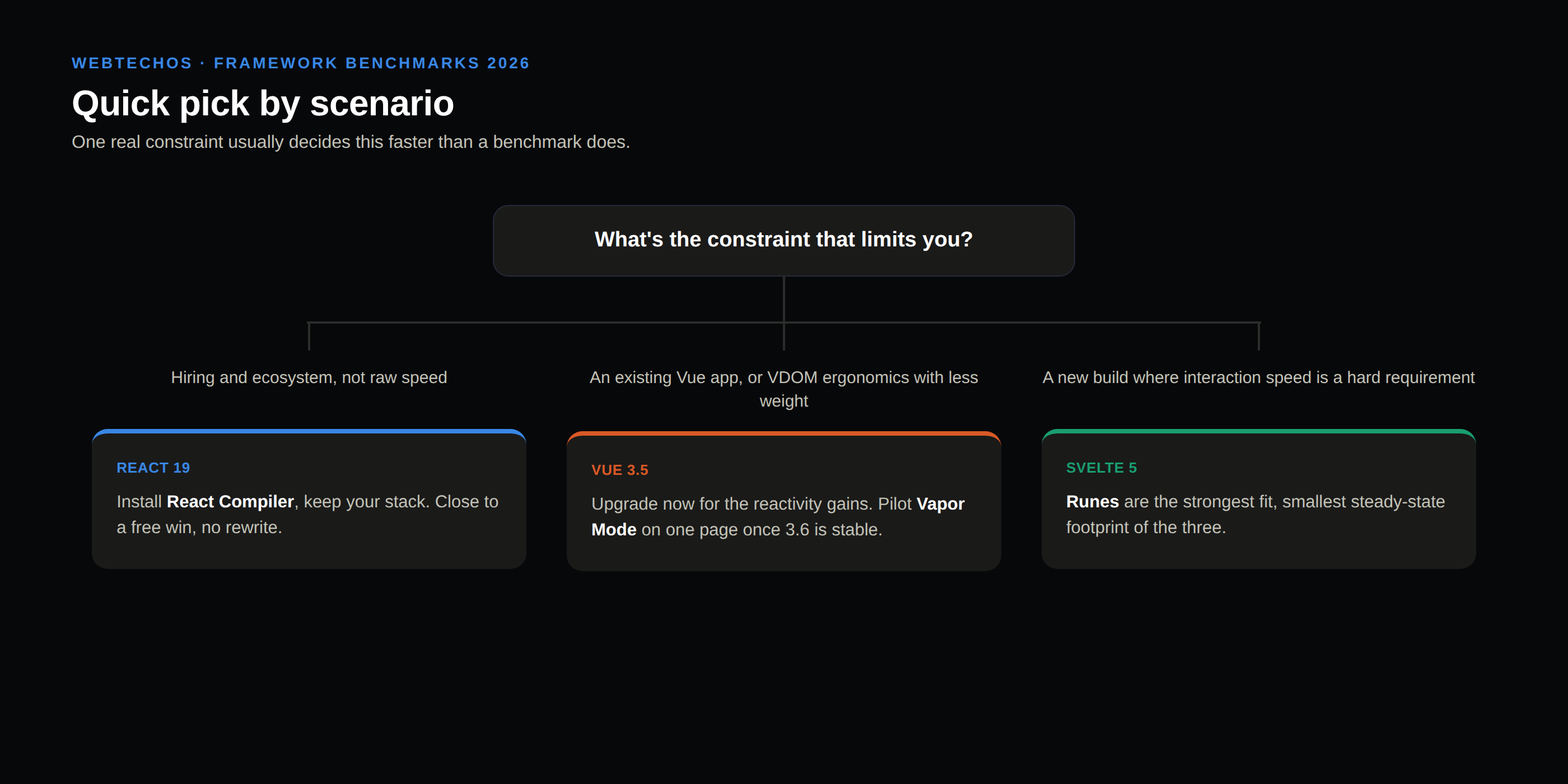
None of this matters if the migration cost eats the performance win. A few things worth weighing honestly:
React's ecosystem gravity is real. More third-party components, more Stack Overflow answers, deeper hiring pools. The Compiler is additive: you install it, you don't rewrite hooks, which is the lowest-friction performance upgrade of the three.
Vue 3.5 is also additive. No breaking changes, and the reactivity gains apply automatically. Vapor Mode, when you're ready for it in 3.6, is opt-in per component, so you can trial it on one performance-sensitive page without touching the rest of the app.
Svelte 5's runes migration is the most invasive of the three, since it changes how state is declared, not just how it's optimized. Teams doing this incrementally report it going smoothly (Svelte 5 runs legacy and runes-based components side by side during the transition), but it's still a rewrite, not a version bump.
Whichever direction you go, the mechanical part of a framework migration (rewriting hooks into runes, or wiring up patch-flag-friendly templates) is exactly the kind of repetitive, context-heavy work teams are increasingly handing to an AI coding agent rather than doing line by line. That's a big part of why AI developer tools have shifted from autocomplete to actual delegation this year: the interesting question for a migration like this isn't which editor autocompletes fastest, it's whether the tool can hold your whole component tree in context while it rewrites state declarations across two hundred files without breaking the parts it didn't touch.
Which one should you actually pick
You're deep in the React ecosystem, hiring is a constraint, and your app isn't update-bound. Install React Compiler, keep your stack. It's close to a free win.
You have an existing Vue codebase, or you want VDOM ergonomics with a lighter footprint than React. Upgrade to 3.5 now for the reactivity gains, and pilot Vapor Mode on one page once 3.6 is stable.
You're starting fresh, performance is a hard requirement (a live dashboard, an editor, a trading surface), and you can absorb a steeper learning curve. Svelte 5's runes are the strongest fit, with the smallest steady-state footprint of the three.
None of these are permanent. React Compiler, Vue's reactivity core, and Svelte's runes are all less than eighteen months old as stable releases. Revisit this call in a year.
Questions
Frequently asked questions
Is the virtual DOM dead in 2026?
No. React 19 and Vue 3.5 both still build and diff a virtual DOM in production for the large majority of real-world apps. What's changed is that both frameworks got much better at minimizing how much of that tree actually needs touching, through the Compiler in React's case, and static hoisting plus patch flags in Vue's. Fine-grained, no-VDOM approaches (Svelte 5's compiled output, Solid's signals, and Vue's still-experimental Vapor Mode) are real and growing, but they haven't replaced the VDOM model industry-wide.
Is Svelte 5 production-ready?
Yes. It's the current stable release, not a preview, and runes work alongside legacy Svelte 4-style components during an incremental migration. The main adoption cost is retraining a team on explicit reactivity rather than any stability concern.
Does React Compiler replace useMemo and useCallback?
For most cases, yes. That's its whole purpose, and the React team recommends removing manual memoization once the compiler is verified to be handling a component correctly. It won't fix an oversized bundle, a genuinely expensive synchronous computation, or an architectural problem like a 50,000-row unvirtualized table; those still need their own fix.
Is Vue's Vapor Mode ready to use in production?
Not broadly, as of Vue 3.5.x. It's feature-complete in the Vue 3.6 release candidate and explicitly opt-in per component, which the core team recommends for new, small apps or a single performance-sensitive page inside an existing one, not a full-app default yet.
Which framework has the smallest bundle for a typical app?
Svelte, and the gap widens as the app grows, since Svelte's compiled components add DOM-manipulation code rather than framework overhead. Vue sits in the middle. React plus ReactDOM carries the heaviest fixed runtime cost of the three before your own code is even counted.
Do I need to rewrite my whole app to see these gains?
No, in two of three cases. React Compiler and Vue 3.5's reactivity refactor are both drop-in upgrades with no required code changes. Svelte 5's runes are the exception: the performance and bundle gains are tied to actually adopting the new reactivity primitives, though the migration can happen incrementally, component by component.
Final verdict
If you need one sentence: pick React if your real constraint is people and ecosystem, pick Vue if you want the smallest possible migration for a meaningful performance gain, and pick Svelte if the interaction itself, not the framework wrapped around it, is the product.
The more useful advice is this: don't let a benchmark make an architecture decision for you. The JS Framework Benchmark measures row creation and swapping in a purpose-built demo app. Your actual bottleneck might be a slow API, an unoptimized image pipeline, or a database query, not the framework's diffing algorithm. Before committing to a rewrite for performance reasons alone, profile your current app and confirm that framework overhead, not something further down the stack, is where the time is actually going.
If it is the framework, build the one screen that matters most (the busiest table, the most frequently interacted-with form) in your two finalists and compare it side by side under real load, not a synthetic one. That one afternoon of prototyping will tell you more than any comparison post, including this one.
The story also isn't finished. Vue 3.6's Vapor Mode and React Compiler's SWC build path are both still landing, and either could shift this comparison again within the year. Whatever you pick today, plan to revisit the decision in twelve to eighteen months, not because you chose wrong, but because all three frameworks are still moving under you.
WebTechOS accepts no payment for coverage, placement or scores. Where a piece references pricing, it reflects published list rates at the date shown.
Keep reading
All insights →Designing Zero-Downtime Database Migration Frameworks
Design a zero-downtime database migration framework with expand and contract, safe backfills, lock budgets, sync, cutover gates and rollback.
Gorgias Alternatives for Small Ecommerce Teams in 2026
Compare the 7 best Gorgias alternatives for small ecommerce teams in 2026. Review pricing, AI automation, features, and support capabilities.
Is ChatGPT or Claude Worth Paying For? 2026 Pricing Breakdown
ChatGPT Plus and Claude Pro both cost $20. Compare Free, Go, Pro, Max and Ultra plans, usage limits and hidden costs to see which is worth paying for.
Best AI chatbot.com alternatives compared in 2026
Compare 7 AI chatbot alternatives for 2026 on resolution claims, pricing, channels and handoff. See where YourGPT, Intercom, Zendesk and Tidio fit.