Designing Idempotent API Protocols for Enterprise Payment Systems
Learn how to design idempotent payment APIs with idempotency keys, atomic claims, and safe retry rules that prevent duplicate charges.
14 Oct 2026·9 min read·General

A customer clicks "Pay" on a checkout page. The request times out after 30 seconds, so the browser shows an error and the customer clicks again. Your payment service has already charged the card once, and the second request charges it again. Now you have a duplicate charge, a refund workflow, and a support ticket someone has to untangle by hand.
This failure rarely comes from a dramatic bug. It comes from the ordinary fact that networks are unreliable. Requests time out, load balancers retry, mobile apps resend on flaky connections, and background jobs run twice after a worker crashes. Your API has to behave correctly when the same request arrives more than once. That property is idempotency, and designing for it is what separates a payment API that holds up in production from one that quietly loses money.
What idempotency means for a payment
An operation is idempotent when running it several times has the same effect as running it once. HTTP defines GET, PUT, and DELETE as idempotent. POST is not, because it typically creates something new on each call. A POST /payments that creates a charge will create a second charge if the client sends it twice.
For payments, the goal is narrower than "do nothing on repeat calls." The client should be able to resend the same logical request as often as needed, and the system should guarantee that the money moves at most once. The retry should return the same payment ID, status, and amount as the original response. A generic "already processed" error forces the client to work out what happened. Returning the original result lets clients treat retries as routine.
The idempotency key pattern
The most common approach is an idempotency key: a unique value the client generates once per intended payment, such as a UUID v4, and sends in an Idempotency-Key header on every attempt. The header is defined in an IETF Internet-Draft, which is still a draft rather than a ratified standard. Stripe's idempotent requests documentation is the reference many teams copy.
POST /v1/payments
Idempotency-Key: 7f3c2a9e-41b8-4d2c-9a1e-0c5d8f6b2e47
Content-Type: application/json

{"amount": 4999, "currency": "USD", "customer_id": "cus_8842"}
When the server receives a request, it checks whether it has seen that key before. If the key is new, the server processes the request, stores the key together with a fingerprint of the request body and the eventual response, and returns the result. If the key exists and the fingerprint matches, the server returns the stored response without repeating the work. If the key exists but the body differs, the server rejects the request, because the client has reused a key for a different payment. That last case is almost always a client bug. A hash of the canonicalized parameters is enough to detect it. Without that check, a client that reuses a key for a $20 payment after a $200 payment would receive the $200 receipt and believe the $20 payment succeeded.
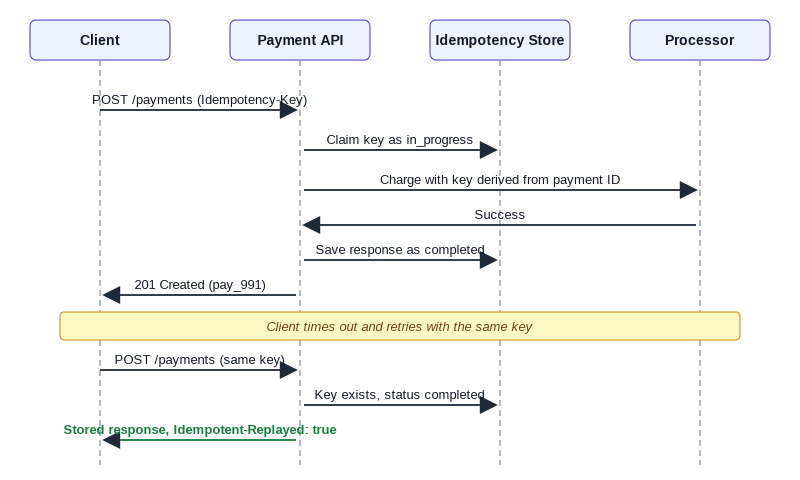
Figure 1. A retry with the same key returns the stored result instead of charging the card again.
Handling concurrent requests with the same key
Retries are not always sequential. A client may time out and resend while the first request is still running. If both reach the server together, a naive implementation runs both.
The fix is to claim the key atomically. Insert a row with a unique constraint on the key before any side effects run, and set its status to in_progress. A second request that arrives during processing finds that row and receives 409 Conflict, which tells the client to retry shortly. By then the first request has usually finished, and the stored response can be returned. Stripe follows this pattern. Blocking the second request on the server instead ties up connections, so use that approach only if your clients cannot handle retries gracefully.
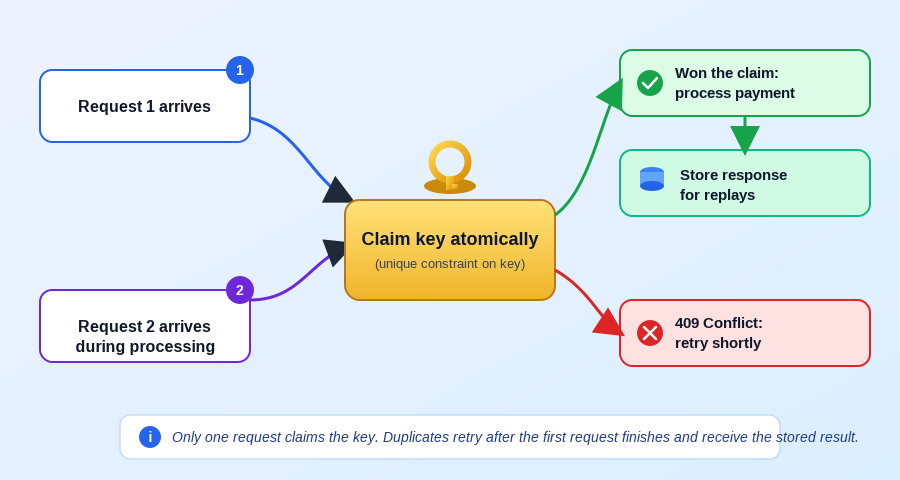
Figure 2. Only one request claims the key. Concurrent duplicates receive a 409 and retry after the first request finishes.
Crashed workers need a plan too. If the first request dies midway, the row stays in_progress indefinitely. Store a timestamp and let stale locks expire after a bounded window. That window must comfortably exceed your slowest legitimate request. If it is too short, a second request can run while the first is still working, and that is how duplicates happen.
Extending idempotency to the payment processor
Your API can be fully idempotent and still double-charge if your call to the external processor is not. Suppose the processor succeeds, and then your server crashes before saving the result. On retry, your server has no record of the success and sends the charge again.
Pass an idempotency key through to the processor if it supports one. Stripe does, and most processors offer an equivalent request ID or idempotency mechanism, so check your provider's documentation. Derive the key from your internal payment ID so every outbound attempt for the same logical payment carries the same value. Generating a fresh random key on each outbound attempt defeats the purpose.
Designing the idempotency store
The store is small but critical, and a few decisions shape how it behaves under load.
Scope keys to the authenticated client. Namespacing prevents one client from reading another's stored responses if a key leaks or is guessed.
Store the full response, including the HTTP status and serialized body, so that a retry receives exactly what the original request received. If those records contain card metadata or customer details, handle them as sensitive data.
Set a retention window, and purge on a regular schedule so the table stays manageable. Stripe prunes keys after a period, and a key reused after pruning is treated as a new request. Choose a window longer than your clients' longest reasonable retry schedule.
Decide deliberately which outcomes to store. Stripe saves the status code and body of the first request, including 500 errors, so a retry with the same key returns the same error. That is a valid design, but it means a transient server failure can stick to a payment the customer never completed. Stripe does not save results when parameters fail validation or when a request conflicts with a concurrent one, which lets those requests be retried. Make the same distinction in your own store.
Commit the key and the business record in the same transaction when possible. If the payment and its idempotency record share a database, writing them together closes the gap where the payment exists but the key does not. That gap is exactly what produces duplicates after a crash.
Which operations need idempotency
Apply keys to operations that create or move money, or that change irreversible state: charges, refunds, payouts, transfers, subscription creation, and anything that triggers a notification a customer will act on. Reads have no side effects and do not need keys. Updates that set a field to the same value are harmless when repeated, so they usually do not need them either.
Refunds deserve particular care. A non-idempotent refund endpoint can refund the same payment twice, and the processor may reject the second attempt only after your ledger has already changed. Validate against the remaining refundable balance inside the same transaction that records the refund.
Designing error responses for retries
Clients can only retry safely if your error responses tell them what to do next.
A 5xx response or a timeout means the outcome is unknown, so retrying with the same key is correct. A 4xx validation failure means the request itself is wrong, and retrying will return the same error. A request that arrives while the original is still running should be told to wait and retry. For a key reused with a different body, conventions vary, so pick one status code, document it, and make sure enterprise customers can map it onto their own error handling. The IETF draft also specifies a 400 response with a link to documentation when the key is missing from an endpoint that requires one, which gives clients a clear fix.
Mark replayed responses with a header such as Idempotent-Replayed: true. It lets clients and your own logs distinguish a fresh operation from a replay. When a customer asks why they received two identical responses, that single header shortens the debugging session considerably.
Support teams need the same clarity. When a customer reports a duplicate charge, the first contact is often an AI-assisted support tool. A first-line assistant built with YourGPT can ask the customer for the payment ID from their receipt and pass it to engineering, so the team can check the stored idempotency record instead of starting from scratch.
Testing idempotency before production
Idempotency bugs rarely appear in happy-path tests. The most valuable test is a concurrency race. Use a barrier to send two identical requests to the server at the same instant, and assert that exactly one side effect occurs. Then test the failure cases: kill the worker after the processor call but before the response is saved, retry, and confirm there is no second charge. Also test key reuse with a different body, and confirm the behavior when a key expires.
Chaos testing in staging, with injected timeouts, catches failure patterns that hand-written tests miss. The only reliable way to find the gap between design and implementation is to simulate the failures that production will produce. Stripe's error handling documentation is a useful reference for which failures are safe to retry.
Questions
Frequently asked questions
What is an idempotency key in a payment API?
It is a unique value the client sends with each attempt of a payment, usually in an Idempotency-Key header. The server uses it to return the original result for retries instead of processing the payment again.
How long should idempotency keys be stored?
Stripe prunes keys after a period and treats a reused key as new once it is pruned. Many teams keep keys for one to three days, which should comfortably exceed the longest retry schedule their clients use.
Do GET requests need idempotency keys?
No. GET requests have no side effects and are already safe to repeat. Keys matter for operations that create or change money or other irreversible state.
What status code should a duplicate request receive while the original is still running?
409 Conflict is a common choice. It tells the client the original request is still in progress and that it should retry after a short delay.
Can one key be reused for different payments?
No. A reused key with a different request body should be rejected, which is why the server fingerprints the body.
Conclusion
Idempotency turns retries from a risk into a routine part of how clients talk to a payment API. The approach that works in production combines a client-generated key, a fingerprint of the request body, an atomic claim on each key, a stable key for the processor, and error responses that tell clients exactly when to retry. Each piece closes a specific gap where a duplicate charge can slip through.
Start with an audit of your existing endpoints. List every operation that moves money, then ask what happens if the response is lost and the client resends. Those answers show where keys are missing and where your processor integration needs the same protection. Teams working on payment infrastructure can apply these patterns to the wider stack, from the store that holds keys to the services that consume payment events.
WebTechOS accepts no payment for coverage, placement or scores. Where a piece references pricing, it reflects published list rates at the date shown.
Keep reading
All insights →Designing Zero-Downtime Database Migration Frameworks
Design a zero-downtime database migration framework with expand and contract, safe backfills, lock budgets, sync, cutover gates and rollback.
Gorgias Alternatives for Small Ecommerce Teams in 2026
Compare the 7 best Gorgias alternatives for small ecommerce teams in 2026. Review pricing, AI automation, features, and support capabilities.
Is ChatGPT or Claude Worth Paying For? 2026 Pricing Breakdown
ChatGPT Plus and Claude Pro both cost $20. Compare Free, Go, Pro, Max and Ultra plans, usage limits and hidden costs to see which is worth paying for.
Best AI chatbot.com alternatives compared in 2026
Compare 7 AI chatbot alternatives for 2026 on resolution claims, pricing, channels and handoff. See where YourGPT, Intercom, Zendesk and Tidio fit.