Claude Fable: How It Compares to Opus and Sonnet
Claude Fable 5.1 explained: how it differs from Opus 5.5 and Sonnet 5.5 on price, speed and capability, plus when the premium is worth paying.
30 Oct 2026·19 min read·General

Anthropic now sells four Claude models whose prices differ by 100x, and the cheaper ones are close enough on many tasks that paying for the top tier is easy to get wrong. Haiku 5.5 costs $0.10 per million input tokens; Claude Fable 5.1 costs $10. Choose badly and you either burn budget on capability you do not need or ship weaker results than you could have.
Fable is the newest and most confusing rung. It sits above Opus, it is the same model as the restricted Mythos tier with different safeguards, and it was pulled offline for almost three weeks this summer. This guide explains what Fable is, how it compares with Opus 5.5 and Sonnet 5.5, where the new Haiku 5.5 fits, and which jobs justify what Fable costs. Every figure was checked on October 27, 2026.
The short answer:
Fable 5.1 ($10 / $50 per million input / output tokens) is for the longest, hardest jobs, and it is the slowest of the four. Test it at lower effort before you pay for high.
Opus 5.5 ($4 / $20) is Anthropic's recommended starting point for most workloads.
Sonnet 5.5 ($2 / $10) is the best value for well-scoped work.
Haiku 5.5 (from $0.10 / $0.50) is for high-volume steps you can check.
A note on method: we did not benchmark these models ourselves. Prices, defaults and safeguards come from Anthropic's own Fable 5.1 announcement and its plan-access help page. Performance figures come from independent testers such as Vals AI and Artificial Analysis, as reported by CatDoes and Taskade, or are labelled vendor-reported. Where a number rests on one tester or one developer's report, we say so.
What is Claude Fable?
Claude Fable is Anthropic's top generally available model tier: a Mythos-class model released with safeguards strong enough that Anthropic gave it its own name. Fable 5.1 and Mythos 5.1 are the same underlying model with different levels of safeguards. Fable is open to everyone. Mythos goes only to vetted organizations through trusted access programs for cybersecurity and life sciences work, and for now only to US organizations.
Fable 5.1 shipped on September 1, 2026 and is aimed at long-running coding, knowledge work and research. It has a 1M-token context window, up to 128K tokens of output and adaptive thinking that is always on, and its API ID is claude-fable-5-1 (AIComparison).
Anthropic's launch post quotes early-access customers describing the job Fable is built for. Ramp reported a 38-hour unattended run on a machine-learning problem. Cognition said it moved Devin's Opus 5 traffic to Fable 5.1 because the new cache pricing made a Fable-class model economical for code review. These are vendor-selected testimonials, not benchmarks, but they show the target: long, tool-heavy sessions where the model keeps working without a human in the loop.
How Fable got here
Date | What happened |
|---|---|
Sep 1, 2026 | Fable 5.1 and Mythos 5.1 released; cache-read price cut by 75% (Anthropic) |
Jul 1, 2026 | Access to Fable 5 restored worldwide (YourStory) |
Jun 30, 2026 | US Commerce Department lifts its export controls |
Jun 12, 2026 | Anthropic suspends Fable 5 and Mythos 5 after a Commerce export-control directive |
Jun 9, 2026 | Fable 5 and Mythos 5 first released |
Apr 7, 2026 | Claude Mythos Preview released to a limited set of partners under Project Glasswing (Taskade) |
The June suspension has its own section further down, because it changes how you should design around any single model.
Claude Fable 5.1 Safeguards and What They Mean for Users
Fable screens requests in sensitive areas and can hand them to an older Opus model, so test your real prompts before you build on it. In the benchmark runs in Anthropic's announcement, cybersecurity tasks that tripped a safeguard were completed by Opus 4.8 and biology tasks by Opus 5. Anthropic notes this likely lowers Fable's scores on those tests.
What Anthropic says changed with Fable 5.1:
Cybersecurity. Claude Code users should see about 60% fewer safeguard interventions per session than on Fable 5. Fable 5.1 may now be used to find software vulnerabilities, but not to build exploits. Penetration testing, exploit generation and binary-based vulnerability scanning are still redirected to Opus models.
Biology. The safeguards fire 85% less often on benign elementary biology and medical questions than they did at Fable 5's launch. Life-sciences research and development queries still go to Opus models, unless you are in the Life Sciences Verification Program, which uses Mythos 5.1.
Data retention. Eligible customers can use Fable 5.1 with zero data retention today. Enterprise Frontier Safeguards, which keep data in infrastructure the customer controls, roll out in phases starting this fall.
Developer note. New API accounts can no longer edit Claude's earlier context in a multi-turn conversation while keeping its thinking transcript. Anthropic says this closes a known distillation technique, and existing accounts are not affected yet.
Watermarking. Text from Fable 5.1 carries an invisible watermark, added to comply with the EU AI Act's transparency code. Anthropic says it has no effect on quality.
For a business buyer, the practical effect is simple. If your work touches security testing or life-science R&D, expect some requests to be answered by a different model, and build a check for that into your evals.
Claude models at a glance
All four current Claude models share a 1M-token context window, 128K tokens of output, text and image input, and a June 2026 knowledge cutoff, so price and speed separate them more than features do (AIComparison).
Model | API ID | Released | Input / output per 1M tokens | Cache reads per 1M | Anthropic's speed rating | Cost of 10M in + 2M out |
|---|---|---|---|---|---|---|
Claude Fable 5.1 |
| Sep 1, 2026 | $10 / $50 | $0.25 | Slower | $200 |
Claude Opus 5.5 |
| Sep 22, 2026 | $4 / $20 | $0.20 | Moderate | $80 |
Claude Sonnet 5.5 |
| Sep 28, 2026 | $2 / $10 | $0.10 | Fast | $40 |
Claude Haiku 5.5 |
| Oct 7, 2026 | $0.10 / $0.50 | $0.01 | Fastest | $2 |
Cost column uses list prices with no caching or batch discount. Haiku 5.5 prices apply to prompts up to 100K tokens; above that they are five times higher. Sonnet 5.5's cache-read price was halved from $0.20 on October 7. Sources: AIComparison, CatDoes, Developers Digest, Anthropic.
The last column is the one to look at. The same workload costs $200 on Fable and $80 on Opus, half of that on Sonnet, and almost nothing on Haiku. Whether Fable is worth 2.5x Opus depends on whether it finishes jobs Opus cannot, and, as the next sections show, on how much of your bill is cache reads.
Claude Fable vs Opus 5.5: Is Fable Worth the Extra Cost?
For most work, Opus 5.5 gets close to Fable-level results at a fraction of the cost, and Anthropic's own guidance says to start there. Its Opus 5.5 launch post places the model at roughly Fable 5.1's level on most tasks (CatDoes), and its model-selection guide tells teams to move up to Fable only when Opus at xhigh or max effort still fails their own evals (AIComparison).
The independent numbers back that up. On the Artificial Analysis Intelligence Index, Opus 5.5 at its default medium effort and Fable 5.1 at its default high effort both score 51. Opus gets there for about $1.34 per task against $3.91 for Fable. Anthropic's own cost guide shows the same pattern on a SWE-bench Pro subset: Opus 5.5 at medium effort scored 92.8% against Fable's 92.3%, a gap inside run-to-run noise, for roughly a fifth of the cost per solved task ($0.22 versus $1.19). Both figures come via CatDoes.
Anthropic's real-world example is a rewrite of the HAProxy load balancer from C to Rust: Opus 5.5 finished in 9.5 hours against 12 for Fable 5.1, and cost 51% less. One developer running a patch-review harness reported Opus 5.5 finding 8 of 14 seeded issues for $15.40 while Fable found 7 of 14 for $66.34, as summarized by Taskade. That is a single report, not a benchmark, but it matches the larger data.
That is also why Opus 5.5 is the default model in Claude Code, the terminal coding agent we score 86/100. Our review notes that costs climb on very large-context tasks, which is exactly where choosing Fable by reflex gets expensive.
Fable's real premium depends on your workload shape
Fable costs 2.5x Opus per token on fresh input and on output, but only 1.25x on cache reads ($0.25 versus $0.20 per million). Anthropic says cache reads make up most of the cost of context-heavy, tool-heavy agent work, so the premium you actually pay depends on what your bill is made of. This is our arithmetic from the list prices above:
Workload shape | Fable 5.1 | Opus 5.5 | Fable premium |
|---|---|---|---|
Chat-style: 10M input, 2M output, no caching | $200 | $80 | 2.5x |
Cache-heavy agent run (illustrative): 500M cache reads, 5M fresh input, 2M output | $275 | $160 | 1.7x |
Cache reads alone, per 1M tokens | $0.25 | $0.20 | 1.25x |
The agent run is an illustration, not a measurement. The break-even rule follows from it: at 2.5x per token, Fable costs less per finished task only if it uses 40% or fewer of the tokens Opus needs, and on the cache-heavy run, 58% or fewer. Anthropic's customer reports of token savings compare Fable 5.1 with older models (Rogo saw 20% fewer tokens than with Fable 5), not with Opus 5.5, so measure the ratio on your own tasks.
Do not compare vendor tables across launch posts
Anthropic's Fable 5.1 post lists Fable at 55.8% on Terminal-Bench 4.0 against 52.3% for Opus 5, the previous Opus. Its Sonnet 5.5 post lists 66.4% for Opus 5.5 on the same benchmark name. Taskade notes that post ran Sonnet at max effort and Opus at xhigh, with 1.5% and 10% of trials sent to a fallback model. The runs differ in effort and fallback rates, so no ranking of Fable 5.1 against Opus 5.5 can be read from them.
Where Fable still earns its price
Hours-long autonomous work. Anthropic recommends Fable for agent sessions that run for hours and for multistep research carried to a finished document, spreadsheet or deck.
Problems Opus has already failed. Millennium told Anthropic that Fable 5.1 explained a crash that happened about once in a million runs and that no engineer or earlier model, Fable 5 included, had explained in four to five years. That is a vendor-selected case, but it is the shape of problem worth escalating.
The quality ceiling on one output. Simon Willison called Fable's max-effort SVG test the best he had seen from any Anthropic model, but it took almost 14 minutes and about $3.30 (CatDoes).
The cost of that ceiling is speed. Artificial Analysis measured Fable 5.1 at about 54 output tokens per second at default effort, against 73 for Opus 5.5 and 102 for Sonnet 5.5.
Claude Sonnet 5.5 vs Opus vs Fable: Price and Performance
On well-scoped tasks, Sonnet 5.5 matches or beats both of its bigger siblings for half the price of Opus. Vals AI's overall index puts Sonnet 5.5 at 67.04% and Opus 5.5 at 66.97%, a gap Vals calls effectively tied, and Sonnet ran it for about two-thirds of Opus's cost per test.
The task-level results from the same testers show why price per token misleads:
Test (max effort) | Sonnet 5.5 | Opus 5.5 | Fable 5.1 |
|---|---|---|---|
Build a web app from a spec, accuracy (Vals Vibe Code Bench) | 92.39% | 90.29% | 90.26% |
Same test, cost per app | $31.25 | $57.92 | $33.37 |
Write clinical notes, accuracy (Vals MedScribe) | 91.10% | 91.43% | 91.29% |
Same test, cost per note | $0.51 | $1.15 | $0.96 |
Source: Vals AI results as compiled by CatDoes on October 4, 2026. Effort settings change these numbers a lot, so treat them as one snapshot, not a ranking.
The most expensive model was not the best app builder. Fable cost almost as little as Sonnet per app and matched Opus's accuracy, but trailed Sonnet. On clinical notes, all three finished within a third of a point of each other, so price decided it.
One more thing changed after those tests. On October 7, Anthropic halved Sonnet 5.5's cache-read price from $0.20 to $0.10 per million tokens, which it says cuts Sonnet's cost on most agentic work by around 20% (Developers Digest). The CatDoes cost figures predate that, so Sonnet's advantage on long agent loops is now larger than the table shows.
Where Opus still beats Sonnet
Anthropic is direct about this: Opus 5.5 stays clearly stronger on complex, open-ended work that needs sustained judgment (CatDoes, quoting Anthropic). On the Artificial Analysis Intelligence Index at default effort, Sonnet 5.5 scores 47 against 51 for Opus and Fable. That gap shows up when a task is ambiguous, spans many files, or runs for hours without a spec.
Sonnet also has an effort trap. At max effort, Artificial Analysis measured about $7.67 per task for Sonnet 5.5, more than the $5.98 it measured for Opus 5.5. The effort section below shows what max effort does to a simple task.
The rule of thumb
Sonnet 5.5 when the task is clear and the output is checkable.
Opus 5.5 when the task is open-ended or an agent will run unattended for hours.
Fable 5.1 when Opus has demonstrably failed on your own evals.
Claude Haiku 5.5: Is It Worth Using?
Haiku 5.5 changes the routing math: at $0.10 / $0.50 per million tokens for prompts up to 100K tokens, it is the cheapest way to run the steps that do not need judgment. Anthropic released it on October 7, 2026 and says it costs about 75% less to run than Haiku 4.5 on average (Developers Digest, summarizing Anthropic's announcement). It is also the first Haiku with an adjustable effort setting, and it defaults to medium.
The vendor-reported benchmarks show where it stops:
Benchmark (vendor-reported) | Haiku 4.5 | Haiku 5.5 | Sonnet 5.5 |
|---|---|---|---|
Terminal-Bench 4.0 (terminal coding agents) | 0.0% | 39.2% | 70.6% |
OSWorld 2.1, offline subset (computer use) | 15.7% | 72.4% | 83.9% |
Humanity's Last Exam, no tools | 10.2% | 45.9% | 56.9% |
GDPval-AA v2.1 (knowledge work, Elo) | 735 | 1620 | 1840 |
Source: Anthropic's launch figures as tabulated by Developers Digest. These are not independent runs.
Haiku 5.5 is a large step up from Haiku 4.5 and close to Sonnet on computer use, but far behind on terminal-driven coding. Anthropic's own guidance, as reported there, keeps Sonnet and Opus for complex agentic coding and points Haiku at narrower tasks such as summaries, compaction, database queries, classification and sub-agents.
The 100K-token cliff
The low price applies only to prompts up to 100,000 tokens. Above that, every rate is five times higher ($0.50 / $2.50). Haiku 5.5 also uses the newer tokenizer, which produces roughly 30% more tokens for the same text than Haiku 4.5, and the cutoff is counted in the new tokens. A prompt that was 90K tokens on Haiku 4.5 is about 117K on Haiku 5.5 and lands in the higher tier. Anthropic's 75% average saving already includes this effect, but your own prompts may sit on either side of the line, so count tokens with claude-haiku-5-5 before you project savings.
Effort levels: the dial that moves your bill
Effort changes what a task costs more than the model name does. The same Sonnet 5.5 request cost 1.6 cents at low effort and $1.28 at max, and at max it returned nothing.
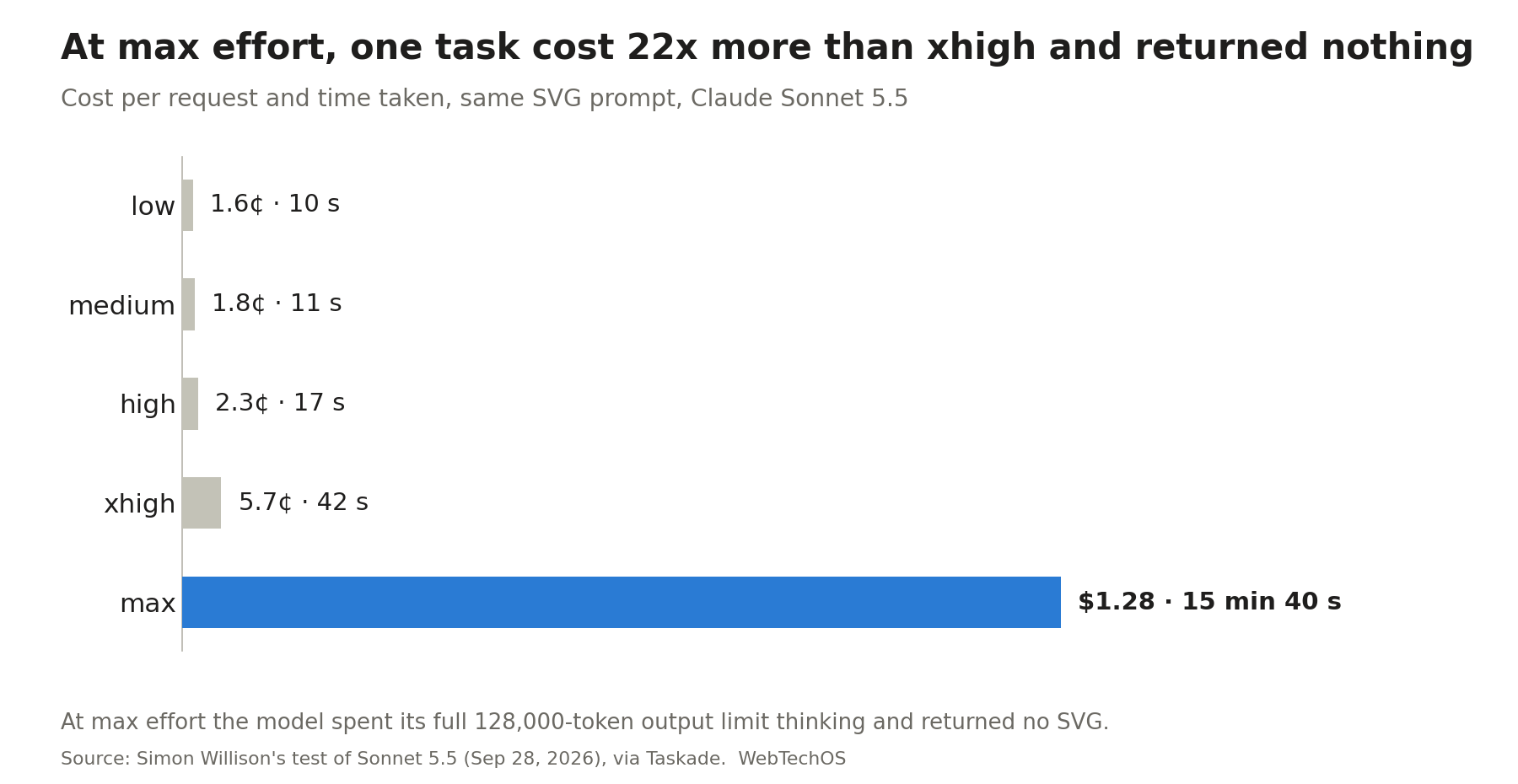
The measurements are Simon Willison's, posted in the Sonnet 5.5 launch thread and summarized by Taskade. CatDoes reports the same behavior on Opus 5.5 a week earlier: at max effort it too used its whole output budget thinking and returned no SVG. It is one simple prompt, not a benchmark, but it shows why max is a special tool rather than a quality setting.
Each model starts from a different default:
Model | Default effort |
|---|---|
Fable 5.1 | High in Claude Code; medium in Claude Cowork and on claude.ai (Anthropic) |
Opus 5.5 | Medium (CatDoes) |
Sonnet 5.5 | High on the API, medium in the Claude apps (Taskade) |
Haiku 5.5 | Medium (Developers Digest) |
Two things follow. First, Anthropic says that at low or medium effort Fable 5.1 achieves results similar to or better than Fable 5's at a much lower cost. So test Fable at medium effort before you write it off on price, because the premium is partly an effort choice. Second, Anthropic's model guide says tuning effort is often a better lever than switching models, so change the dial before you change the tier.
Which Claude model should you use?
Start at the cheapest tier that could plausibly work and move up only when your own tests show a gap.
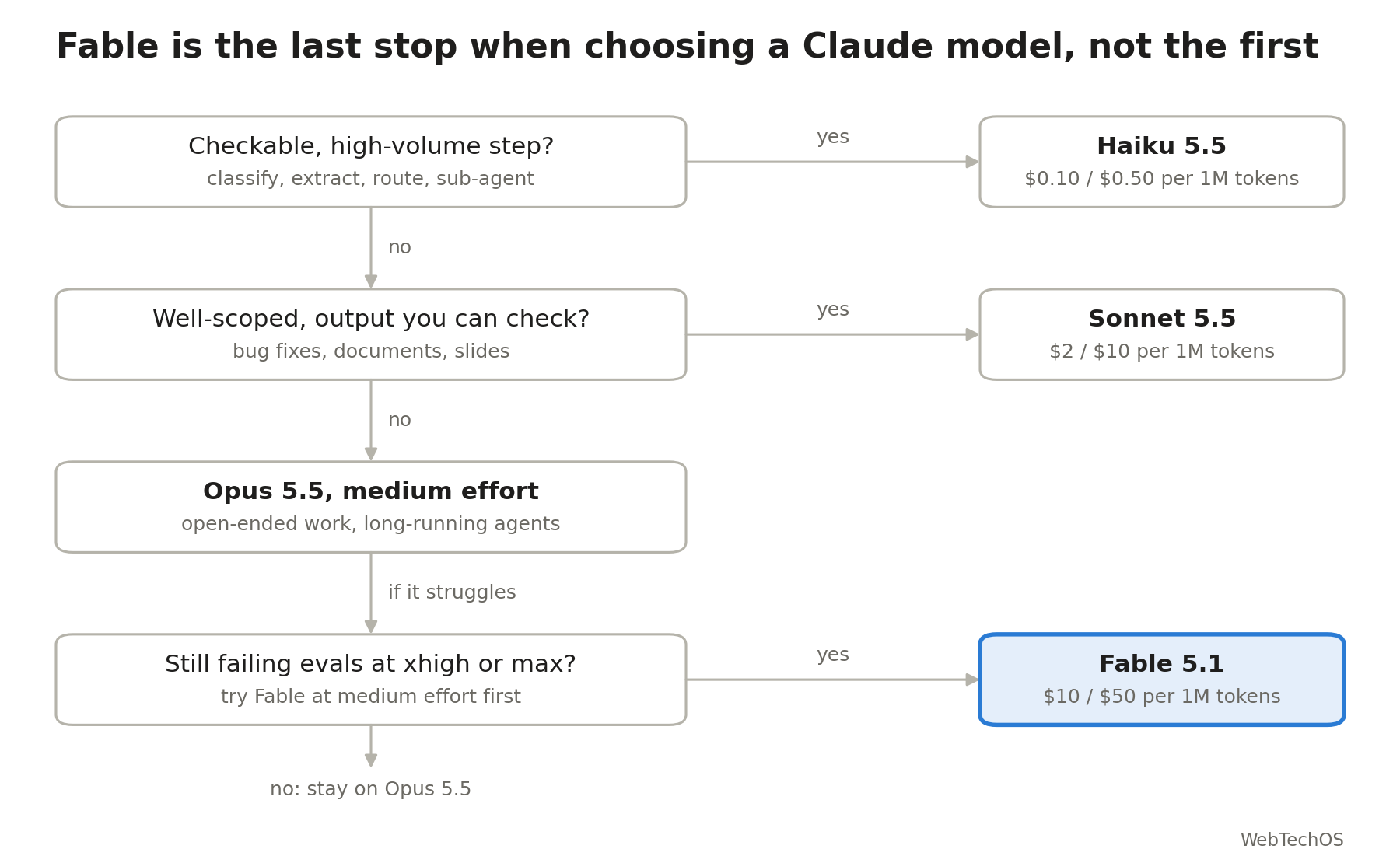
Haiku takes checkable volume, Sonnet takes clear tasks, Opus takes open-ended work, and Fable is the escalation for what Opus has already failed. Three habits matter more than any single model pick.
Build a small eval set from your real work. Anthropic calls this the most important step in choosing a model (AIComparison). Twenty to thirty real prompts with a pass/fail check is enough to see whether Sonnet's discount or Fable's premium pays off for you, and to catch requests that a Fable safeguard hands to Opus. Tracing and evaluation tools such as LangSmith make the replay and scoring part cheap, and our head-to-head of LangSmith vs Braintrust covers how they differ.
Route instead of picking one model. The cheapest pipelines send easy steps to Haiku or Sonnet and keep Opus or Fable for planning and the hard calls. Anthropic positions Haiku 5.5 as a sub-agent under Opus or Sonnet (Developers Digest). If you are wiring Claude into long-running agents, the AI Agent Hub stack shows one way to assemble the orchestration, tracing and hosting around the model so a bad run can be replayed instead of debated.
Match the tool to the job. If your goal is coding help rather than raw API access, the harness matters as much as the model. Whether you want an editor or a terminal agent is a separate decision, and our comparison of Cursor vs Claude Code walks through it.
Claude Fable pricing, plans and access
Fable 5.1 costs $10 per million input tokens and $50 per million output tokens on the Claude API, the highest in the lineup, and the 5.1 release cut the price of cache reads by 75% to $0.25 per million. Anthropic estimates that lowers typical workloads by around 25% against Fable 5 and highly agentic work by up to about 45%, with all other prices unchanged. Batch processing halves the rate to $5 / $25, and the full 1M-token window is billed at the standard rate with no long-context surcharge (Taskade). Fable 5.1 is available on the Claude Platform, Amazon Web Services, Google Cloud and Microsoft Azure.
Who gets Fable on a Claude plan
Anthropic's help center says Fable 5.1 is on every paid plan, but it works differently by tier:
Plan or seat | How Fable 5.1 works |
|---|---|
Max, premium Team seats, premium seat-based Enterprise seats | Included: up to 50% of your weekly usage limits at no extra cost, then usage credits or a switch to another model |
Pro, standard Team seats, standard seat-based Enterprise seats | Not part of plan limits; runs on pay-as-you-go usage credits |
Usage-based Enterprise and the Claude API | Standard API rates |
Free | Not available |
Fable draws down your limits faster than other Claude models. In Claude Code, Fable 5.1 needs version 2.1.255 or later, and Claude Cowork needs the latest Claude Desktop. Anthropic lists it on Claude on the web, mobile, desktop, Cowork, Claude Code, Claude Design, Claude for Microsoft 365 and Claude Tag.
Budgeting for a premium model
Token metering is the most transparent way to pay for AI and the hardest for finance teams to forecast, a tension we dig into in our look at how agent pricing models are shifting. With Fable, a runaway agent loop costs up to 2.5x what it would on Opus, so set spend caps before you let it run unattended, and count cache reads separately from fresh tokens when you forecast.
The June 2026 pause, and what it means for how you build
A model you depend on can disappear for reasons that have nothing to do with your code, and Fable already did. On June 12, 2026, three days after Fable 5's public launch, the US Commerce Department issued an export-control directive requiring Anthropic to block foreign nationals from Fable 5 and Mythos 5. Anthropic could not verify nationality in real time, so it disabled both models for everyone (YourStory).
Reporting links the directive to a security finding, reportedly raised by Amazon researchers, that a jailbreak could get Fable 5 to identify software vulnerabilities and, in one case, produce exploit code. Anthropic disputed how serious that finding was. Commerce lifted the controls on June 30, after Anthropic added new safeguards and agreed to detect security risks proactively and to coordinate with the government on testing and release standards. Access returned on July 1.
Supporters of the intervention say oversight helps manage national security risk from advanced models. Critics say ad hoc export actions create unpredictability for customers and for the companies building on these models. Fable 5.1, released two months later, shipped with revised safeguards, and Anthropic says external testing found no critical-severity jailbreak of its cybersecurity safeguards (Anthropic).
You do not have to take a side to take the practical lesson:
Keep the model name in a config file, not scattered through your code.
Test a fallback, such as Opus 5.5, before you need it.
Do not make Fable the only path for work with a deadline.
Questions
Frequently asked questions
What is Claude Fable 5.1?
Claude Fable 5.1 is Anthropic's most capable model that is open to all customers, released on September 1, 2026. It is the same model as Mythos 5.1 with different safeguards, and it costs $10 / $50 per million input / output tokens.
Is Claude Fable better than Opus 5.5?
It is more capable on the longest, hardest tasks, but the evidence for most work is close. Opus 5.5 at default effort matched Fable 5.1 at default effort on the Artificial Analysis index for about a third of the cost per task. Anthropic's launch posts report results under different settings, so do not read a ranking off them. Test both on your own tasks.
Is Claude Fable 5.1 worth the price?
For most teams, not as a default. At 2.5x Opus per token on fresh input and output, it must use 40% or fewer of Opus's tokens to cost less per finished task. It pays off on multi-hour agent work, on problems Opus has already failed, and on cache-heavy workloads where its premium shrinks toward 1.7x.
What is the cheapest way to use Fable 5.1?
Lean on cache reads, which cost $0.25 per million tokens, use the Batch API for work that can wait, which halves the rate, and test Fable at low or medium effort, where Anthropic says it matches or beats Fable 5 at a much lower cost. Send easy steps to Sonnet or Haiku.
Can I use Fable in Claude Code?
Yes. Claude Code needs version 2.1.255 or later for Fable 5.1, and Fable defaults to high effort there. On Pro and standard Team seats it runs on usage credits rather than plan limits.
Why did Claude answer with Opus when I picked Fable?
A safeguard redirected the request. Penetration testing, exploit generation, binary-based vulnerability scanning and life-sciences research and development are still routed to Opus models.
Does Fable 5.1 keep my data?
Eligible customers can use it with zero data retention today. Anthropic's Enterprise Frontier Safeguards, which keep data in infrastructure you control, roll out in phases starting this fall.
Is Fable available on AWS, Google Cloud and Azure?
Yes. Anthropic lists Fable 5.1 on the Claude Platform, Amazon Web Services, Google Cloud and Microsoft Azure.
What is Mythos 5.1, and can I get it?
Mythos 5.1 is the same model as Fable 5.1 with more permissive safeguards for vetted cyberdefenders and life scientists, through the Cyber Verification Program and the Life Sciences Verification Program. For now it is limited to a set of US organizations.
Is Claude Fable free?
No. Fable is not on the Free plan. On paid plans it is included within usage limits on Max and premium seats, and runs on usage credits on Pro and standard seats.
What replaced Claude Haiku 4.5?
Claude Haiku 5.5, released on October 7, 2026, is the current small model. It costs $0.10 / $0.50 per million tokens for prompts up to 100K tokens, and it is the first Haiku with an adjustable effort setting.
Why was Claude Fable taken offline in June 2026?
Anthropic suspended Fable 5 and Mythos 5 on June 12, 2026 to comply with a US Commerce Department export-control directive. The controls were lifted on June 30 and access returned on July 1.
Conclusion
Claude Fable 5.1 is the strongest model Anthropic sells to everyone, but for most teams it is the escalation, not the default. Opus 5.5 gets close for 40% of the price, Sonnet 5.5 wins on well-scoped work for less, and Haiku 5.5 handles high-volume steps for pennies. Reach for Fable when a job runs for hours or Opus has already failed it, and test it at medium effort before you pay for high.
To put this to use today, run 20 to 30 of your real prompts through two tiers and compare cost per passed task, not price per token. Cap spend on any agent that runs unattended, and keep Opus 5.5 wired in as a tested fallback. This lineup has changed roughly every month since June, so revisit the choice often. For the tools that sit on top of these models, our AI developer tools category scores them side by side, and our methodology page explains how.
WebTechOS accepts no payment for coverage, placement or scores. Where a piece references pricing, it reflects published list rates at the date shown.
Keep reading
All insights →Claude vs ChatGPT vs Gemini vs Grok: The 2026 Showdown
Claude, ChatGPT, Gemini and Grok compared after October’s launches: which fits coding, writing and teams, what each plan costs, and where benchmarks mislead.
ChatGPT vs Claude: An Honest Comparison After Testing Both
I tested ChatGPT and Claude on editing, research, coding, document analysis, and long-form writing. See where each one led and where both made mistakes.
Grok 5 vs Claude: Is It Worth Switching?
Grok 5 isn't out yet. See how Grok 4.7 compares with Claude on independent benchmarks, cost per task, coding and plans.
I tested dozens of free SEO AI tools in 2026
Free SEO AI tools often stop after a few searches or hide the good features behind a paid plan. See what each free plan includes and where the limits are.