Claude Opus vs Sonnet: Which Model Should You Pay For?
Is Claude Opus worth double the price of Sonnet? Compare 5.5 pricing, benchmarks and a break-even rule to pick the right model for your work.
3 Nov 2026·20 min read·General

Opus 5.5 costs exactly twice as much as Sonnet 5.5 per token. Yet in one independent test of long agentic tasks at maximum effort, Opus was the cheaper model to run. That contradiction is why choosing between them takes more than comparing two price tags.
Where you use Claude changes the question, too. On a $20 Pro plan both models are included, so you are choosing a default, not a price. Through the API, you choose the rate every token is billed at. On a team plan, people quietly default to whichever model sounds smartest. Pick wrong in the app and you lose a few minutes to retries. Pick wrong at API scale and you overspend by hundreds of dollars a year, or ship weaker work where a miss is costly.
The short answer: make Sonnet 5.5 ($2 input, $10 output per million tokens) your default for any job where you can say in advance what a correct result looks like. Pay for Opus 5.5 ($4 and $20) when the hard part is deciding what to do, when a missed detail is expensive, or when you would otherwise run Sonnet at its highest effort setting. Below you will find the prices, the benchmarks and a break-even rule you can apply to your own work.
A note on method: we did not run our own benchmark for this piece. Prices, model specs and positioning come from Anthropic's pricing docs, model pages and Sonnet 5.5 launch post, checked in late October 2026. Independent performance figures come from Artificial Analysis and a CodeRabbit code-review test, and we flag which numbers are vendor-reported. The break-even analysis is our own, worked from those published figures. Opus 5.5 also tops the index we used when we compared Claude, ChatGPT, Gemini and Grok, so some of the same data appears here in more detail.
Claude Opus vs Sonnet: the quick answer
Start with Sonnet 5.5 and escalate to Opus 5.5 when the work gets ambiguous or the stakes get high. Here is how that plays out for the most common buyers.
If you are... | Use | Why |
|---|---|---|
A solo user or freelancer in the Claude app | Pro at $20, Sonnet by default | You get Opus on the same plan, so switch up only for hard problems |
A developer in Claude Code all day | Pro, or Max if you hit limits; Sonnet for routine tasks | Sonnet matches Opus on several coding tests and runs faster |
A team running high-volume API work (triage, extraction, drafts) | Sonnet, ideally through the Batch API | Half the token price, and the work has a clear right answer |
A team running long agents or reviewing risky changes | Opus | A missed issue costs more than the token premium |
Anyone who would run Sonnet at maximum effort | Opus | It was cheaper per task and stronger in independent testing |
Two more models sit at the edges. Haiku 5.5 is the budget tier for simple classification and extraction, and Fable 5.1 is the premium tier above Opus. We cover where they fit near the end.
What actually separates Opus 5.5 from Sonnet 5.5
Very little on paper except price and speed. Anthropic released Opus 5.5 on 22 September 2026 and Sonnet 5.5 six days later, so for once you are comparing two models from the same generation. If an article you are reading quotes Opus 4 or Sonnet 4.5 numbers, treat it as out of date.
Spec | Sonnet 5.5 | Opus 5.5 |
|---|---|---|
API price per million tokens (input / output) | $2 / $10 | $4 / $20 |
Batch API price (input / output) | $1 / $5 | $2 / $10 |
Cache reads | 5% of input price ($0.10) | 5% of input price ($0.20) |
Context window | 1M tokens | 1M tokens |
Maximum output (Messages API) | 128K tokens | 128K tokens |
Knowledge cutoff | June 2026 | June 2026 |
Default effort on the API | High | Medium |
Speed label in Anthropic's docs | Fast | Moderate |
Measured output speed | about 127 tokens per second | about 91 tokens per second |
Claude app plans | Free, Pro, Max, Team, Enterprise | Pro, Max, Team, Enterprise |
The context window is a tie, so it is not a reason to pay more. The differences that matter are positioning, effort defaults and how many tokens each model spends on a job.
Anthropic frames Sonnet as the model for well-scoped everyday work such as fixing bugs and producing polished documents, slides and spreadsheets. It frames Opus as the stronger choice for open-ended work that needs sustained judgment. That is vendor positioning, but the independent numbers below mostly back it up.
One trap for anyone running their own tests: a request with no effort setting runs Sonnet at high and Opus at medium on the API, while Sonnet defaults to medium in the Claude apps. Anthropic's launch post also says Sonnet 5.5 pairs best with Opus at lower effort settings, where it costs less per task. Set effort explicitly on both models, or the comparison is not fair.
Claude Opus vs Sonnet pricing: three different bills
The phrase "which model should you pay for" hides three separate purchases. Each has a different answer.
In the Claude app
On consumer and team plans, you do not pay per model. You pay for a plan, and the plan decides which models you can open.
Plan | Price (USD) | Models included | Worth knowing |
|---|---|---|---|
Free | $0 | Sonnet and Haiku | No Opus, no Claude Code |
Pro | $20 monthly, or $17 billed annually | Sonnet, Opus, Claude Code | Fable is available through credits |
Max | $100 (5x Pro usage) or $200 (20x) | All models | Fable 5.1 has its own access rules |
Team | Standard seat $20 billed annually, $25 monthly | Sonnet and Opus | Premium seats are $100 or $125 |
Plan prices are US list rates reported at the end of October 2026. Confirm them on Anthropic's pricing page before you buy.
Usage limits are the catch. Paid plans have a session limit that resets every five hours plus weekly limits, and what you burn depends on conversation length, features, model and effort. Anthropic does not publish a fixed Sonnet-to-Opus exchange rate, so do not assume Sonnet gives you twice as many messages. One more wrinkle: the Research feature runs on Opus 5.5 no matter which model you picked for the chat.
For most individuals, the answer is simple. Pro gives you both models, so you are not choosing a model to pay for. You are choosing a default, and upgrading to Max only if you keep hitting limits.
In the API
Here the price per token is the whole story. Prices are per million tokens.
Model | Input | Output | Batch API (input / output) |
|---|---|---|---|
Haiku 5.5 | $0.10 | $0.50 | $0.05 / $0.25 |
Sonnet 5.5 | $2 | $10 | $1 / $5 |
Opus 5.5 | $4 | $20 | $2 / $10 |
Fable 5.1 | $10 | $50 | $5 / $25 |
Haiku's rate applies to prompts up to 100K tokens and rises above that. Sonnet, Opus and Fable keep one rate across the full 1M-token window.
Opus 5.5 also has a fast mode, listed at $8 input and $40 output per million tokens, for work where latency matters more than cost. It is not available through the Batch API.
What the price gap looks like in practice
The per-token gap is exactly 2x. The per-job gap depends on volume and on how many tokens each model spends.
High volume, simple job. Triaging 6,000 support tickets a month, at roughly 2,000 tokens in and 300 out each, is 12 million input and 1.8 million output tokens. Sonnet costs about $42 a month and Opus about $84. That is roughly $504 a year for a result that does not improve, and the Batch API halves both bills if the work can wait.
Low volume, high stakes. A monthly board report with 50,000 tokens in and 3,000 out costs about 13 cents on Sonnet and 26 cents on Opus. Paying 13 cents extra for a sharper read is an easy call.
A coding agent run. Say 100K fresh input tokens, 300K cache reads and 40K output tokens. On Opus that is $0.40 + $0.06 + $0.80 = $1.26. On Sonnet with the same token counts it is $0.20 + $0.03 + $0.40 = $0.63.
That last example assumes both models spend the same tokens, and in practice they often do not. That is the question the next section answers.
Token pricing is the most transparent billing model and the hardest to forecast, so model your expected volume against each billing shape before you compare headline rates. Batch (50% off) and cache reads (5% of the input price on both 5.5 models) change the answer for repeat workloads, so include them in the model.
How many extra tokens can Sonnet burn before Opus is cheaper?
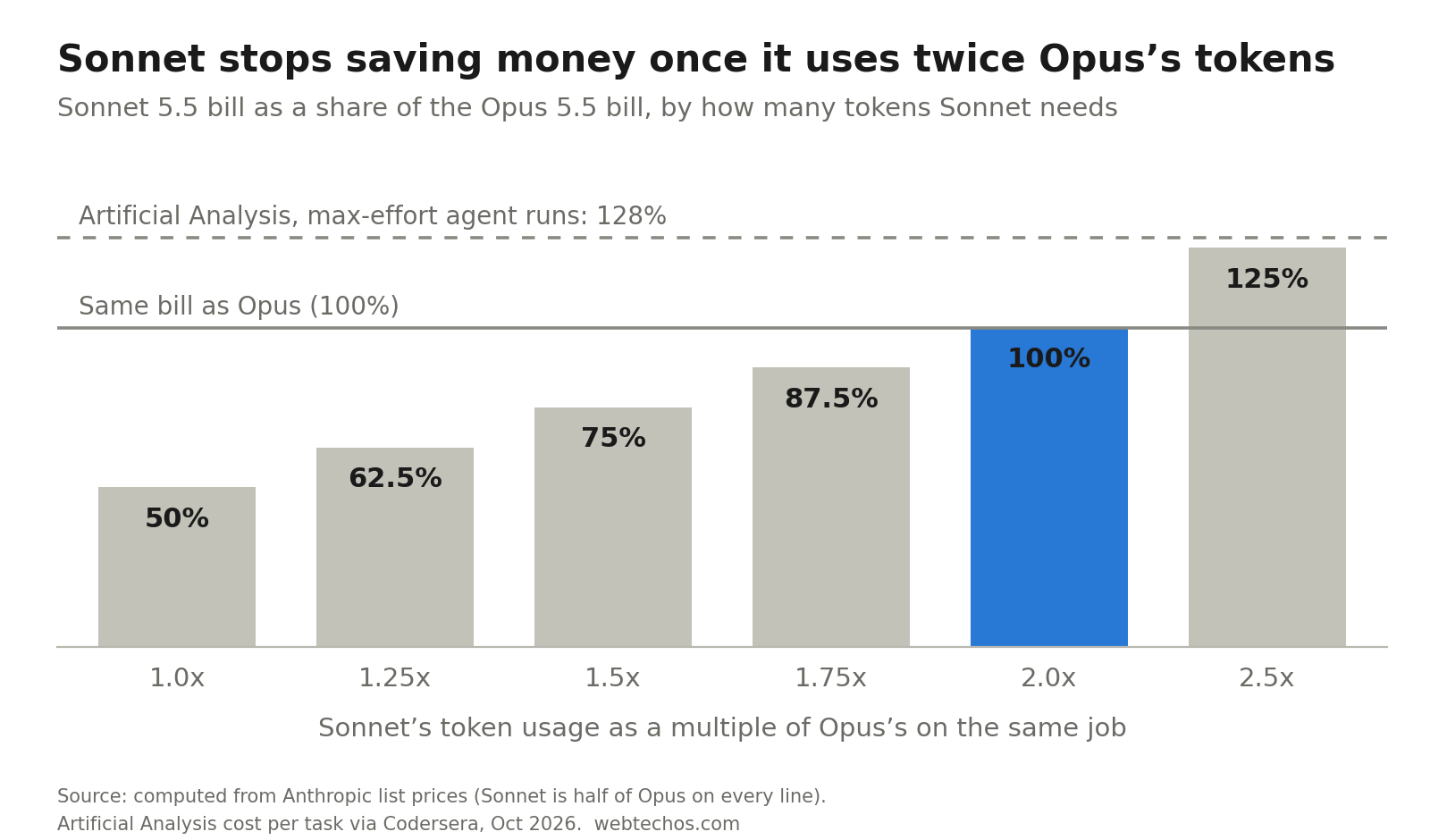
Sonnet 5.5 is priced at exactly half of Opus 5.5 on every line of the price sheet: input, output, cache reads and batch. That makes the break-even easy to work out. If Sonnet needs the same tokens as Opus for a job, its bill is 50% of Opus's. If it needs twice as many, the bills are equal. Beyond that, the cheaper model is the more expensive one.
[embed: node/19472c44-3296]
Independent testing landed on the wrong side of that line for long agentic work. At maximum effort, Artificial Analysis measured a cost of $7.67 per task on Sonnet and $5.98 on Opus, so Sonnet's bill was about 128% of Opus's. Output tokens alone were 193K against 119K, a 1.6x multiple. Total billed usage rose faster than that, because long agent runs re-send context on every turn.
Anthropic's own guidance points the same way: Sonnet 5.5 complements Opus best at lower effort settings, where it costs less per task. That gives you three working rules:
Low or medium effort, short well-scoped jobs: expect Sonnet's discount to hold, with a bill somewhere between half and four-fifths of Opus's.
Maximum effort or long agent runs: expect the discount to shrink or reverse, and test Opus.
Either model: log billed tokens per accepted result for a week before you commit a workload.
How Opus 5.5 and Sonnet 5.5 perform in practice
The gap is real but narrow, and it sits in specific places. Opus leads on most of Anthropic's own benchmark table, usually by a few points, while Sonnet wins one coding test outright.
Benchmark | Sonnet 5.5 | Opus 5.5 | Who leads |
|---|---|---|---|
Terminal-Bench 4.0 (vendor-reported) | 70.6% | 66.4% | Sonnet |
CursorBench 4.0 (vendor-reported) | 55.5% | 57.8% | Opus, by 2.3 |
FrontierCode 1.1, max effort (vendor-reported) | 46.2% | 54.4% | Opus, by 8.2 |
GDPval-AA v2.1, knowledge work (vendor-reported) | 1844 Elo | 1846 Elo | Effectively a tie |
Humanity's Last Exam, with tools (vendor-reported) | 64.5% | 67.7% | Opus, by 3.2 |
Artificial Analysis Intelligence Index (independent) | 56.0 | 57.6 | Opus |
AA-Omniscience factual accuracy (independent) | 54% | 66% | Opus |
Hallucination rate, lower is better (independent) | 47% | 59% | Sonnet |
Two footnotes keep this table honest. Anthropic ran Opus at its extra-high effort setting on Terminal-Bench, so that row is not a like-for-like comparison. And Sonnet's FrontierCode score at maximum effort understates it, because Anthropic reports 52.1% at extra-high effort, which shrinks the gap to about two points.
Read the table in two layers. The vendor-reported rows come from Anthropic's launch post, and they show a cheaper model closing most of the gap: Anthropic says Sonnet 5.5 at Max effort performs comparably to Opus 5.5 on several evaluations. The independent rows add what vendor tables leave out, which is how much each model knows and how often it guesses.
That second layer shows a trade-off rather than a winner. Opus answers more factual questions correctly, 66% against 54%, but it also guesses more when it does not know. Sonnet is faster, at roughly 127 output tokens per second against about 91, and more willing to say it does not know. For tools that answer from your own documents, that habit is arguably the safer one. For questions the model must answer from memory, Opus is the better bet.
A benchmark gap of a point or two is closer to a tie than a ranking, and none of these tests measure how much review time your own work needs. The next two sections apply the numbers to the jobs most readers actually run.
Claude Opus vs Sonnet for coding
For scoped coding, Sonnet is close enough that the choice comes down to cost and speed. For open-ended engineering, Opus still has a measurable edge.
Anthropic's table shows Sonnet 5.5 leading on Terminal-Bench 4.0 (70.6% against 66.4%), trailing by about two points on CursorBench (55.5% against 57.8%), and trailing on FrontierCode, the hardest test in the set (46.2% at max effort and 52.1% at extra-high, against 54.4% for Opus). The pattern is consistent. Sonnet does well when the task has a clear shape and falls behind when it needs sustained planning.
CodeRabbit's code-review test shows what that means in practice. On 13 known issues, Sonnet 5.5 caught 6, at about 46 cents a review. Opus 5.5 caught 8 at standard effort and 10 at maximum effort. CodeRabbit's conclusion was that Sonnet suits routine pull requests but is not a replacement for Opus on high-risk changes. Thirteen cases is a small sample, so treat it as a direction.
A workable split:
Sonnet at medium effort: a reproducible bug with a failing test, a small feature with a written spec, terminal and DevOps agent tasks, routine pull request review.
Opus: an unfamiliar failure nobody has diagnosed, architecture decisions, changes across many interdependent files, and review of auth, payments or migrations.
Both: let Opus plan and Sonnet implement, using the
opusplanmode covered below.
Whichever model you pick, review is the bottleneck. We have argued that coding tools should be judged on the size and legibility of their diffs, not on how much they can do unattended. The same test applies here: if one model's changes take longer to review, its token savings are gone.
Claude Code, which scores 86 out of 100 in our index, lets you set the model per session and defaults both models to medium effort, so check your session with /model. If you are still choosing between a terminal agent and an editor, our comparison of Cursor vs Claude Code covers that decision separately from the model question.
Claude Opus vs Sonnet for writing
Sonnet is the default for writing where you supply the facts and the format. Opus earns its price when the writing is also analysis.
Anthropic positions Sonnet 5.5 for polished documents, slides and spreadsheets, and on its knowledge-work benchmark the two models sit within two Elo points (1844 against 1846). Emails, summaries, customer updates and reports built from approved notes are bounded transformations, and bounded transformations are where Sonnet's lower price and faster output pay off.
Opus is the better starting point when the argument has to be discovered rather than transcribed: a strategy memo that reconciles conflicting customer interviews, an investor update that must weigh a weak assumption, or a long article that has to hold one structure across 2,000 words.
One published test shows the kind of difference to expect. The SEO Agent ran a single article brief three times on each model at API default effort. All six drafts met the hard rules: the exact title, five H2 sections in order, the word range and no banned phrases. The differences were in softer rules. Every Opus lead stayed inside the brief's sentence limit, while one Sonnet lead ran a sentence over. Two of the three Sonnet drafts also added a claim the brief had not supplied. Sonnet's median draft cost about 3.8 cents against about 7 cents for Opus, and took 27 seconds against 30. Three runs each is a test, not a benchmark, but it fits the pattern above: Sonnet executes well and drifts a little more.
Route by stage, not by habit. Use Sonnet for outlines, briefs, metadata and first drafts you will rewrite anyway, and Opus for the final long-form draft and the edit. Switch between stages rather than mid-draft, or the voice can change at the seam. Whichever model writes it, check every claim the brief did not supply against a source. If you want purpose-built tooling for brand voice and editorial workflow, our AI writing tools category covers the options.
When Claude Opus is worth the extra money
Opus earns its premium when the job is long, open-ended and hard to check, because a weak answer is expensive to catch later. The test is not how big the task looks. It is how costly a wrong first decision would be.
Migrations and audits across many systems. Replacing an authentication service while keeping live customer sessions means finding hidden dependencies before anyone writes a line. A plausible but wrong first plan wastes the whole run.
Questions answered from the model's own knowledge. The 66% versus 54% accuracy gap shows up when the model cannot lean on a document you supplied.
Dense, ambiguous documents. Reading a 60-page tender, reconciling conflicting evidence, or untangling a messy financial model is judgment work, and judgment is where Anthropic says Opus pulls ahead.
Anything you would run at maximum effort. In Artificial Analysis's testing, Opus was cheaper per task than Sonnet at that setting, and stronger.
High-stakes engineering review. One missed bug in payments or auth can cost more than a year of the token premium, as the review test above suggests.
A rule that holds across all of these: move to Opus when the missing ingredient is judgment, not when the prompt just needs clearer instructions. A vague request with no source material stays vague on the more expensive model.
When Sonnet is the smarter buy
Sonnet wins any job that repeats often, has a clear right answer and can be checked cheaply. In those cases the extra Opus spend buys you nothing you can see.
High-volume workflows. Support triage, invoice field extraction, lead-reply drafts and inbox sorting all have an answer you can verify. Run them on Sonnet, push anything that can wait through the Batch API, and use prompt caching for shared instructions.
Latency-sensitive chat. At roughly 127 tokens per second, Sonnet feels quicker when a customer or colleague is waiting on the reply.
Answers grounded in your own documents. Its lower hallucination rate and willingness to say it does not know make it a reasonable engine for retrieval-based tools, provided you still spot-check citations.
Documents, slides and spreadsheets from supplied material. On the knowledge-work benchmark the two models are within two Elo points, so if you supply the sources and the format, Sonnet delivers.
Subagents and bulk steps. When one stronger model plans and many workers execute, the workers are usually Sonnet.
Sonnet is also the model on Claude's Free plan, which makes it the easiest way to test a prompt before you pay for anything.
The habit worth building is to lower effort before you raise the model. Anthropic's own guidance treats effort as the first dial to tune, and a well-specified job at low or medium effort on Sonnet is often all you need. Reaching for Opus first can mean paying double to fix a prompt problem.
A simple way to decide, and how to mix both
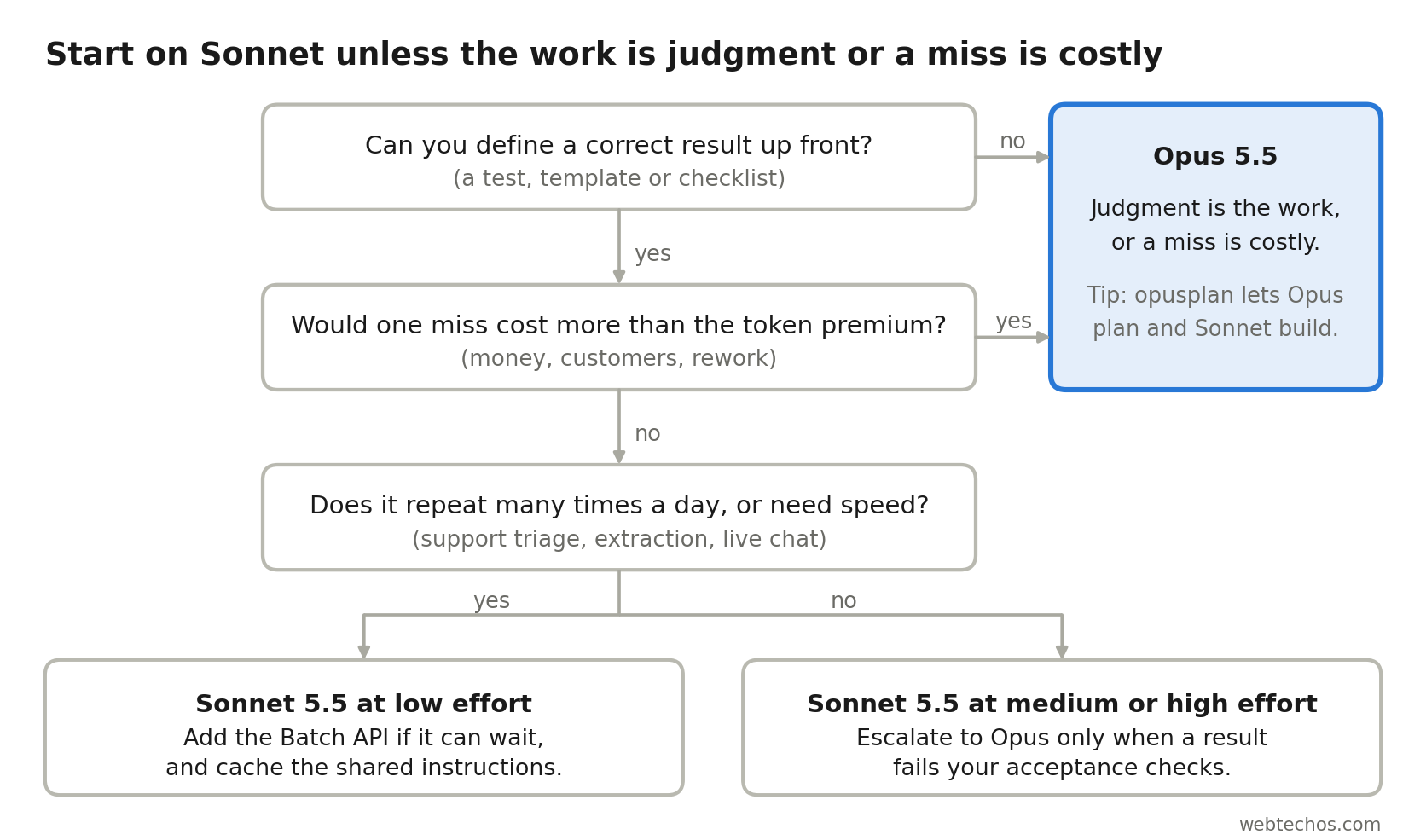
Use the flow below as a first cut, then confirm it with a short test on your own work.
[embed: node/f2dda6ae-5bc8]
Opus is the exception you reach by answering "no" to the first question or "yes" to the second. Everything else starts on Sonnet, with effort kept at medium until a result fails your checks.
Define done before you start. Write down the tests, checklist or approved sources that prove a result is correct. If you can, start on Sonnet.
Price a miss. If one wrong output costs more than the token premium, such as a flawed migration plan, start on Opus.
Run 20 real examples on both models at the same explicit effort. Set effort yourself, because the API defaults differ. Log tokens, retries and review time.
Compare cost per accepted result, not cost per response. Two failed Sonnet attempts plus one fix can cost more than one clean Opus run.
Keep the cheaper model that passes, and escalate only the failures.
If you run this as a product rather than a one-off, you will want traces and scored evaluations to do step 4 properly. Tools like Braintrust are built for that, and our comparison of LangSmith vs Braintrust shows how the two approach it. The AI Agent Hub stack pairs evaluation tooling with an orchestration layer if you are building your first production agent.
Use both on purpose
The cheapest setup is often not a choice at all. Claude Code includes a mode, opusplan, where Opus handles planning and architecture and Sonnet takes over for code generation. You can also switch mid-session:
# in your terminal: Opus plans, Sonnet builds
claude --model opusplan

# inside a session: switch model and effort
/model sonnet
/effort high
Anthropic's own guidance describes the same two patterns for API builders: a cheap model that escalates to a stronger one on hard decisions, or a strong planner that hands bulk work to cheaper workers. In one reported Anthropic test, a strong coordinator with Sonnet workers cost roughly half as much as the strong model working alone. Switch at task boundaries, and pass decisions and acceptance checks as plain text so the cheaper model does not depend on the other model's internal reasoning.
Build so you can switch later
Pin full model IDs, claude-sonnet-5-5 and claude-opus-5-5, rather than the short aliases. One analysis found that the sonnet alias resolves to older Sonnet versions on Amazon Bedrock and Google Cloud. Anthropic has also committed not to retire Opus 5.5 before 22 September 2027, but you should still ask every vendor built on Claude the question from our procurement checklist for AI tools: which model provider is behind this, and what happens if they deprecate it?
Where Haiku and Fable fit
Haiku 5.5 ($0.10 and $0.50 per million tokens for prompts up to 100K) is the tier for simple classification, extraction and routing at scale. Fable 5.1 ($10 and $50) sits above Opus, and Anthropic's guidance suggests moving up to it only if Opus 5.5 still falls short at its highest effort settings. For most teams, the real decision stays between Sonnet and Opus.
Questions
Frequently asked questions
What is the difference between Claude Opus and Sonnet?
Opus 5.5 is Anthropic's model for complex, open-ended work that needs sustained judgment, at $4 input and $20 output per million tokens. Sonnet 5.5 is the faster, cheaper complement for well-scoped everyday tasks, at $2 and $10. They share a 1M-token context window, a 128K output limit and a June 2026 knowledge cutoff, so the real differences are price, speed and how each handles ambiguity.
Is Claude Opus worth it over Sonnet?
Only for the right jobs. Opus 5.5 costs twice as much per token and leads on open-ended engineering, factual recall and high-risk review. For well-defined, repeatable work, Sonnet 5.5 gets close enough that the premium rarely shows up in the result.
Is Sonnet 5.5 good enough for coding?
For scoped work, yes. It scores 55.5% on CursorBench against 57.8% for Opus and leads on Terminal-Bench. For architecture work and large refactors, Opus has the edge on FrontierCode, and CodeRabbit's review test favored it on risky changes.
Can I use Claude Opus on the free plan?
No. The Free plan includes Sonnet and Haiku. Opus starts on Pro at $20 a month, or $17 a month billed annually, and is also on Max, Team and Enterprise. On the API there is no plan gate, and you simply pay per token.
How much cheaper is Sonnet than Opus really?
Exactly half per token: $2 and $10 against $4 and $20 per million input and output tokens. Per task the saving is usually smaller because Sonnet can spend more tokens. At maximum effort, independent testing measured $7.67 per task on Sonnet and $5.98 on Opus.
Which is better for writing, Opus or Sonnet?
Start with Sonnet for emails, summaries, slides and documents where you supply the facts and format. Use Opus when the writing is also analysis, such as reconciling conflicting sources into a recommendation. Either way, check claims against sources before publishing.
Is Opus 5.5 slower than Sonnet 5.5?
Yes, per token. Anthropic labels Sonnet fast and Opus moderate, and Artificial Analysis measured about 127 tokens per second for Sonnet against about 91 for Opus. On long agent runs, Sonnet may produce more tokens, which narrows the gap in total time.
Do Opus and Sonnet have the same context window?
Yes. Both offer a 1M-token context window and up to 128K tokens of output per request on the Messages API, with the same June 2026 knowledge cutoff.
Which Claude model should I use if I am unsure?
Start with Sonnet 5.5 for everyday tasks and escalate to Opus 5.5 when a result needs sustained judgment or a miss would be costly. Anthropic's developer documentation suggests Opus when you are unsure, which makes sense for open-ended work but not for every repeating task.
Does Sonnet 5.5 beat Opus 5.5 at anything?
Yes. On Anthropic's own benchmark table it leads on Terminal-Bench 4.0 (70.6% against 66.4%, with Opus run at its extra-high setting). It also generates output faster, and in independent testing it had a lower hallucination rate (47% against 59%). It trails Opus on factual accuracy and on most other benchmarks.
Is Sonnet always cheaper than Opus in practice?
No. It is half the price per token, but at maximum effort on long agent runs Artificial Analysis measured $7.67 per task for Sonnet against $5.98 for Opus. Sonnet's discount holds best at low or medium effort on short, well-scoped jobs.
Conclusion
Opus 5.5 is not a better default than Sonnet 5.5. It is a better escalation. Sonnet 5.5 ($2 and $10 per million tokens) handles well-scoped, repeatable work at half the token price and a faster speed, and it trails Opus by only a few points on most benchmarks. Opus 5.5 ($4 and $20) earns its premium on open-ended engineering, risky code review, answers from the model's own memory, and any job you would otherwise run at maximum effort, where independent testing found it cheaper per task as well.
So which model should you pay for? If you use Claude in the app, pay for Pro at $20, which includes both, and treat the model picker as a default you change for hard problems. If you build on the API, route by job, set effort explicitly, and judge each model by cost per accepted result rather than cost per token. The model is usually the cheapest line in the budget. The expensive parts are retries, review time and the occasional miss that reaches a customer.
If you are weighing Claude against OpenAI rather than Opus against Sonnet, we tested ChatGPT and Claude side by side on editing, research, coding and long documents. And because lineups and prices keep shifting, rerun your 20-example test after any new release.
WebTechOS accepts no payment for coverage, placement or scores. Where a piece references pricing, it reflects published list rates at the date shown.
Keep reading
All insights →Zapier Pricing 2026: What Each Plan Actually Costs
Zapier pricing 2026: see exactly what Free, Professional, Team, and Enterprise cost, how task billing works, and which plan actually fits you.
10 Best n8n Alternatives for Workflow Automation
Compare 10 n8n alternatives, from Zapier and Make to AI agent platforms like YourGPT, on verified 2026 pricing and who each tool actually fits.
Claude Haiku vs Opus: When the Cheaper Model Is Enough
Haiku 5.5 costs 40x less than Opus 5.5 per token. See which tasks it handles equally well, where Opus pays off, and how to route between them.
9 Best AI Video Editors for Product Demos (2026)
Nine AI-native video tools for product demos and tutorials, compared on what an update costs when your interface changes, with prices, limits and picks.