Claude Opus vs Sonnet: Which Model Should You Pay For?
Opus 5.5 costs twice what Sonnet 5.5 does. Here's what the extra money buys, with current prices, published benchmarks and a simple way to choose.
13 Nov 2026·16 min read·General

Opus 5.5 costs twice as much per token as Sonnet 5.5, yet Anthropic's own benchmark table has the two within two points of each other on knowledge work. So the question is fair: what exactly are you paying double for? Pay it on the wrong jobs and you burn budget on tasks Sonnet finishes just as well. Skip it on the right ones and you spend your evenings reviewing work that went sideways three steps earlier.
This Claude Opus vs Sonnet guide uses Anthropic's published specs, prices and benchmark results to show where each model earns its price. It includes worked costs and a short test you can run on your own work. Prices and specs were checked against Anthropic's documentation on 27 October 2026. We did not run our own benchmark for this piece, so every figure is Anthropic's or comes from coverage we cite, and every worked example is labelled arithmetic.
Claude Sonnet 5.5 vs Opus 5.5: A Practical Decision Framework
Use Sonnet 5.5 for work where you can describe a good result before the model starts. Move to Opus 5.5 when working out the right approach is most of the job, or when a wrong answer costs more than the token bill. That is our editorial position rather than Anthropic's.
Anthropic's models overview starts from the other end: if you are unsure, it says to begin with Opus 5.5 for most workloads. That is sound advice for a one-off task, where a few cents of extra spend buys insurance. It is a poor default for a pipeline that runs 20,000 times a month, where the same insurance doubles the invoice.
Three questions settle most cases:
Can you check the result cheaply? A failing test, a schema, or a checklist means Sonnet. If checking is as slow as doing, lean Opus.
Is the path known? If you can write the steps, Sonnet can follow them. If the model has to decide what to investigate, lean Opus.
What does a wrong answer cost? If one bad output wastes more than an hour of someone's time, the Opus premium is small change.
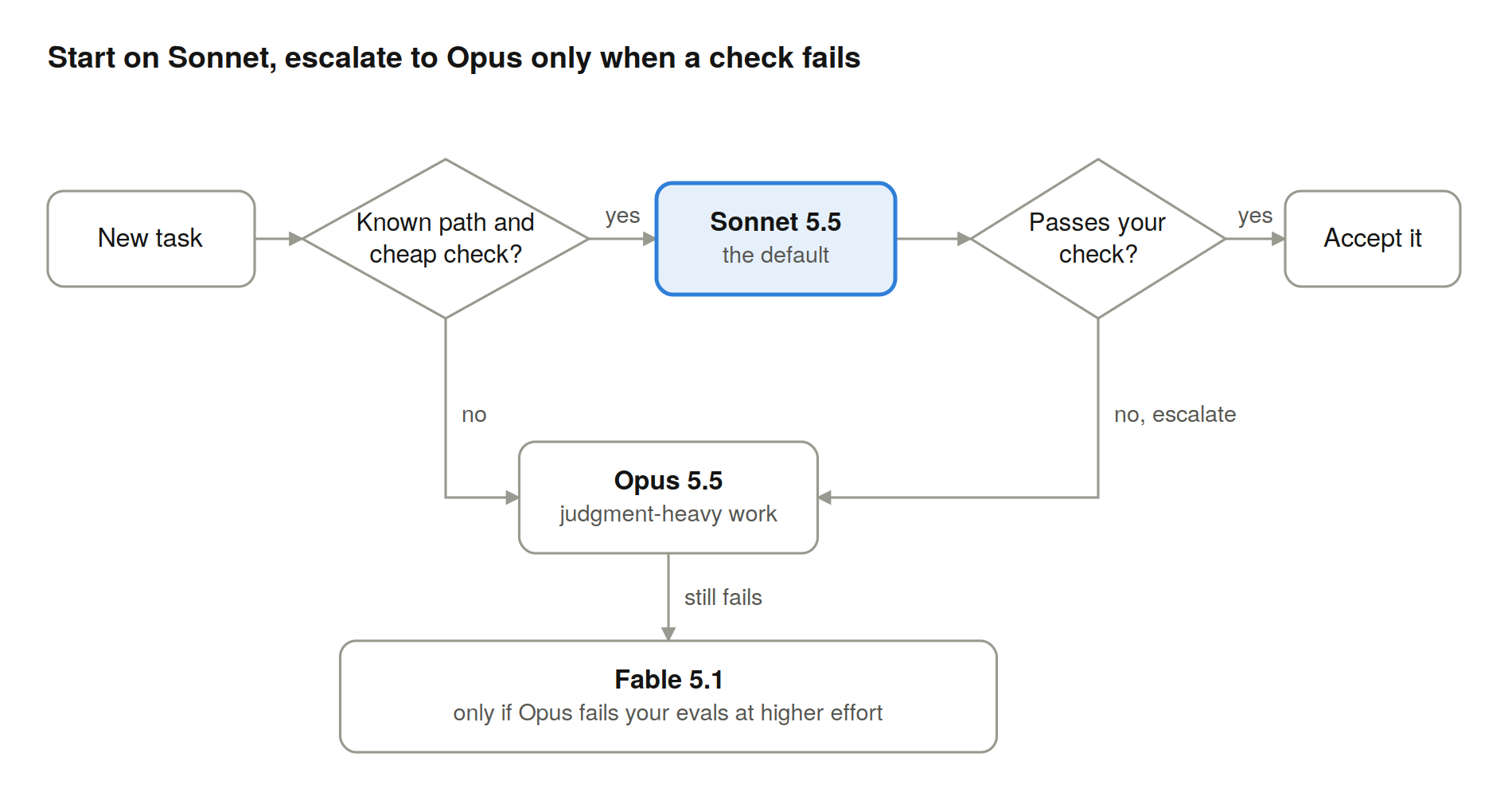
Start every task on Sonnet 5.5 unless the first answer is no. A failed check sends the work to Opus, and Fable is the last step rather than the second.
Claude Opus 5.5 vs Sonnet 5.5 at a glance
The two models are the same generation, which makes older Opus vs Sonnet advice stale. Opus 5 launched in July at $5 input and $25 output per million tokens. Opus 5.5 arrived in September at $4 and $20.
Claude Opus 5.5 | Claude Sonnet 5.5 | |
|---|---|---|
Released | 22 Sep 2026 | 28 Sep 2026 |
API price, input / output per million tokens | $4 / $20 | $2 / $10 |
Batch API discount | 50% off | 50% off |
Cache read, per million tokens | $0.20 | $0.10 |
Speed (Anthropic's label) | Moderate | Fast |
Thinking | Adaptive, always on | Adaptive, on by default |
Default effort on the API | Medium | High |
Context window / max output | 1M / 128K tokens | 1M / 128K tokens |
Reliable knowledge cutoff | June 2026 | June 2026 |
API model ID | claude-opus-5-5 | claude-sonnet-5-5 |
Source: Anthropic's Opus 5.5 and Sonnet 5.5 model pages, checked 27 October 2026.
Read the table for what matches. Both models take 1M tokens of context, write up to 128K tokens, and know the world to June 2026, so capacity will not decide this for you. Price, speed and judgment will.
The effort defaults also differ. Opus runs at medium out of the box and Sonnet at high, so an untuned comparison pits different amounts of thinking against each other. On the API, Sonnet also lets you switch off up-front thinking at high effort or below, which Opus does not. Claude Code offers that switch for neither model.
What Sonnet 5.5 vs Opus 5.5 Benchmarks Actually Show
Anthropic's Sonnet 5.5 announcement puts the two models nearly level on knowledge work and has Sonnet ahead on one coding test. All figures below are vendor-reported.
Benchmark | What it measures | Sonnet 5.5 | Opus 5.5 |
|---|---|---|---|
GDPval-AA v2.1 | Real-world tasks across 44 occupations (Elo-style score) | 1,844 | 1,846 |
Terminal-Bench 4.0 | Agentic coding in a terminal | 70.6% | 66.4% (at xhigh effort, its best) |
CursorBench 4.0 | Coding tasks in the Cursor editor | 55.5% | 57.8% |
OSWorld 2.1 (partial) | Computer use | 80.1% | 81.8% |
Sources: Anthropic's announcement, with the CursorBench and OSWorld rows as reported by MarkTechPost and VentureBeat.
Two caveats matter before you quote these. Anthropic's footnote says the GDPval-AA runs used a pre-release Sonnet 5.5 deployment with a bug that could degrade structured-output responses, so Sonnet's score may be understated. And the Opus Terminal-Bench figure is its highest-effort setting, which spends more tokens per task.
The bigger point is what these tests measure. Most have a checkable outcome: a test passes, a task is graded against a rubric. That is the ground where a fast, cheaper model does well. They say little about the work Anthropic sells Opus for, which is open-ended jobs that need sustained judgment. Anthropic positions Opus 5.5 as the stronger choice there and Sonnet 5.5 for well-scoped everyday work, but we have not found a published head-to-head that measures the open-ended gap. Treat it as Anthropic's claim, not a measured number.
One independent signal points the same way. Fello AI's roundup reports Artificial Analysis Intelligence Index scores of 58 for Opus 5.5 and 56 for Sonnet 5.5, both at max effort. Opus leads, by a small margin.
Where Opus 5.5 earns the extra money
Opus is worth $4 and $20 per million tokens when at least one of these is true. The examples below are illustrations, not case studies.
The model has to work out what to do
Say a platform lead needs a plan to replace an authentication service without logging out live customers. The hard part is deciding which dependencies to inspect and noticing when the first hypothesis was wrong. That is judgment rather than execution, and it is the work Anthropic describes Opus 5.5 as built for: long-running agentic coding and knowledge work. A plausible but wrong first step can waste everything built on top of it.
Errors are costly and hard to spot
A contract summary that misses an indemnity clause, or a financial model with one silent formula error, looks fine until someone relies on it. When checking the output takes as long as producing it, the stronger model is cheaper in practice. A single 15-minute review at an assumed $80 an hour costs $20, which is more than eight times the $2.40 Opus run priced in the cost section below.
Long autonomous runs where mistakes compound
An agent that makes fifty tool calls without a human in the loop carries every early mistake forward. This is where a per-token discount stops mattering, because a failed run costs the whole run plus the cleanup. If you are assembling the surrounding stack as well, the model is only one line item next to orchestration, tracing, evaluation and compute, as the line-up in our AI Agent Hub stack shows.
Where Sonnet 5.5 is the better buy
Sonnet is the better purchase for any job that repeats all day and has a clear right answer. Anthropic describes it as the model with the best combination of speed and intelligence, and its launch material points it at well-scoped everyday work such as bug fixes, documents, slides and spreadsheets.
High-volume classification and drafting. Ticket triage, field extraction and replies drafted from an approved policy have a known shape and an easy check. Support is the clearest example, since it is where autonomous agents reached production first. Our look at autonomous customer support agents in 2026 covers resolution rates and outcome pricing if you are sizing a project.
Anything a user is waiting on. Anthropic labels Sonnet fast and Opus moderate. On the API, Sonnet also lets you turn off up-front thinking at high effort or below, which can trim latency on short, well-specified requests.
Bounded transformations. Turning approved notes into an update, filling a template, or rewriting to a house style. You supply the evidence and the shape, and the model does the typing.
Coding against a test. Give it a reproducible bug, the relevant files and a failing test. Its 70.6% on Terminal-Bench 4.0 beats Opus's 66.4%, though that Opus score is at the highest effort.
Sonnet's weak spot is discipline on loose briefs. In one small published test by The SEO Agent, two of three Sonnet 5.5 drafts added a claim the brief had not supplied, while the Opus drafts did not. Three runs is an anecdote rather than a benchmark, but it is a good reason to keep a checking step on anything Sonnet writes for publication.
What each model costs on real workloads
Per token, Sonnet 5.5 is exactly half the price of Opus 5.5. Per finished task, the gap can be wider or narrower. Both calculations below use Anthropic's list prices and assumed workloads that we made up for illustration. They are arithmetic, not measurements.
Example 1: a high-volume job
Assume 20,000 support conversations a month, each using about 3,000 input tokens and 500 output tokens. That is 60 million input and 10 million output tokens, with both models using the same number of tokens.
Input cost | Output cost | Monthly total | With Batch API (50% off) | |
|---|---|---|---|---|
Sonnet 5.5 | $120 | $100 | $220 | $110 |
Opus 5.5 | $240 | $200 | $440 | $220 |
Opus adds $220 a month, or $2,640 a year, for work where the answer is usually checkable. That is where the premium is hardest to justify.
Example 2: a hard task with retries
Assume one agentic coding attempt reads 400,000 tokens and writes 40,000. On Sonnet 5.5 that costs $1.20 (0.4M x $2 plus 0.04M x $10). On Opus 5.5 it costs $2.40 (0.4M x $4 plus 0.04M x $20).
If you retry until an attempt succeeds, the expected cost per accepted result is the attempt cost divided by the success rate. Sonnet stays cheaper as long as its success rate is more than half of Opus's. If Opus lands 90% of the time, Sonnet needs to land at least 45% of the time to break even on tokens.
Then add people. A 15-minute review at an assumed $80 an hour is $20, more than eight times the $2.40 Opus run. Once a person reads every output, the failure rate drives your real cost far more than the token price does.
Why half the price is not half the cost
Token counts differ by model and by effort level. Anthropic says Sonnet 5.5 can cost up to 30% less per task than Sonnet 5, but that compares generations, not Sonnet against Opus. Artificial Analysis data, as summarised by eesel, put Sonnet 5.5 at roughly 193,000 output tokens per index task at max effort against about 119,000 for Opus 5.5. A model that thinks longer can erase part of its price advantage.
Three levers cut the bill without changing models:
Batch API. Anthropic discounts input and output by 50% for work that can wait, such as overnight reports.
Prompt caching. Cache reads cost $0.10 per million tokens on Sonnet and $0.20 on Opus, so a long prompt you reuse all day gets cheap.
Effort. Anthropic says Sonnet 5.5 complements Opus best at lower effort settings, where it costs less per task. Test a lower setting before you switch models.
Fast mode is a premium rather than a saving. Anthropic's fast mode for Opus 5.5 is priced at $8 input and $40 output per million tokens for up to 2.5 times the output speed, and it reportedly left research preview on 15 October 2026. That is four times Sonnet 5.5's list price. If latency is the only reason you are considering Opus, test Sonnet at a lower effort first.
Whatever you choose, instrument your own usage rather than relying on a provider dashboard. Disputes over AI bills usually come down to a definition of what counts as usage, and the buyer who measured independently has the better conversation.
Claude Opus vs Sonnet for coding
Coding is where the Opus vs Sonnet question gets asked most often, and where the benchmark gap is smallest. On Anthropic's published numbers Sonnet 5.5 leads on Terminal-Bench 4.0 and trails Opus 5.5 by about two points on CursorBench 4.0. For a scoped task with a test to pass, that favors Sonnet.
A workable split is to let Opus plan and diagnose, then hand well-specified units to Sonnet. Claude Code, the terminal agent we scored 86/100 in our review, lets you switch models inside a session, and its docs describe an opusplan alias that uses Opus in plan mode, then switches to Sonnet for execution.
Two details from Anthropic's Claude Code model configuration docs are worth knowing. On Pro, Max, Team, Enterprise and API accounts the default model is now Opus 5.5 (from Claude Code v2.1.280), so you are on Opus unless you change it with /model sonnet. Both 5.5 models also default to medium effort in Claude Code. Anthropic says Opus 5.5 at medium matches or exceeds Opus 5 at high on its coding and knowledge-work evaluations. Sonnet 5.5 needs Claude Code v2.1.284 or later, so run claude update first.
This split also helps with the real bottleneck. Our review lists reviewing large agent-written diffs as a standing bottleneck when you delegate whole tasks. A stronger model that gets the plan right first time can save more review time than it costs in tokens, while a cheaper model working to a clear plan keeps the bulk of the run inexpensive.
If you have not yet picked the tool around the model, our Cursor vs Claude Code comparison walks through that decision. Claude Code won four of eight dimensions to Cursor's two, and the verdict turns on working style more than capability.
Which Claude plan to pay for
If you use Claude in the app rather than the API, you are buying a plan, not tokens, and the decision is mostly about access and usage limits. Plan details change, so confirm them on claude.com/pricing before you buy.
Free. Includes Sonnet. Opus is not part of the Free plan.
Pro, $20 a month billed monthly. Gives you both models, so it is the right first paid step if you want to try Opus on hard tasks.
Max, from $100 a month. Adds 5x or 20x Pro's usage. Upgrade only after you repeatedly hit limits, not because Opus exists.
Team and Enterprise. Seat-based plans with admin controls, where an administrator may restrict which models people can use.
Two cautions. API price ratios do not convert into message allowances, so Sonnet being half the price per token does not promise twice as many chats on a subscription. And higher effort settings use more tokens, so they can bring you to a usage limit sooner.
If your bottleneck is a usage limit, moving to a bigger plan fixes capacity. If your bottleneck is output quality on a specific task, changing the model fixes that. Work out which one you have before you spend.
How to decide with your own work
Published benchmarks cannot tell you how either model handles your documents, your codebase or your customers. A one-afternoon test can.
Collect 20 to 50 real cases with known-good outputs. That is the size our piece on building the evaluation set before the agent recommends, and it is enough to catch the regressions that matter. Include a few ambiguous cases on purpose, since they are where the models should differ.
Run both models on identical prompts and set effort explicitly. Opus defaults to medium and Sonnet to high on the API, so leaving defaults in place compares unequal amounts of thinking. Leave enough output budget, because thinking tokens count toward it.
Score against criteria you wrote first. Mark each output accepted or rejected, then record cost per accepted result and the minutes a reviewer spent. A tool such as LangSmith, which can compare models and configurations side by side across a dataset, saves you building this by hand.
Route by result. Make Sonnet the default and escalate to Opus when a task fails your check or arrives ambiguous. Re-run the test when a new model ships, because Opus's list price fell from $5 and $25 to $4 and $20 between July and September.
Score every case the same way, then total each column.
Case | Sonnet 5.5 accepted? | Opus 5.5 accepted? | Sonnet tokens in / out | Opus tokens in / out | Review minutes, Sonnet / Opus |
|---|---|---|---|---|---|
1 | |||||
2 | |||||
3 |
Then calculate the number that decides the question:
\text{cost per accepted result} = \frac{\text{token spend} + \text{review hours} \times \text{hourly rate}}{\text{accepted outputs}}One caution for later. Models fail quietly, returning a confident wrong answer at normal latency. Keep a small scheduled evaluation running in production after launch, so a provider-side change does not surprise you.
Where Haiku 5.5 and Fable 5.1 fit
Opus and Sonnet are not the only options. Anthropic's current lineup also includes two models at either end, and each one changes the math for specific jobs.
Haiku 5.5 is the fastest and cheapest model, priced from $0.10 input and $0.50 output per million tokens. Anthropic aims it at high-volume, latency-sensitive tasks such as classification, extraction and routing. If your Sonnet job is mostly sorting and tagging, test Haiku first.
Fable 5.1 sits above Opus at $10 and $50 per million tokens. Anthropic's guidance is to move to it for demanding reasoning and long-horizon agentic work, or when your own evaluations on Opus 5.5 at higher effort still fall short. Raise Opus's effort before you pay 2.5 times its price.
Quick decision guide
Your situation | Pick | Why |
|---|---|---|
Sorting, tagging, extraction, routing at volume | Haiku 5.5, or Sonnet 5.5 if Haiku misses | Price and speed decide; the answer is easy to check |
Replies, summaries or documents from material you supply | Sonnet 5.5 | Well-scoped, and half Opus's token price |
Bug fix with a failing test | Sonnet 5.5 | 70.6% on Terminal-Bench 4.0, and the test is your check |
Migration plan, root-cause investigation, unfamiliar codebase | Opus 5.5 | The model must decide what to examine |
Long autonomous agent run | Opus 5.5, with Sonnet for well-specified sub-tasks | Early mistakes compound across steps |
User-facing feature where latency matters | Sonnet 5.5 at lower effort | Anthropic's fast label, and on the API up-front thinking can be turned off |
Opus at higher effort still fails your evaluations | Fable 5.1 | Anthropic's own escalation guidance |
Unsure, and the task runs once | Opus 5.5 | Anthropic's suggested starting point, and the cost is small |
Questions
Frequently asked questions
Is Claude Opus better than Sonnet?
For complex, open-ended work, Anthropic says yes, and Opus 5.5 leads slightly on the Artificial Analysis index. On the published tests the gap is small: 1,844 vs 1,846 on GDPval-AA, and Sonnet ahead on Terminal-Bench 4.0. Which is better depends on the job.
How much more does Opus 5.5 cost than Sonnet 5.5?
Exactly twice as much per token on the API: $4 input and $20 output per million tokens against $2 and $10. Both get the same 50% Batch discount, and cache reads cost $0.20 and $0.10 per million tokens. Cost per task depends on how many tokens each model uses.
Is Sonnet 5.5 good enough for coding?
For scoped work, yes. It scores 70.6% on Terminal-Bench 4.0 and 55.5% on CursorBench 4.0, against Opus's 66.4% and 57.8%. Use Opus for architecture decisions, unfamiliar failures and changes that sprawl across many files.
Can I use Claude Opus for free?
Not in the Free app plan, which includes Sonnet. Opus comes with paid plans starting at Pro, and on the API you pay per token. Confirm current plan details on Anthropic's pricing page.
Do Opus and Sonnet have different context windows?
No. Both 5.5 models accept 1M tokens of context and produce up to 128K tokens of output per request.
Can I switch between Opus and Sonnet in the middle of a project?
Yes, but switch at task boundaries and pass decisions along as plain text. Anthropic's documentation notes that thinking blocks are tied to the model that produced them, so a second model cannot rely on the first model's internal reasoning.
Which is better for writing, Opus or Sonnet?
Start with Sonnet when you have a clear brief and approved sources, such as emails, updates and summaries. Use Opus when the writing is also analysis, for example a memo that must reconcile conflicting evidence. Check the facts either way.
Which model does Claude Code use by default?
On Pro, Max, Team, Enterprise and API accounts it defaults to Opus 5.5 from Claude Code v2.1.280, according to Anthropic's Claude Code docs. Run /model sonnet for routine work, or use the opusplan alias to plan on Opus and execute on Sonnet.
Is Opus 5.5 fast mode worth it?
Fast mode costs $8 input and $40 output per million tokens, four times Sonnet 5.5's list price, for up to 2.5 times the output speed. If latency is the only problem, try Sonnet at lower effort first.
Conclusion
Opus 5.5 and Sonnet 5.5 are closer than their price gap suggests. On Anthropic's published tests they sit within a few points of each other, and Sonnet leads on terminal coding. What the extra $2 and $10 per million tokens buys is Opus's stronger handling of open-ended work, where the model has to decide what to investigate and a wrong turn is expensive to find.
In the Sonnet vs Opus choice, make Sonnet 5.5 your default for anything with a known path and a cheap check, and escalate to Opus 5.5 when judgment, long autonomous runs or hidden errors are the real risk. Judge the choice by cost per accepted result, including review time, rather than by token price alone.
Run the 20-to-50-case test on your own work, set effort deliberately, and repeat it when the next model ships. If you are also choosing the tools around the model, our index of AI developer tools scores coding agents and editors on the same five axes we use across every review.
WebTechOS accepts no payment for coverage, placement or scores. Where a piece references pricing, it reflects published list rates at the date shown.
Keep reading
All insights →Best AI chatbot for property management FAQs in 2026
Compare 7 AI chatbots that answer tenant and prospect FAQs for property managers, with pricing, PMS fit and setup tips. Updated for 2026.
8 Best CrewAI Alternatives for Building Multi-Agent Systems
8 real CrewAI alternatives for multi-agent systems, including LangGraph and YourGPT, with features and pricing verified from each company’s own site.
How to Turn a Blog Post into a Video with AI (Step by Step)
Learn blog to video with AI. Turn a post into a video from a link or a document, with the real costs, limits, and fixes covered.
Jira Service Management Reviews 2026: Ratings, Pricing, Pros and Cons
Read Jira Service Management reviews for 2026. Compare user ratings, pricing, pros, cons, AI features, and limitations before choosing a plan.