Claude vs Grok: Which AI Is Better After Real Testing?
We ran Claude and Grok through 7 real tests, research, coding, writing, reasoning, and pricing, to see which AI actually performs better.
10 Nov 2026·17 min read·Insights

Claude and Grok are two popular AI assistants, but they take different approaches to helping users research, write, code, and solve everyday problems.
Both offer similar core capabilities, but how do they actually perform when given the same tasks?
To find out, I compared both assistants across seven practical tests covering research, reasoning, writing, editing, coding, image understanding, and business planning. Each received the same prompts, and their responses were evaluated for accuracy, clarity, completeness, and practical usefulness.
The result was close: Claude won three tests, Grok won three, and they tied on one. The differences were often in citations, error checking, or how an answer was organized, not whether a task was answered at all.
Here's how both assistants performed, where they fell short, and which one makes more sense for your work.
A Brief Introduction to Claude and Grok
Claude, developed by Anthropic, is an AI assistant designed for writing, research, coding, document analysis, and complex reasoning. It helps users work with information, solve problems, and complete professional tasks.
Grok, developed by xAI, is an AI assistant that supports research, coding, content creation, and problem-solving. It also integrates with X, providing access to public conversations and trending discussions alongside information from the web.
Testing Process for Claude and Grok
I compared Claude and Grok across seven practical tasks covering research, reasoning, writing, editing, debugging, visual analysis, and business planning. The goal was to evaluate how useful their first responses were for everyday work, rather than measure their overall intelligence.
The comparison followed these principles:
Models and Plans Used: Tests were conducted in October 2026 using the Claude and Grok chat interfaces. Exact model versions, subscription plans, and reasoning settings were not recorded, which limits direct reproducibility.
Identical Prompts: Both assistants received the same task instructions and constraints, allowing their responses to be compared against the same requirements.
First-Response Evaluation: Only the initial answers were considered. Neither assistant received follow-up instructions to correct mistakes or improve its response before evaluation.
Accuracy Checks: Research claims were reviewed against available sources, financial calculations were checked, and coding solutions were examined for correctness and edge cases.
Instruction Following: Responses were checked against specific requirements, including word limits, formatting, citations, test cases, and requested outputs.
Practical Usefulness: Beyond correctness, I considered whether the responses were clear, relevant, and usable without substantial editing.
Visual Analysis: Both assistants received the same synthetic analytics dashboard. Their ability to identify metrics, interpret trends, and suggest actions was compared.
Scoring Method: Each test was judged on accuracy, completeness, clarity, instruction following, and usefulness. A winner was selected based on the stronger response, while comparable performance could result in a tie.
The tests were not repeated systematically, and some judgments, particularly for writing and planning, involved editorial preference.
Across seven completed tests, Claude won three, Grok won three, and one ended in a tie.
Test 1: Deep Research
This test examined how well Claude and Grok gathered evidence from multiple studies, compared conflicting findings, and produced a balanced research summary.
The Prompt
Analyze how AI coding assistants have affected software developer productivity between 2024 and 2026. Use at least five credible sources, including independent research where available. Compare findings, include measurable results, identify disagreements between studies, and explain the limitations of the evidence. Provide direct source links and a balanced conclusion in under 600 words.
Claude's Result
Claude discussed six sources, including the multi-company Copilot field experiments, METR's randomized trial, DORA, and Faros AI. It contrasted approximately 26% more completed tasks in one study with a 19% slowdown in another, then explained differences in developers, tasks, and research methods. It also supplied links rather than leaving the reader to trace the figures.
Grok's Result
Grok introduced additional large-scale observational findings and a claimed meta-analysis of 23 studies. It made a useful distinction between more code being produced and more software being shipped. But despite specific requests for direct source links, it provided none, making its additional statistics harder to verify
What I Found
Both assistants recognized that AI coding tools can increase individual productivity without necessarily improving overall software delivery.
Claude did a better job explaining conflicting evidence and research limitations. Grok offered useful large-scale findings but made broader numerical conclusions without directly linking supporting studies.
Winner: Claude
Claude wins for source transparency and synthesis. It linked the research and explained why seemingly contradictory results could both be plausible. Grok's coverage was broad, but its missing links were a clear failure against the prompt.
Test 2: Complex Reasoning
This test evaluated how well Claude and Grok solved a business problem involving customer churn, revenue projections, and investment decisions.
The Prompt
A SaaS company has 10,000 customers, each paying $50 monthly, with a 5% monthly churn rate. It can spend $20,000 per month to either reduce churn to 4% or acquire 300 new customers monthly. Calculate six-month revenue, net incremental revenue after investment, and recommend the better option.
Claude's Result
Claude laid out assumptions, month-by-month tables, and a sensible recommendation. Its figures showed roughly +$170,024 in net incremental revenue for acquisition versus −$53,553 for churn reduction. But a supporting explanation said the retention option saved only about 85 customers by month six; the difference between the two starting customer bases in month six is actually about 416. The final conclusion was right, but that explanation was wrong.
Grok's Result
Grok reached the same financial conclusion with accurate calculations and a more concise explanation. It clearly presented the assumptions, revenue projections, and investment comparison without introducing a numerical error.
What I Found
Both assistants correctly identified customer acquisition as the better six-month investment.
Result | Claude | Grok |
|---|---|---|
Churn reduction net result | −$53,553 | −$53,553 |
Customer acquisition net result | +$170,024 | +$170,024 |
Correct recommendation | Yes | Yes |
Reasoning error | One | None identified |
Claude explained the business implications more thoroughly, while Grok delivered a shorter, mathematically consistent answer.
Winner: Grok
Grok wins narrowly for internal consistency. Both models solved the central problem correctly; Grok avoided the numerical slip in Claude's explanation. This result is not evidence that Grok is universally stronger at mathematics.
Test 3: Long-Form Writing
This test evaluated how well Claude and Grok handled long-form writing, including clarity, structure, tone, practical examples, and instruction following.
The Prompt
Write a 500-word article titled "Why AI Tools Don't Always Make Teams More Productive." Use a conversational but professional tone, short paragraphs, and clear H2 headings. Include two workplace examples, two limitations of AI tools, and a practical takeaway. Avoid exaggerated claims, repetition, and invented statistics.
Claude's Result
Claude used concrete situations: a meeting summary missing important context and support drafts that sounded polished but needed correction. The article had a strong narrative flow and readable transitions. It was, however, shorter than the requested 500 words, so it did not fully meet the length instruction.
Grok's Result
Grok used relevant examples involving marketing copy and meeting summaries. The writing was direct, organized, and useful, but relied more on familiar framing, including "AI tools are amplifiers." It also fell short of the requested length.
What I Found
Both assistants followed the main instructions and avoided unsupported statistics. Claude made better use of storytelling and specific workplace situations, while Grok prioritized direct explanations and a conventional article structure.
Neither fully met the requested 500-word length.
Winner: Claude
Claude wins on editorial quality in this sample. Its examples were more specific and its flow felt more natural. The judgment is stylistic; neither assistant met the 500-word target.
Test 4: Editing a Weak Draft
This test examined how well Claude and Grok improved poorly written content while preserving its original meaning, removing repetition, and maintaining a professional tone.
The Prompt
Rewrite the provided paragraph to make it clearer, more natural, and professional. Preserve the original meaning, remove unnecessary words, and keep the revised version under 120 words without adding new information.
Claude's Result
Claude reduced the draft to 58 words, removing repetitive phrases and improving sentence structure. The result was clear and professional, although expressions such as "boost productivity" and "streamline workflows" remained somewhat generic.
Grok's Result
Grok produced a similarly concise revision of 57 words. It preserved the original meaning, improved readability, and used slightly smoother transitions between benefits, limitations, and human oversight. However, it also retained some generic business language.
What I Found
Both assistants followed the instructions, retained the original information, and avoided introducing new claims. Their revisions were nearly identical in structure and wording, with only minor differences in phrasing.
Winner: Grok
Grok wins by a minimal stylistic margin. Both revisions preserved the meaning and could be used with minimal editing. This result is best read as a near-tie, not a significant performance gap.
Test 5: Coding and Debugging
This test evaluated how well Claude and Grok identified bugs, corrected Python code, handled edge cases, and explained their solutions.
The Prompt
Fix a Python function that incorrectly returns the second-largest distinct number. Handle duplicates, negative numbers, empty lists, and insufficient distinct values. Do not modify the original list. Provide at least six test cases and explain the solution.
def second_largest(numbers):
    numbers.sort()
    return numbers[-2]
Claude's Result
Claude identified five problems with the original code and corrected them using set() and sorted(). It provided eight test cases covering duplicates, negative numbers, empty lists, and other edge cases. It also included an explicit assertion confirming that the original list remains unchanged.
Grok's Result
Grok identified four problems and provided a shorter solution using sorted(set(numbers), reverse=True). Its eight test cases covered the required edge cases, including zero and negative values. The implementation was correct, although it did not include an explicit test confirming that the input list remains unchanged.
What I Found
Both solutions were correct and had the same O(n log n) worst-case time complexity. Neither modified the input list.
Claude provided more detailed debugging explanations and stronger regression-test coverage. Grok's solution was shorter and equally valid.
Winner: Claude
Claude wins narrowly for test coverage. Both functions correctly handle the specified cases; Claude additionally showed an explicit assertion that the original list is unchanged. This single Python exercise does not compare the full capabilities of their coding agents.
Test 6: Multimodal Understanding
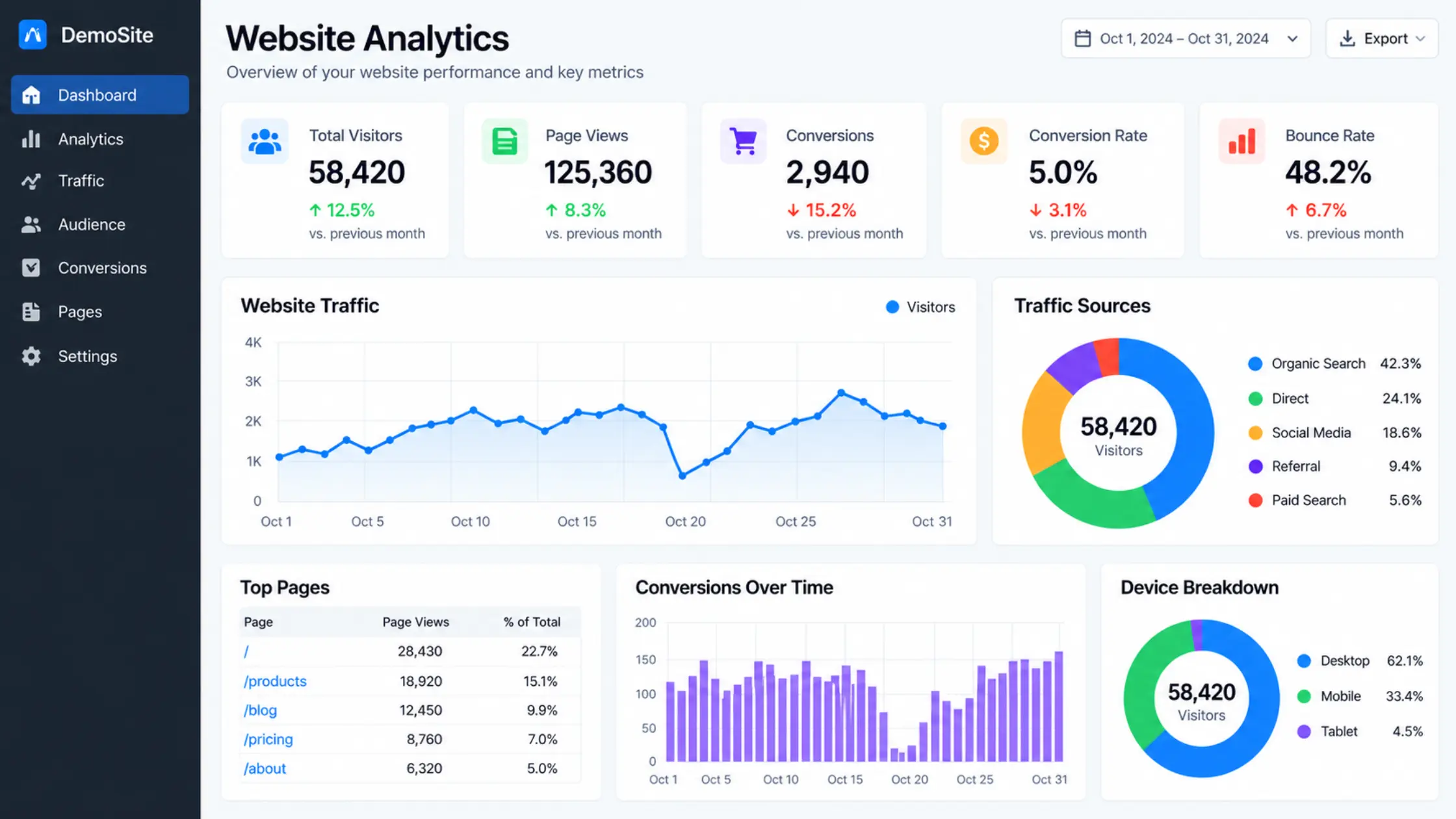
This test evaluated how accurately Claude and Grok interpreted an analytics dashboard, identified trends, detected unusual values, and recommended practical actions.
The Prompt
Analyze the attached dashboard screenshot. Identify five important metrics, two trends, unusual values, and three practical actions. Separate visible facts from assumptions and keep the response under 300 words.
Claude's Result
Claude correctly identified the key metrics, including 58,420 visitors, 2,940 conversions, and a 48.2% bounce rate. It spotted the sharp mid-October traffic decline and questioned a possible inconsistency between the reported conversion changes and conversion rate. It also suggested relevant actions while separating observations from assumptions.
Grok's Result
Grok accurately extracted all five headline metrics and identified the mid-month traffic and conversion decline. Its recommendations focused on investigating the traffic drop, improving the conversion funnel, and analyzing bounce rates. However, it did not flag the possible inconsistency in the conversion figures.
What I Found
Both assistants accurately interpreted the dashboard, identified the main performance trends, and provided three practical recommendations. Claude offered additional analysis by questioning the conversion-rate figures, while Grok presented a more concise response focused on the most visible performance issues. Although Claude identified an additional potential problem, both responses met the main requirements of the test and provided useful insights.
Winner: Tie
Both Claude and Grok performed well in multimodal understanding. Claude provided deeper analysis of the metrics, while Grok delivered a clear and actionable summary. The difference was not significant enough to declare a decisive overall winner for this test.
Test 7: Everyday Usability
This test evaluated how well Claude and Grok handled a practical business task: planning a SaaS product launch with a five-person team, a $5,000 budget, and no existing audience.
The Prompt
Create a practical four-week SaaS launch plan with a weekly timeline, responsibilities for five team members, a $5,000 budget allocation, three measurable KPIs, and five major risks. Prioritize organic marketing and avoid expensive paid campaigns.
Claude's Result
Claude produced a detailed plan covering team responsibilities, budgets, measurable KPIs, and risk management. Its focus on signup conversions, activation rates, and tracking made the plan useful for measuring results. However, it scheduled the main product launch in Week 3, leaving Week 4 for optimization.
Grok's Result
Grok provided a clear four-week plan, dedicating the first three weeks to preparation, audience building, and testing before launching in Week 4. It assigned responsibilities, allocated the full $5,000 budget, and included practical risk mitigation steps. However, its KPIs focused more on awareness and engagement than actual product activation.
What I Found
Both plans were actionable and stayed within the budget. Claude provided stronger performance measurement, while Grok offered a more structured preparation period before launch.
The key difference was timing: Claude favored an earlier launch with more time for optimization, whereas Grok used the full preparation period before launch.
Winner: Grok
Grok wins narrowly on the preferred launch sequence. Its three weeks of preparation before a Week 4 launch may suit a team starting without an audience. Claude's Week 3 launch was also a valid interpretation of the prompt and included stronger conversion and activation measures; this verdict reflects a planning preference, not a missed requirement.
Comparing Claude and Grok Test Results
We compared Claude and Grok across seven practical tests covering research, reasoning, writing, coding, and everyday business tasks.
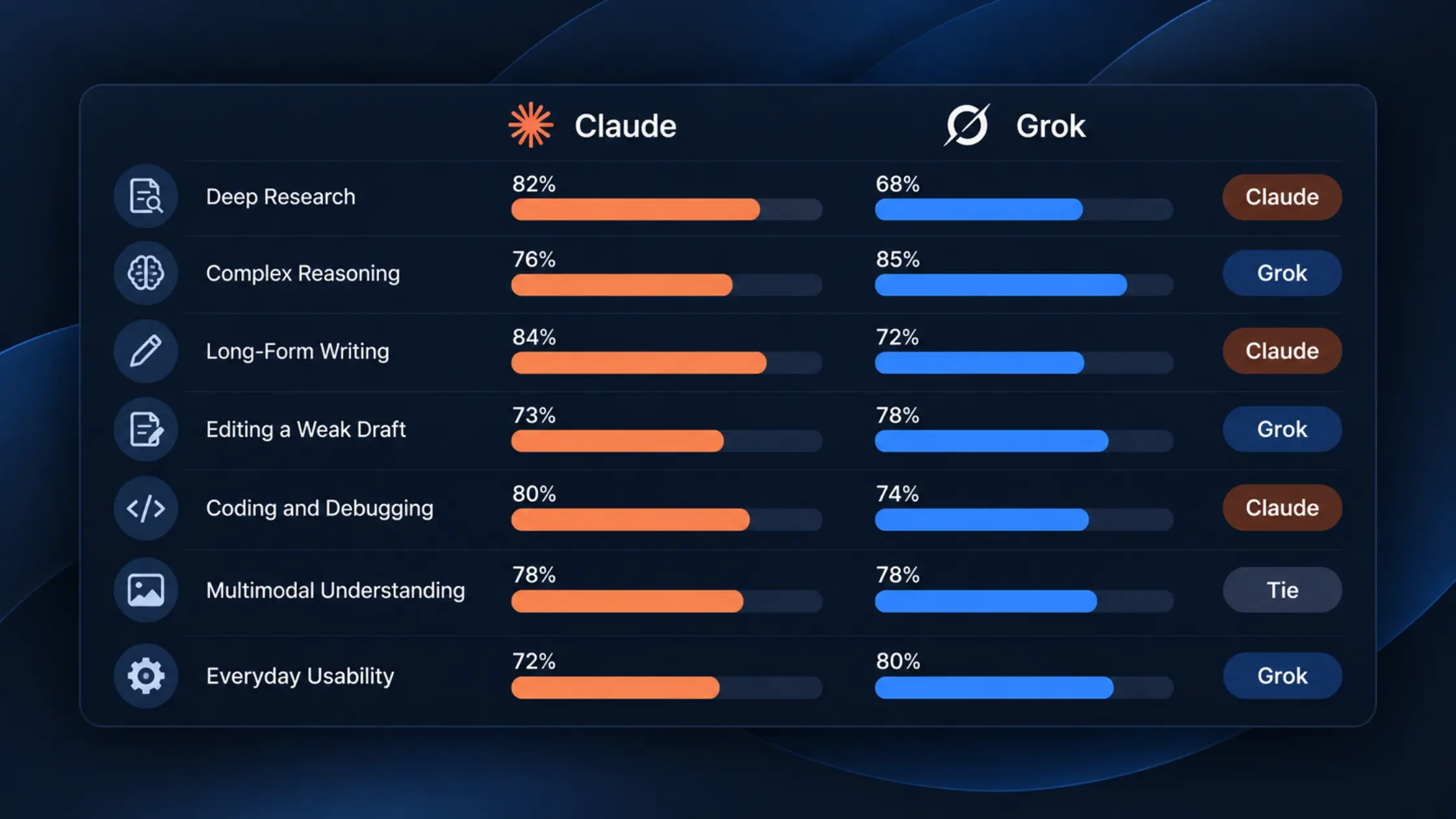
Here is how both assistants performed.
Test | Claude's Performance | Grok's Performance | Winner |
|---|---|---|---|
Deep Research | Strong citations and balanced analysis | Broad research but missing source links | Claude |
Complex Reasoning | Correct calculations with one explanation error | Accurate calculations and clear reasoning | Grok |
Long-Form Writing | Natural writing with stronger examples | Clear but somewhat formulaic | Claude |
Editing a Weak Draft | Clear and concise revision | Slightly smoother wording | Grok |
Coding and Debugging | Correct code with better test coverage | Correct code with a shorter solution | Claude |
Multimodal Understanding | Accurate metrics plus deeper analysis | Accurate metrics, clear summary | Tie |
Everyday Usability | Strong performance tracking and KPIs | Better launch planning and organization | Grok |
Final Score
Claude: 3 wins
Grok: 3 wins
Ties: 1
Incomplete: 0
What the Results Show
Claude performed better in deep research, long-form writing, and coding explanations. Grok had the advantage in complex reasoning, editing, and practical business planning.
The multimodal test ended in a tie: both assistants read the dashboard accurately, but Claude's analysis was more thorough.
The result is a 3–3 split across six decisive tests, plus one tie. Neither assistant consistently outperformed the other. The better choice depends on the task you need to complete.
Claude and Grok Pricing
Claude subscriptions and xAI's newer X Subscription are different product offerings; older SuperGrok subscriptions can remain active without migrating. The table compares consumer subscriptions, not per-token API pricing. See Claude pricing and X Subscription pricing.
Claude | Grok (new X Subscription) | |
|---|---|---|
Free | $0; limited use on web, desktop, and mobile | $0; limited use |
Entry paid | Pro: $20/month, or $200/year | Plus: $8/month, or $80/year |
Additional tier | N/A | Premium: $30/month, or $300/year |
Higher tier | Max 5x: $100/month | Super: $100/month, or $1,000/year |
Highest listed individual tier | Max 20x: $200/month | Ultra: $200/month, or $2,000/year |
Team options | Standard and Premium seats, priced separately | Premium from $30/seat/month; Super and Ultra seats also available |
Enterprise | Contact sales | Contact sales |
Claude Pro includes Claude Code, projects, and higher limits than Free; its Max plans increase available usage further. Claude's free plan is not restricted to a browser: it supports mobile and desktop access and includes web search and file tools. Claude's plan comparison lists the details.
The new X Subscription combines eligible Grok and Cursor usage into one shared weekly pool, with optional X benefits when an account is connected. Premium and above include Grok Bot, but Plus does not. Third-party models used in Cursor are charged separately rather than drawn from that first-party allowance. Existing Cursor or SuperGrok subscriptions do not automatically switch. See xAI's subscription explanation and usage rules.
Value depends on what you use. Grok's new entry tier is cheaper on list price, while Claude Pro includes Claude Code at $20/month. The seven tests did not measure usage caps or subscription value directly, so neither can be declared the better buy from the 3–3 score alone. Taxes, included usage, and plan availability can change; verify your checkout price before subscribing.
Limitations of This Test
Although these tests provide useful insights into Claude and Grok's performance, several factors limit how broadly the results can be applied.
Small Test Sample: Seven tasks cannot represent every capability or use case. Performance on different tasks may produce different results.
Model and Plan Differences: Exact model versions, subscription plans, and reasoning settings were not recorded. Different configurations could affect performance.
Response Variability: AI assistants can produce different answers to the same prompt. Since the tests were not repeated systematically, the results reflect individual responses rather than consistent performance.
Limited Multimodal Testing: Only one analytics dashboard was used. This does not establish how either assistant performs with photographs, diagrams, complex charts, or other visual formats.
Subjective Evaluation: Writing quality, editing style, and business-planning usefulness involve personal judgment. Small stylistic differences should not be treated as major performance advantages.
Limited Coding Scope: The coding test involved one Python debugging problem. It did not assess large codebases, multi-file changes, or autonomous coding agents.
Tool and Search Differences: Available browsing tools, reasoning modes, and integrations may affect research quality. The tests did not control every difference between the two platforms.
No Speed or Usage-Limit Testing: Response times, subscription restrictions, and performance under repeated use were not measured.
Equal Weight Across Tests: Each completed category contributed equally to the final score, although research, coding, or writing may matter more to individual users.
Choosing the Right AI Assistant
Seven tests resulted in a 3–3 split, with one tie between Claude and Grok. Rather than treating both as equally capable, choose based on your daily tasks, expected output quality, and budget.
Research, long-form writing, and code reviews → Claude. Claude performed better in research synthesis, professional writing, and debugging. It provided direct citations, more natural writing, and stronger test coverage. However, these results don't establish its superiority in larger coding projects.
Calculations, quick copy edits, and launch planning → Grok. Grok provided consistent calculations, concise edits, and a structured SaaS launch plan. Its editing and planning wins were narrow, but it performed impressively in tasks requiring clear, practical responses.
Visual data analysis → Either Claude or Grok. Both correctly interpreted the dashboard and suggested useful actions. Claude identified an additional potential inconsistency, while Grok provided a concise analysis. The test ended in a tie.
Research and planning tasks → Use both. Claude can help prepare research reports, while Grok can review calculations or suggest alternative approaches. A second perspective is useful, but important information still needs verification.
Budget-conscious users → Compare plans. Grok offers a lower entry price, while Claude Pro includes additional tools for coding and research. Test their free options before paying for features you may not need.
For most users, the better choice depends on their primary tasks, not the test score alone. Claude showed strengths in research synthesis, professional writing, and debugging, while Grok performed well in calculations, editing, and planning. Both handled the visual analysis task effectively.
Questions
Frequently asked questions
Is Claude or Grok better overall?
There was no overall winner in this small comparison. Claude and Grok each won three of six completed tests, and the image-analysis attempt was incomplete. The result depends on the kind of task you prioritize.
Is Claude or Grok better for coding?
Claude narrowly won the Python debugging test because it included an additional assertion checking that the input list stayed unchanged. Both assistants wrote correct solutions. This result does not establish which dedicated coding agent is better for a complex repository.
Which AI is better for writing and editing?
Claude's longer article used stronger concrete examples and read more naturally to the reviewer, while Grok's short rewrite was preferred by a small stylistic margin. Both missed the requested article length in the long-form test.
Is Grok better at reasoning?
Grok won the single SaaS calculation test because its explanation stayed consistent. Both assistants provided the correct main financial answer. A single scenario cannot establish general reasoning superiority.
Which one is better for research?
Claude won the deep-research prompt by linking its sources and explaining conflicting studies. Grok included relevant findings but omitted the links explicitly requested. Current-events research was not among these final seven tests.
Which one is cheaper?
The new X Subscription lists Plus at $8/month, versus Claude Pro at $20/month. They have different tools and usage allowances, and existing Grok subscriptions may use different plans. Compare the official plan pages before buying.
Can both assistants analyze images?
Both offer image-related capabilities, but the article's screenshot comparison was not completed: neither assistant received the file. Their image-understanding quality cannot be ranked based on this test.
Should I subscribe to both?
Only if the second assistant consistently adds value to your workflow. The tests show complementary strengths, but they do not prove that using both is necessary or cost-effective.
Conclusion
After seven tasks, Claude and Grok each won three comparisons and tied on one, the multimodal test. Claude's strongest responses were in research synthesis, long-form writing, and debugging coverage. Grok had the edge in the numerical explanation, short editing task, and preferred launch-plan sequence. Several differences were small, and both assistants produced useful work even when they lost.
If your daily work centers on sourced research, drafting, or code review, start by trying Claude. If it centers on calculations, concise editing, and planning, give Grok the same opportunity. Run your own recurring task through both before paying: the assistant that needs fewer corrections on your work is the more useful one, regardless of how close this comparison turned out.
WebTechOS accepts no payment for coverage, placement or scores. Where a piece references pricing, it reflects published list rates at the date shown.
Keep reading
All insights →Best AI chatbot for property management FAQs in 2026
Compare 7 AI chatbots that answer tenant and prospect FAQs for property managers, with pricing, PMS fit and setup tips. Updated for 2026.
8 Best CrewAI Alternatives for Building Multi-Agent Systems
8 real CrewAI alternatives for multi-agent systems, including LangGraph and YourGPT, with features and pricing verified from each company’s own site.
How to Turn a Blog Post into a Video with AI (Step by Step)
Learn blog to video with AI. Turn a post into a video from a link or a document, with the real costs, limits, and fixes covered.
Jira Service Management Reviews 2026: Ratings, Pricing, Pros and Cons
Read Jira Service Management reviews for 2026. Compare user ratings, pricing, pros, cons, AI features, and limitations before choosing a plan.